Chainsaw Man Necklace Guide: Materials, Pull-Cords & Craftsmanship
An expert technical guide to Chainsaw Man necklace ripcord pendants. Explore 316L steel grades, chain gauges, weight distribution, and custom fabrication.

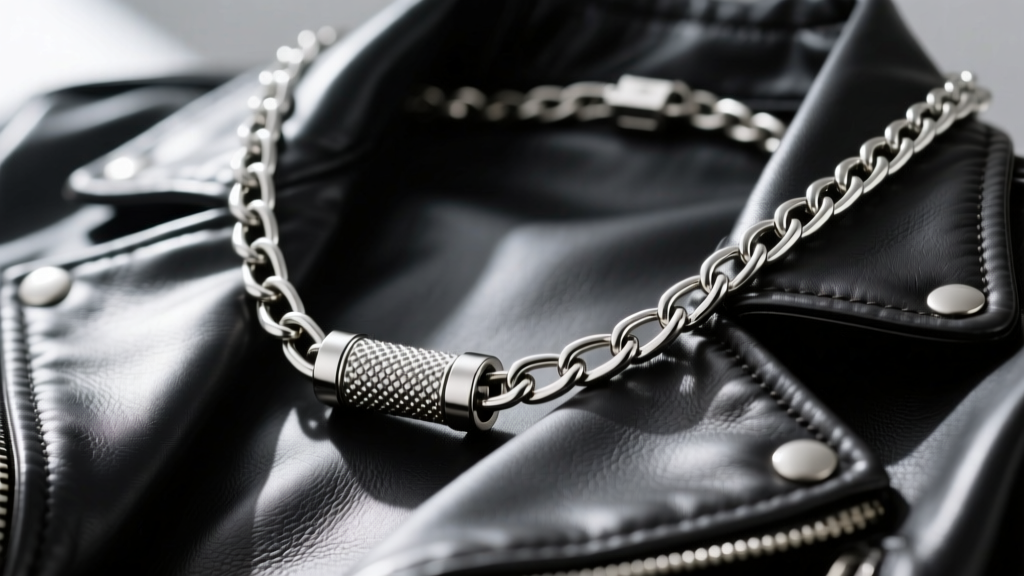
The Evolution of Anime Iconography in Fine Jewelry
When anime iconography transitions from screen to physical jewelry, the line between cheap cosplay prop and premium accessory is defined entirely by metallurgy and structural engineering. The Chainsaw Man necklace—specifically the ripcord pull-cord pendant worn by Denji—is a masterclass in this transition. Originally depicted as a simple mechanical cord, translating this piece into a functional, daily-wear necklace requires a deep understanding of weight distribution, kinetic stress on hardware, and skin-safe alloys. In this expert deep dive, we dismantle the anatomy of a screen-accurate ripcord necklace, exploring the exact gauge sizes, material grades, and fabrication techniques required to create a piece that survives the pendulum effect of daily wear without snapping, tarnishing, or causing contact dermatitis.
The Anatomy of a Screen-Accurate Ripcord Pendant
A high-fidelity Chainsaw Man ripcord pendant is not merely a cast lump of metal; it is a precision-machined component. To achieve screen accuracy while maintaining jewelry-grade durability, custom fabricators rely on CNC (Computer Numerical Control) machining rather than traditional lost-wax casting. The knurling—the diamond-patterned grip on the handle—requires sharp, precise edges that casting often rounds off or fills with porosity.
- Handle Dimensions: A true-to-scale handle measures approximately 68mm in length and 16mm in diameter. Anything smaller loses the visual weight required for the character's design; anything larger becomes a cumbersome chest plate.
- The Ring Loop: The top loop must have an inner diameter of at least 8mm to allow the chain to articulate freely without binding against the handle's shoulder.
- Weight Profile: A solid 316L stainless steel handle of these dimensions weighs between 45 and 60 grams. This substantial mass is the primary driver for the hardware specifications discussed below.
Metallurgical Realities: Why Base Metals Fail
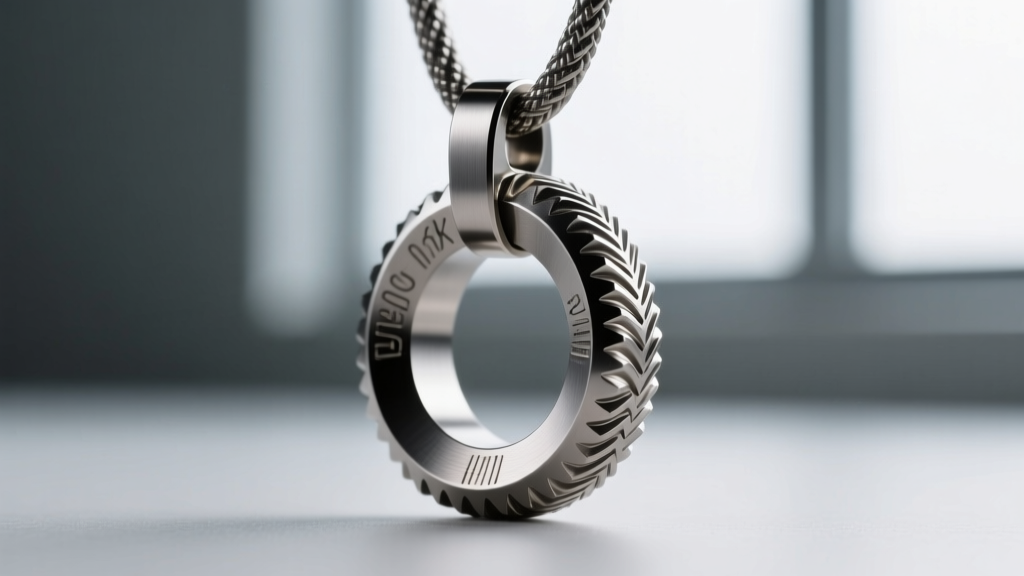
The mass market is flooded with die-cast zinc alloy (Zamak) and hollow brass replicas of the Chainsaw Man necklace. While these may look adequate in product photos, they fail catastrophically in real-world wear. Zamak is highly porous, prone to micro-fractures at the bail (the loop connecting the pendant to the chain), and will snap under the kinetic stress of a 60-gram pendulum swinging against the chest. Furthermore, base metals react with human sebum and sweat, resulting in rapid oxidation and the dreaded 'green skin' effect.
For a permanent, heirloom-grade piece, 316L surgical stainless steel is the undisputed gold standard. According to Britannica's metallurgical overviews, the addition of molybdenum in 316L steel drastically increases its resistance to chlorides and industrial solvents, making it impervious to the salt and acids present in human sweat. For those with larger budgets, 925 Sterling Silver offers a brighter luster and higher intrinsic value, though it requires more frequent polishing and is softer, making it more susceptible to denting if the heavy handle swings into a hard surface.
| Material | Tarnish Resistance | Tensile Strength | Avg. Market Price | Skin Safety |
|---|---|---|---|---|
| Zinc Alloy (Zamak) | Very Low | Low (Brittle) | $15 - $30 | Poor (Nickel/Lead risks) |
| Solid Brass | Low | Medium | $40 - $70 | Moderate (Oxidizes) |
| 925 Sterling Silver | Medium | Medium-High | $150 - $250 | Excellent (Hypoallergenic) |
| 316L Surgical Steel | Extremely High | Very High | $80 - $140 | Excellent (Nickel-safe) |
Chain Selection and Kinetic Stress Management
The most common point of failure in heavy anime pendants is not the pendant itself, but the chain and its connecting hardware. A 60-gram steel handle worn on a 26-inch chain acts as a pendulum. Every time the wearer stops walking, leans forward, or stands up, kinetic energy transfers directly to the clasp and the jump rings. Standard jewelry jump rings (typically 20-gauge or 0.8mm wire) will pull apart under this repetitive stress.
Hardware Specifications for Heavy Pendants
To engineer a Chainsaw Man necklace that will never snap, fabricators must adhere to strict gauge requirements:
- Chain Style: A 3.5mm to 4.0mm Cuban Curb or Rope chain. These interlocking styles distribute lateral stress evenly across multiple links, unlike fragile cable or box chains.
- Wire Gauge: The chain links must be forged from at least 14-gauge (1.6mm) wire.
- Jump Rings: The rings connecting the chain to the pendant bail must be 12-gauge (2.05mm) wire thickness with an outer diameter no larger than 6mm to prevent leverage-induced prying.
- Clasp: A heavy-duty, 15mm stainless steel lobster clasp with a reinforced internal spring. Toggle clasps are discouraged for heavy pendants, as the pendulum effect can easily flip the bar out of the ring.
Ergonomics: Solving the Asymmetrical Bail Problem
One of the most overlooked aspects of custom anime jewelry is the center of gravity. The Chainsaw Man ripcord handle is not perfectly symmetrical; the top loop is often offset or integrated into a specific shoulder of the cylinder. If a jeweler simply solders a standard bail to the exact geometric top of the handle, the pendant will hang at a permanent 15-degree angle, digging into the wearer's collarbone and looking visually incorrect.
'When fabricating a ripcord pendant, we map the center of mass before cutting the bail. By offsetting the bail attachment point by 2 to 3 millimeters toward the heavier side of the handle, we trick gravity into hanging the piece perfectly vertical against the sternum.' — Master Fabricator, Custom Anime Jewelry Studio
Skin Safety and Contact Dermatitis Prevention
Because the ripcord handle rests directly against the sternum—a high-sweat, high-friction area of the body—material purity is a medical necessity, not just an aesthetic choice. The American Academy of Dermatology notes that allergic contact dermatitis is frequently triggered by nickel release in cheap jewelry alloys. While 316L steel does contain trace amounts of nickel, its crystalline structure traps the nickel tightly, resulting in a release rate so low that it is universally accepted as safe for surgical implants and daily skin contact. However, buyers must be wary of 'stainless steel' listings that do not specify the 316L grade, as cheaper 304 steel or mystery alloys can leach nickel when exposed to the acidic pH of human sweat, resulting in severe sternal rashes.
Maintenance and Hardware Troubleshooting
Even premium 316L steel requires basic maintenance to preserve its matte or polished finish. The knurling on the ripcord handle acts as a trap for dead skin cells, lint, and sebum.
Cleaning Protocol
- Ultrasonic Cleaning: The safest method. A standard 3-minute cycle in an ultrasonic jewelry cleaner with a mild dish soap solution will vibrate debris out of the knurled grip without scratching the metal.
- Manual Scrubbing: If an ultrasonic cleaner is unavailable, use a soft-bristled toothbrush and isopropyl alcohol. Avoid wire brushes, which will leave micro-scratches on the gunmetal or polished finish.
- Jump Ring Inspection: Every three months, inspect the 12-gauge jump rings. If you notice even a 1mm gap where the ring ends meet, use two pairs of flat-nose jewelry pliers to twist the ring closed laterally. Never pull the ends apart outward, as this weakens the metal's structural memory.
Ultimately, investing in a properly engineered Chainsaw Man necklace is about respecting the source material through superior craftsmanship. By demanding 316L steel, 12-gauge hardware, and precision CNC knurling, collectors can secure a piece of anime history that functions flawlessly as premium daily-wear jewelry.


