How to Choose and Style Your First Rock Crystal Necklace
Discover everything you need to know about buying your first rock crystal necklace, from spotting real quartz to chain pairings and everyday care.

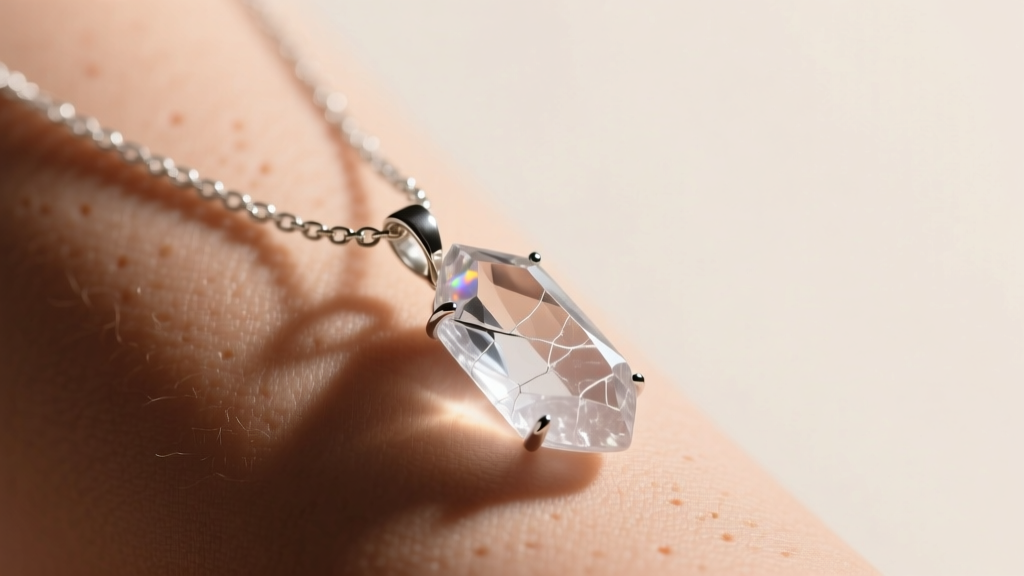
There is a distinct reason why the rock crystal necklace has remained a staple in jewelry boxes for centuries. As the purest, most transparent variety of the quartz family, rock crystal offers an icy, glass-like clarity that catches the light beautifully while maintaining an earthy, organic origin. For beginners stepping into the world of gemstone jewelry, navigating the market can be tricky. Synthetic glass imitations are rampant, and understanding how to pair, layer, and care for natural quartz requires a bit of gemological know-how.
This beginner-friendly explainer will walk you through the exact mineral properties of rock crystal, how to confidently spot a fake, and the structural nuances of choosing the perfect setting and chain for your everyday wear.
What Exactly is a Rock Crystal Necklace?
Before purchasing, it is crucial to understand what you are actually wearing. Rock crystal is the colorless, transparent macrocrystalline variety of quartz. Chemically, it is silicon dioxide (SiO2). According to the comprehensive mineralogical database Mindat.org, natural quartz forms in igneous, metamorphic, and sedimentary environments, often growing in large, hexagonal prismatic crystals within geodes or hydrothermal veins.
From a durability standpoint, rock crystal scores a 7 on the Mohs hardness scale. This makes it highly resistant to everyday scratches from dust and dirt (which typically contain quartz particles scoring a 6 or lower). It also has a specific gravity of 2.65, meaning it has a satisfying, substantial weight when held in the palm of your hand—a key indicator of authenticity that lightweight glass simply cannot replicate.
Glass vs. Genuine Quartz: A Buyer’s Checklist
The most common pitfall for beginners buying a rock crystal necklace online or at tourist markets is accidentally purchasing molded glass. Glass and clear quartz look nearly identical to the untrained eye, but their physical properties differ vastly. Here is how to perform a quick, non-destructive authentication check.
The Temperature and Weight Test
Natural rock crystal is a thermal conductor, while glass is an insulator. If you press a genuine quartz pendant against your cheek or the inside of your wrist, it will feel noticeably cool to the touch and will take several seconds to warm up to your body temperature. Glass, conversely, will feel room-temperature or warm almost immediately. Furthermore, because quartz has a higher density (2.65 g/cm³) than standard soda-lime glass (approx. 2.4 g/cm³), a real stone will feel heavier than a glass replica of the exact same size.
The Inclusion Examination
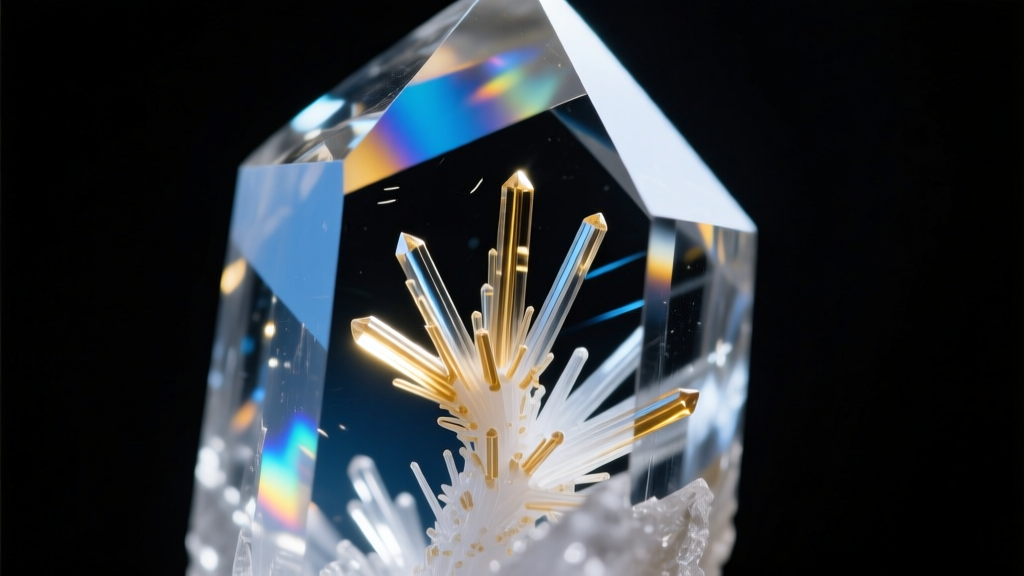
If you have a jeweler's loupe (10x magnification), examine the interior of the stone. Glass is manufactured in a vacuum or poured into molds, which often traps perfectly spherical air bubbles. Natural rock crystal never contains spherical bubbles. Instead, genuine stones may feature angular liquid inclusions, tiny fractures (often called 'veils'), or microscopic mineral needles like rutile.
| Feature | Natural Rock Crystal (Quartz) | Molded Glass Imitation |
|---|---|---|
| Mohs Hardness | 7 (Scratches a steel knife) | 5.5 (Scratched by steel knife) |
| Internal Inclusions | Angular liquids, veils, mineral needles | Perfectly spherical air bubbles |
| Thermal Conductivity | Feels cold to the touch initially | Feels neutral or warm immediately |
| Specific Gravity | 2.65 (Noticeably heavy) | ~2.40 (Feels relatively light) |
| Price Range (Pendant) | $25 - $200+ depending on cut/setting | $5 - $15 |
Choosing the Right Cut and Setting
The way your rock crystal is shaped and secured drastically alters the vibe, price point, and durability of your necklace. Here are the three primary styles you will encounter:
- Tumbled and Drilled: These are smooth, polished, irregular pebbles with a hole drilled straight through the top. They are usually strung on leather cords or simple chains. They offer a bohemian, earthy aesthetic and are highly affordable ($15–$40). However, the drill hole can be a point of structural weakness if the necklace is yanked.
- Faceted Gemstones: Cut similarly to diamonds, faceted rock crystal pendants maximize light return and brilliance. These are typically held in prong settings made of sterling silver or gold. They look elegant and formal, with prices ranging from $50 to $150 depending on the metal purity and carat weight.
- Raw and Unpolished: Raw quartz points or geode slices are incredibly popular in modern metaphysical jewelry. Because raw stones have irregular, jagged edges, they must be secured in a custom bezel or a heavy wire-wrap setting to protect the fragile crystal terminations from chipping against your collarbone.
Chain Pairings: Metals that Complement Clear Quartz
Because rock crystal is entirely colorless, it acts as a blank canvas. The metal you choose for your chain and setting will dictate the overall color temperature of the necklace.
Sterling Silver and White Gold: Pairing clear quartz with white metals enhances its icy, pristine clarity. This combination looks exceptionally modern, crisp, and minimalist. It is the go-to choice for faceted quartz pendants intended for professional or evening wear.
Yellow Gold: A 14k or 18k yellow gold chain creates a striking, high-contrast vintage look. The warmth of the gold reflects through the clear stone, giving the quartz a subtle, honeyed glow. This pairing works beautifully with raw, unpolished quartz points for a luxurious yet organic aesthetic.
Rose Gold: Rose gold introduces a soft, romantic blush tone. While less common than silver or yellow gold, it offers a highly unique, feminine contrast that softens the harsh, icy edges of a highly faceted clear quartz gemstone.
Sizing and Layering Techniques
A rock crystal necklace is highly versatile, but getting the length right is essential for your neckline.
- 16 Inches (Choker): Sits tightly at the base of the neck. Best for small, delicate faceted quartz studs or tiny raw points. Ideal for V-neck and scoop-neck tops.
- 18 Inches (Princess): The universal standard. Rests perfectly on the collarbone. This is the most flattering length for a medium-sized raw quartz pendant or a tumbled stone.
- 20 to 24 Inches (Matinee): Falls below the collarbone, resting on the upper chest. Excellent for large, heavy statement pieces or elongated quartz wands. Pairs best with high-neck blouses or turtlenecks.
The Rule of Three for Layering
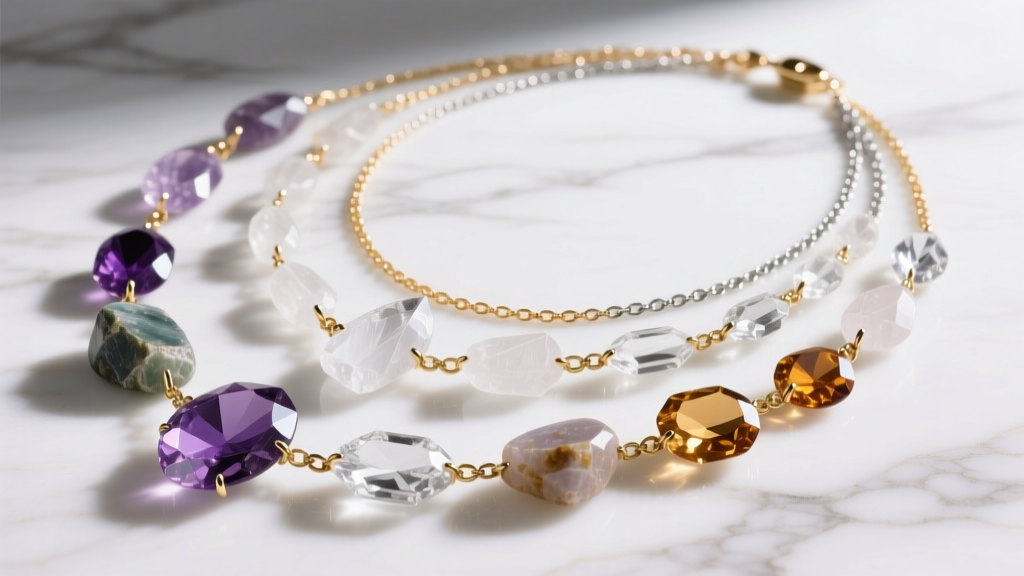
If you want to layer your rock crystal necklace with other pieces, follow the 'Rule of Three' to avoid tangling and visual clutter. Start with a 16-inch delicate silver chain (no pendant), add your 18-inch rock crystal pendant as the focal point, and finish with a 22-inch heavier chain featuring a small, complementary opaque stone like onyx or lapis lazuli. Ensure there is at least a 2-inch gap between each chain length so the pendants do not collide and scratch one another.
Care and Maintenance for Lasting Clarity
While quartz is durable, it is not indestructible. The Gemological Institute of America (GIA) notes that while quartz resists everyday abrasion, it possesses indistinct cleavage and can fracture under hard impacts. Furthermore, quartz is piezoelectric—meaning it can accumulate an electrical charge under mechanical stress—which can attract dust and oils to the surface of the stone over time, dulling its brilliance.
The Ultrasonic Cleaner Danger
Never put a raw or heavily included rock crystal necklace into an ultrasonic jewelry cleaner. The high-frequency vibrations can cause existing microscopic fractures (veils) inside the stone to expand, potentially shattering the crystal from the inside out. This is especially true for raw stones or quartz that contains rutile needles.
The Proper Cleaning Routine
To restore the glass-like shine of your rock crystal pendant, use a few drops of mild dish soap in a bowl of lukewarm water. Let the pendant soak for five minutes to break down body oils and lotions. Gently scrub the back of the stone (the pavilion) with a soft-bristled baby toothbrush, as this is where light-blocking grime accumulates. Rinse thoroughly under warm running water and pat dry with a lint-free microfiber cloth. Avoid harsh chemical cleaners, bleach, or hydrofluoric acid, which can permanently etch the surface of the quartz.
By understanding the mineralogy, mastering the authentication tests, and pairing your stone with the correct metal and chain length, your first rock crystal necklace will become a timeless, versatile anchor in your everyday jewelry rotation.


