A Beginner's Guide to Buying and Styling a Plate Necklace
Discover everything you need to know about buying a plate necklace. Learn about metal grades, ideal chain lengths, and engraving tips for beginners.

What Exactly is a Plate Necklace?
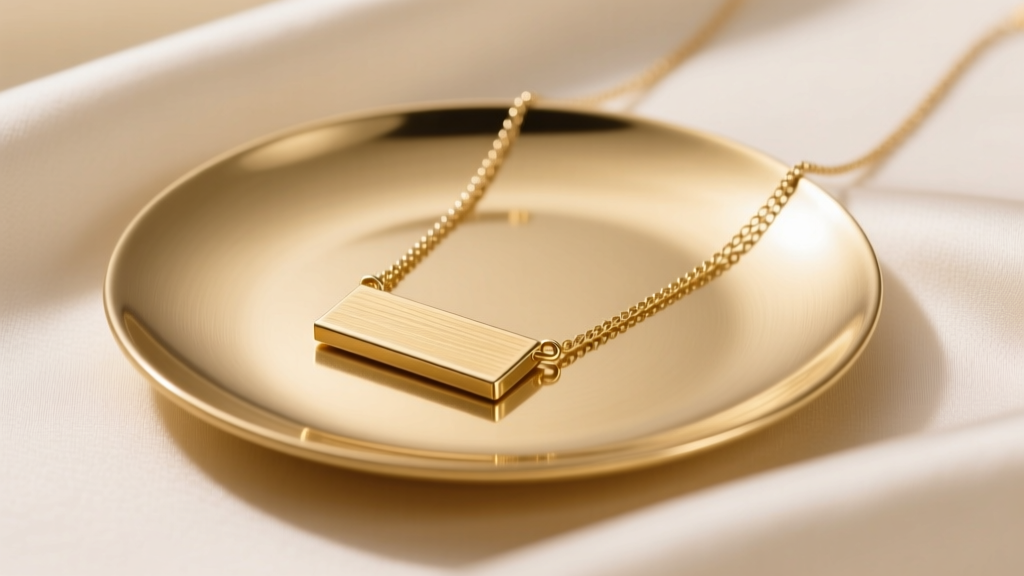
When building a foundational jewelry wardrobe, the minimalist plate necklace is an absolute necessity. Unlike the flashy, cursive 'nameplate' necklaces popularized in the early 2000s, a modern plate necklace features a clean, geometric metal canvas—usually a rectangle, disc, or horizontal bar. It serves as a subtle, sophisticated anchor for your neckline, offering a blank slate that can be worn completely unadorned or personalized with meaningful engravings.
For beginners, the sheer volume of options on the market can be overwhelming. Prices range from $15 fast-fashion pieces to $500 fine jewelry staples. The secret to making the right investment lies in understanding metal thickness, chain mechanics, and engraving techniques. This guide will break down the exact specifications you need to look for to ensure your plate necklace lasts a lifetime.
Decoding Metal Grades and Thickness
The most common mistake beginners make is ignoring the physical dimensions and metal composition of the pendant. A plate necklace takes a lot of friction against clothing and skin, meaning structural integrity is paramount.
In jewelry manufacturing, thickness is measured in millimeters or gauge. A high-quality plate pendant should be at least 1.5mm thick (roughly 14-gauge). If you purchase a plate that is 1.0mm or thinner (18-gauge to 20-gauge), it will inevitably warp, bend, and dent with daily wear. When evaluating metals, always look for proper hallmarking. According to the Federal Trade Commission's Jewelry Guides, terms like 'vermeil' and 'sterling' have strict legal definitions that protect consumers from misleading marketing.
| Metal Type | Base Material | Gold Layer | Price Range (Pendant) | Durability |
|---|---|---|---|---|
| 925 Sterling Silver | 92.5% Pure Silver | None | $25 - $60 | High (Requires polishing) |
| Gold Vermeil | 925 Sterling Silver | 2.5+ microns of gold | $45 - $95 | Medium-High |
| Solid 14k Gold | 58.3% Gold Alloy | Solid throughout | $150 - $350+ | Lifetime (Heirloom) |
| Gold Plated (Brass) | Brass or Copper | < 0.5 microns | $15 - $30 | Low (Will oxidize) |
Expert Tip: Always avoid 'gold plated' pieces with a brass or copper base for daily wear. Once the microscopic gold layer wears off, the base metal will oxidize and turn your skin green. Always opt for Gold Vermeil or Solid 14k Gold, as detailed in the Gemological Institute of America's (GIA) gold guidelines.
Chain Pairings and Bail Mechanics
The pendant is only half the equation; the chain and the 'bail' (the connector) dictate how the plate necklace actually sits on your body. Have you ever worn a pendant that constantly flips backward, hiding the front against your skin? This is a bail mechanics issue.
The Hidden Bail vs. The Jump Ring
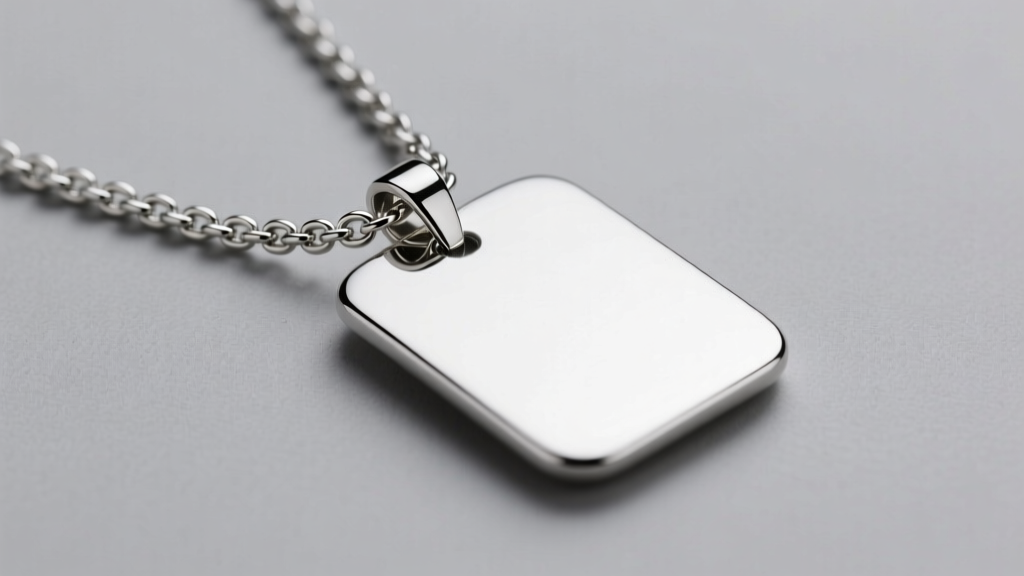
- Hidden Bail: A small loop soldered horizontally across the upper back of the plate. This is the gold standard. It forces the plate to lay perfectly flat against your chest and prevents flipping.
- Top-Drilled Hole / Jump Ring: A simple hole punched through the top of the plate with a ring attached. While cheaper to manufacture, this acts as a pivot point, causing the plate to spin and flip constantly.
Choosing the Right Chain
Because plate pendants have a broad, flat surface area, they carry more visual and physical weight than a simple gemstone drop. You need a chain that provides structural support without tangling.
- Box Chains: Excellent for plate necklaces. The square links lay flat, resist twisting, and can easily support the weight of a 1.5mm solid metal plate.
- Rolo Chains: Featuring round, uniform links, rolo chains offer a classic, vintage look that pairs beautifully with engraved disc plates.
- Cable Chains: While delicate and pretty, thin cable chains are prone to twisting. If you choose a cable chain, ensure it is at least 1.2mm thick to prevent the links from catching on the plate's edges and scratching the metal.
Engraving 101: Fonts, Depth, and Placement
Personalizing your plate necklace with coordinates, initials, or a short word elevates it from a simple accessory to a sentimental keepsake. However, not all engraving methods are created equal. Understanding the difference will save you from a faded, unreadable pendant five years down the line.
Laser Engraving vs. Diamond Drag
Laser Engraving uses a concentrated beam of light to burn the surface of the metal. It is incredibly precise, allowing for microscopic text, intricate logos, and even fingerprint transfers. However, the depth is very shallow (usually around 0.1mm). Over years of polishing and friction, laser engravings can slowly fade.
Diamond Drag (Rotary) Engraving uses a diamond-tipped bit to physically carve into the metal. This creates a much deeper groove (0.5mm or more). While you are limited to traditional block or script fonts, a diamond-drag engraving will literally last a lifetime and can be polished endlessly without losing its legibility.
'When sizing text for a standard 15mm x 20mm rectangular plate, keep your font height between 3mm and 5mm. Anything smaller becomes illegible to the naked eye when worn on the chest, and anything larger leaves no negative space, making the design look cramped and unrefined.' — Master Bench Jeweler
Common Beginner Mistakes to Avoid
Even with the right metal, a few subtle design flaws can ruin the wearing experience. Watch out for these red flags when shopping:
- Sharp Edges: Run your thumb along the perimeter of the plate. High-quality jewelers use a process called 'bezel setting' or edge-beveling to slightly round the sharp 90-degree corners of a rectangular plate. If the edges are razor-sharp, it will catch on knit sweaters and scratch your collarbone.
- Hollow Construction: Some budget brands stamp thin sheets of metal into a slight dome to create the illusion of thickness. Tap the plate with your fingernail; if it sounds tinny or hollow, put it back. You want solid, cast, or die-struck metal.
- Weak Clasps: A solid metal plate adds frontal weight to a necklace, which pulls on the clasp at the back of the neck. Ensure your chain features a sturdy lobster clasp. Tiny spring-ring clasps will eventually fail under the uneven weight distribution.

Care and Maintenance Framework
To keep your plate necklace looking pristine, you must adapt your cleaning routine to the metal's finish.
If your plate has a high-polish (mirror) finish, regular use of a treated silver or gold polishing cloth will keep it gleaming. However, if you opted for a brushed or matte finish, you must never use abrasive polishing cloths or ultrasonic cleaners. The friction will literally polish away the matte texture, leaving you with a patchy, uneven surface. For matte plates, simply wash them with warm water, a drop of mild dish soap, and a soft-bristled baby toothbrush, then pat dry with a microfiber towel.
Finally, always store your plate necklace separately. Because the surface area is wide and flat, tossing it into a communal jewelry box guarantees it will become scratched by harder gemstones or tangled with other chains. Keep it in its own anti-tarnish pouch or a dedicated compartment.


