How to Clean and Care for a Multi Colored Jade Bead Necklace
Learn expert tips to clean, maintain, and restring your multi colored jade bead necklace without damaging the stones or silk thread.

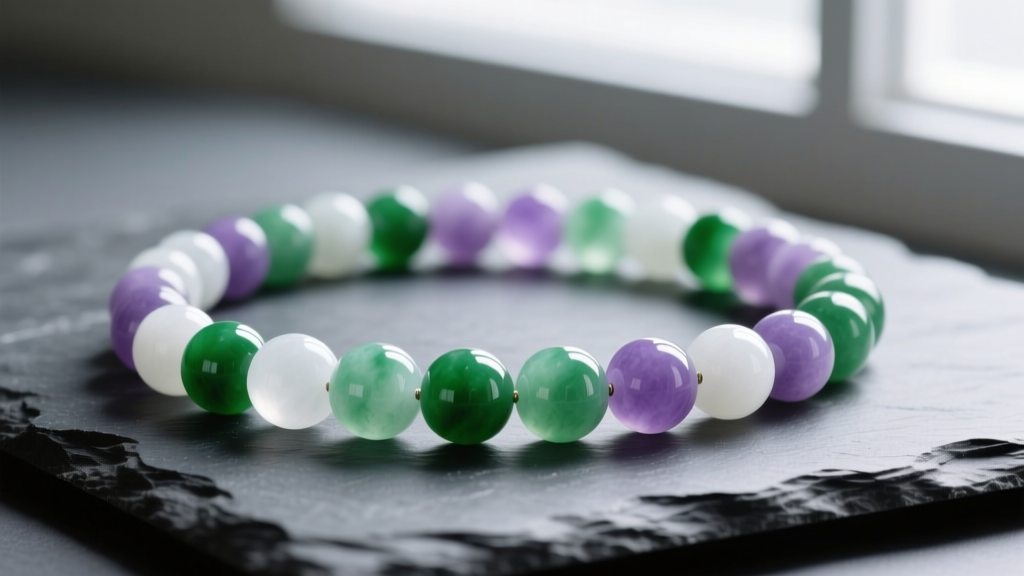
Owning a multi colored jade bead necklace is an investment in both geological history and artisanal craftsmanship. Whether your piece features the glassy luster of Burmese jadeite or the waxy, oily sheen of Chinese nephrite, proper maintenance is non-negotiable. Jade is famously tough—meaning it resists shattering and chipping better than almost any other gemstone—but its surface hardness and the delicate materials used to string it require highly specific care protocols. In this comprehensive guide, we break down the exact cleaning methods, structural maintenance routines, and storage environments required to preserve the vibrant greens, lavenders, yellows, and whites of your jade bead necklace for generations.
Understanding Your Jade: Type A, B, and C Treatments
Before applying any moisture or cleaning agents to your multi colored jade bead necklace, you must identify its treatment grade. The Gemological Institute of America (GIA) categorizes jade into three distinct treatment types, which directly dictate how the stones will react to cleaning solutions.
- Type A (Untreated): This is natural, untreated jadeite or nephrite. It may have a light wax polish applied during manufacturing, but its internal structure is entirely intact. Type A jade is the most durable and can withstand gentle wet cleaning without issue.
- Type B (Bleached and Polymer-Impregnated): Stones are soaked in hydrochloric acid to remove brown or yellow impurities, then injected with a polymer resin to improve clarity and stability. The resin is highly sensitive to heat, ultrasonic vibrations, and harsh solvents.
- Type C (Dyed): The jade has been artificially colored. Many multi colored jade bead necklaces on the market feature dyed beads to achieve uniform, vibrant hues. The dye can fade or bleed if exposed to strong chemicals, prolonged sunlight, or acidic solutions.
If you are unsure of your necklace's treatment grade, always assume it is Type B or C and proceed with the most conservative cleaning methods outlined below.
The Golden Rules of Cleaning Jadeite and Nephrite
Jade possesses a Mohs hardness of 6.5 to 7, making it susceptible to scratching by harder materials like diamonds, sapphires, and even airborne quartz dust. However, its interlocking crystalline structure gives it immense toughness. When cleaning your multi colored jade bead necklace, the goal is to remove sebum, cosmetic residue, and environmental dust without degrading the stringing material or the stone's polish.
Step-by-Step Wet Cleaning Method
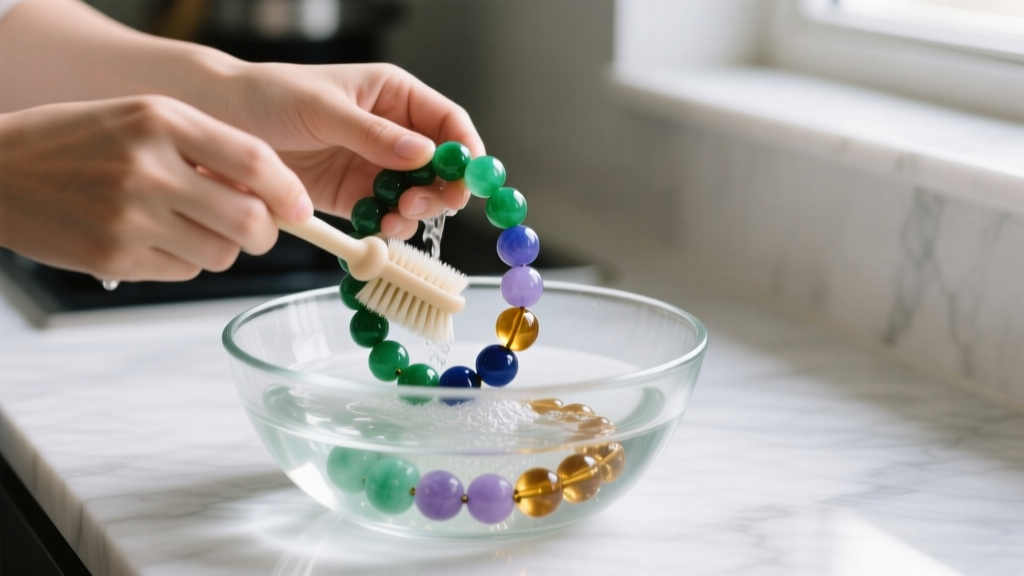
- Prepare the Solution: Fill a glass or ceramic bowl with lukewarm distilled water. Add two drops of a pH-neutral, dye-free dish soap (such as original Dawn or a pure Castile soap). Avoid tap water, as heavy minerals and chlorine can leave a micro-film on the beads.
- Submerge Briefly: Place the necklace in the water for no more than 3 to 5 minutes. Prolonged submersion can weaken the silk or nylon thread, especially at the knot points.
- Agitate Gently: Use a clean, ultra-soft baby hair brush or a dedicated makeup blending brush to lightly sweep the bristles between the beads and around the drill holes. Never use a standard toothbrush, as the stiff nylon bristles can create micro-scratches on the wax polish of Type A jade or degrade the resin on Type B jade.
- Rinse: Rinse the necklace under a gentle stream of lukewarm distilled water to remove all soap residue.
- Dry Thoroughly: Lay the necklace flat on a clean, lint-free microfiber towel. Use a second towel to gently pat the beads dry. Allow the necklace to air dry completely for 24 hours in a shaded, well-ventilated area before wearing or storing. Never use a hair dryer or place it in direct sunlight to speed up the drying process.
What to Avoid: Chemical and Mechanical Hazards
The most common way collectors ruin a multi colored jade bead necklace is by using modern jewelry cleaning technology that is entirely incompatible with jade's physical and chemical properties. Below is a breakdown of common cleaning agents and their specific effects on jade.
| Cleaning Agent / Method | Impact on Jade (Type A) | Impact on Treated Jade (Type B/C) |
|---|---|---|
| Ultrasonic Cleaners | Risk of shattering internal fractures | Shatters resin, causes clouding |
| Steam Cleaners | Thermal shock risk | Melts polymer, causes dye bleeding |
| Ammonia / Bleach | Strips natural wax polish | Dissolves resin, destroys color |
| Alcohol / Acetone | Dries out the stone surface | Extracts polymer, ruins finish |
| pH-Neutral Soap & Water | Safe and highly recommended | Safe if done quickly and gently |
According to mineralogical data from Mindat.org, jadeite's specific gravity and crystalline matrix mean it does not require chemical solvents to achieve a high polish. Mechanical vibration from ultrasonic cleaners (typically operating at 40kHz) is the number one cause of catastrophic failure in beaded jade necklaces, as it easily exploits microscopic stress fractures inside the beads.
Thread and Hardware Maintenance: Restringing Your Necklace
The structural integrity of a multi colored jade bead necklace relies entirely on its stringing material. Because jade beads are dense and relatively heavy, the friction between the bead holes and the thread causes gradual degradation over time.
Silk vs. Nylon Stringing
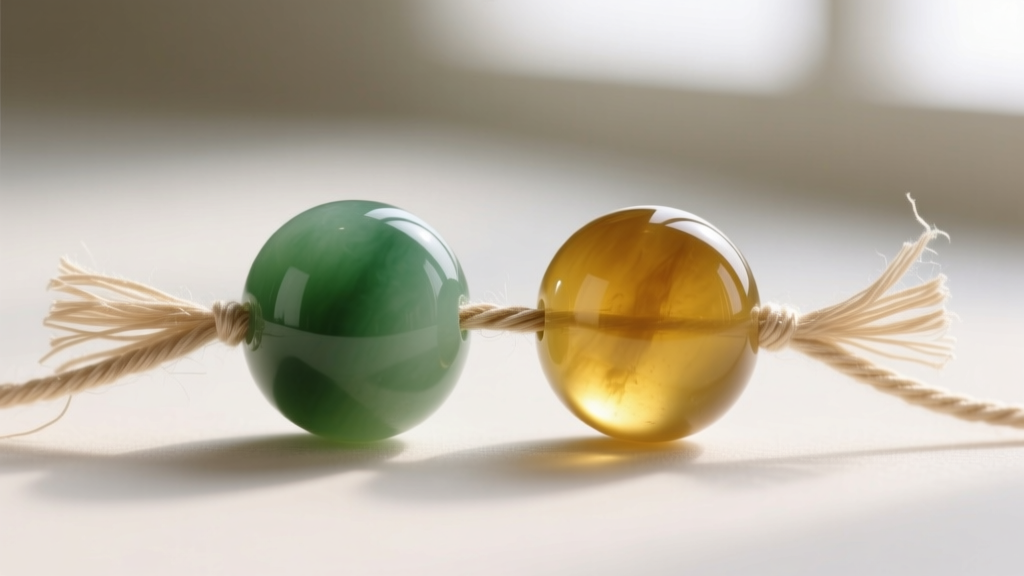
Traditionally, high-end jade necklaces are strung on 100% silk thread with individual knots between every single bead. Knotting serves two vital purposes: it prevents the heavy jade beads from grinding against one another (which would dull their polish), and it ensures that if the thread snaps, you only lose one bead rather than the entire necklace. However, silk is a natural protein fiber that degrades rapidly when exposed to human sweat, perfumes, and water. If you wear your necklace weekly, GIA experts recommend having it professionally restrung every 12 to 18 months.
For daily wearers, modern jewelers often use high-tenacity nylon threads (like PowerPro or Beadalon). Nylon is impervious to water and sweat, vastly extending the lifespan of the stringing, though it lacks the traditional drape of silk. Regardless of the material, ensure your jeweler uses 'French wire' (also known as bullion)—a tiny coil of fine silver or gold wire—where the thread loops through the metal clasp. This prevents the heavy jade beads from sawing through the thread at the closure point.
Proper Storage for Multi Colored Jade Bead Necklaces
How you store your jade is just as critical as how you clean it. Jade is a hydrous mineral aggregate; while it does not craze or crack from drying out like opals or turquoise, extreme environmental fluctuations can affect the wax coatings and polymer resins used in its finishing.
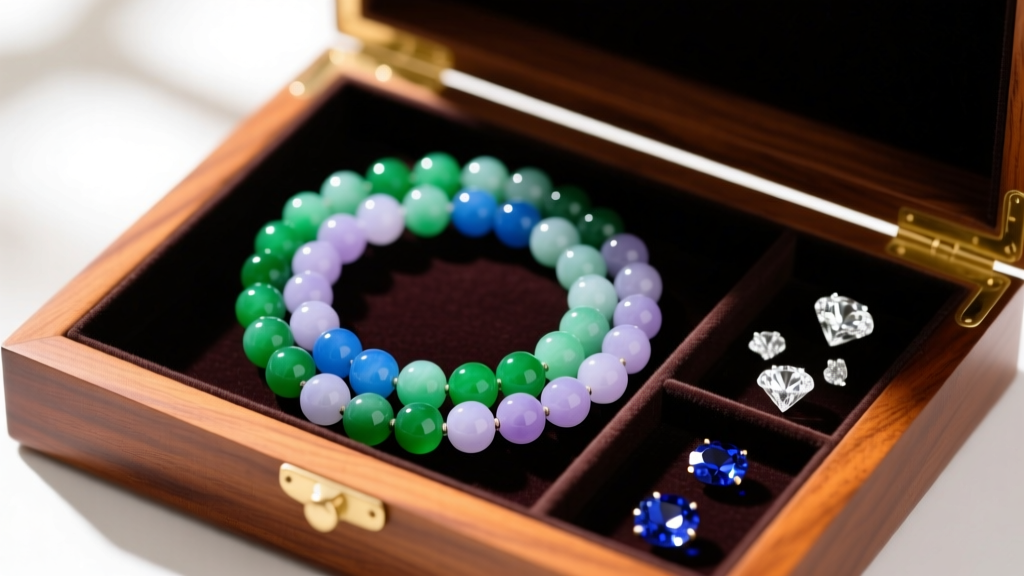
- Isolate from Harder Gems: Never store your jade necklace in a communal jewelry box where it can rub against diamonds (Mohs 10), sapphires (Mohs 9), or even quartz (Mohs 7). Always keep it in a dedicated, soft-lined pouch or a separate compartment.
- Avoid Extreme Heat: Do not leave the necklace in a hot car, near a radiator, or in direct sunlight. High heat can cause the polymer in Type B jade to yellow and become brittle, and it can cause the dyes in Type C jade to fade unevenly.
- Maintain Ambient Humidity: Jade thrives in standard indoor humidity levels (40-60%). If you live in an exceptionally arid climate, occasionally wiping the beads with a slightly damp microfiber cloth will help maintain their lustrous, oily appearance.
Expert Troubleshooting: Dullness and Discoloration
If your multi colored jade bead necklace begins to look dull or cloudy despite regular, gentle cleaning, the issue is likely related to the surface polish rather than dirt. Over years of wear, the microscopic wax coating applied to Type A jade can wear away, leaving the stone looking matte and lifeless. Do not attempt to re-wax or oil the jade yourself using household products, as these can turn rancid and attract dust.
Instead, take the necklace to a lapidary professional who specializes in Asian gemstones. They can safely remove the beads, give them a professional tumble or hand-polish with diamond grit compounds, and apply a fresh, jewelry-grade microcrystalline wax. For Type B and C jade, dullness usually indicates that the polymer resin is breaking down or the dye is degrading; in these cases, professional re-polishing is not always viable, making preventative care and strict adherence to the cleaning rules above your best defense.


