How to Clean and Style a Fake Diamond Choker Necklace
Learn how to clean, restore, and style a fake diamond choker necklace. Step-by-step guide to maintaining brilliance and layering like a pro.

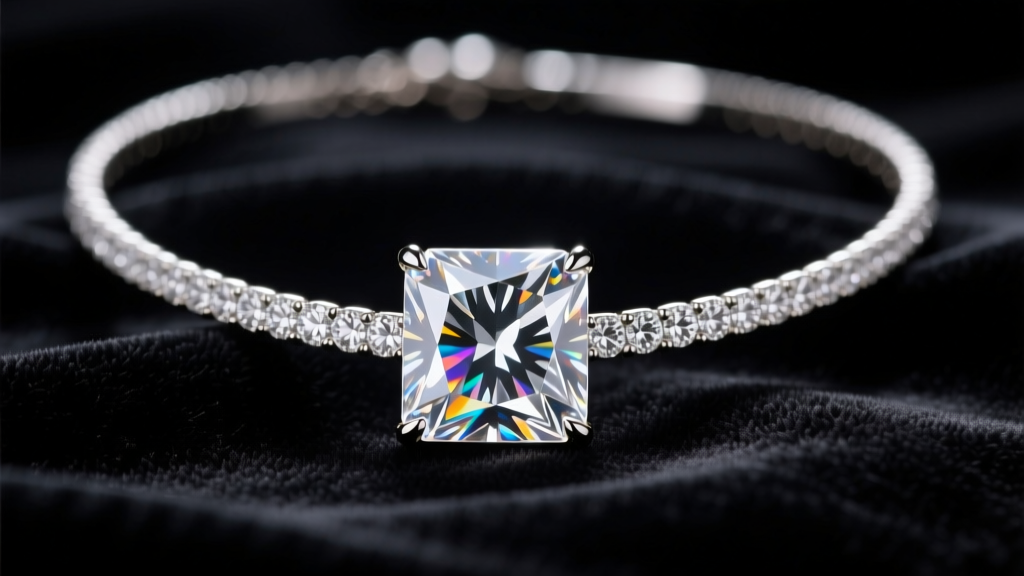
The Anatomy of a Simulated Stone Choker
A fake diamond choker necklace is a staple in modern jewelry wardrobes, offering the icy brilliance of fine jewelry without the exorbitant price tag. However, the term 'fake' encompasses a wide spectrum of materials, from high-grade cubic zirconia (CZ) and moissanite to lower-tier glass rhinestones. The base metal—often brass plated with rhodium or gold vermeil—dictates the piece's longevity. To maintain the luxurious illusion of a simulated diamond tennis choker or a delicate riviere style, you must understand the specific chemical and physical properties of your materials. This step-by-step guide will teach you how to clean, restore, and strategically style your choker to elevate your everyday and formal looks.
Step 1: Identify Your Stone and Base Metal
Before applying any cleaning solution, you must identify the simulant and the setting method. Glued-in rhinestones require vastly different care than prong-set cubic zirconia. According to the Gemological Institute of America (GIA), cubic zirconia ranks at 8 to 8.5 on the Mohs hardness scale, making it highly resistant to scratching but susceptible to chipping if struck against hard surfaces. Glass crystals, conversely, rank much lower and can be easily scratched by abrasive cleaning tools.
| Material | Mohs Hardness | Refractive Index (Brilliance) | Setting Style | Ultrasonic Cleaner Safe? |
|---|---|---|---|---|
| Cubic Zirconia (CZ) | 8.0 - 8.5 | 2.15 - 2.18 | Prong / Bezel | Yes (if prong-set) |
| Moissanite | 9.25 | 2.65 - 2.69 | Prong / Bezel | Yes |
| Swarovski / Crystal | 6.0 - 7.0 | 1.50 - 1.70 | Glue / Foil-back | No (destroys foil/glue) |
| Acrylic / Resin | 2.0 - 3.0 | 1.49 | Glue | No (melts/clouds) |
Step 2: The Safe Cleaning Protocol (Step-by-Step)
Tarnish on the base metal and the accumulation of sebum (skin oils) and cosmetics on the stone's pavilion (bottom facets) are the primary reasons a fake diamond choker necklace loses its sparkle. Follow this precise protocol to restore its optical clarity without damaging the plating or adhesive.
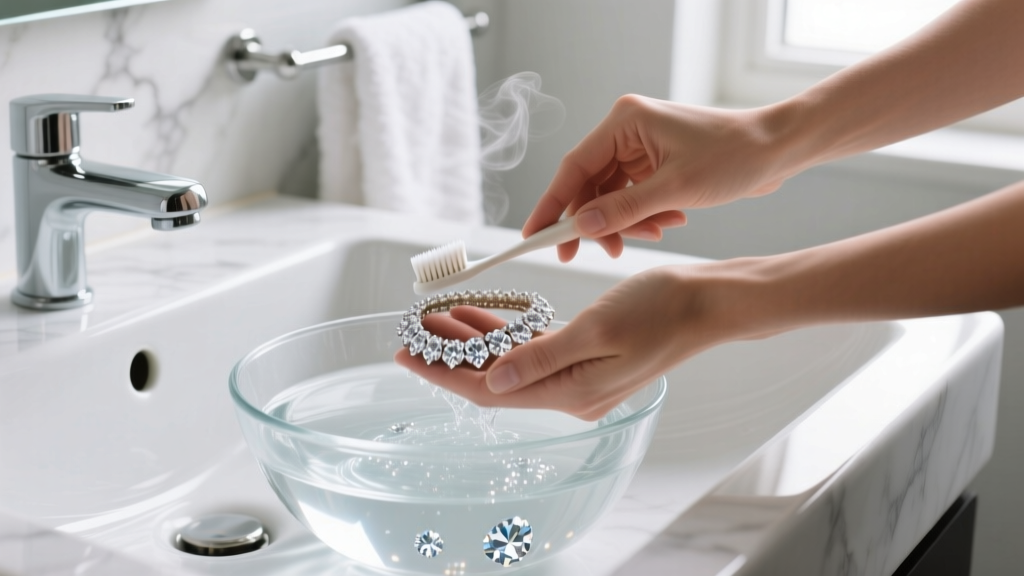
The Distilled Water & Surfactant Method
- Prep the Solution: Mix 1 cup of distilled water (never tap water, as chlorine and hard minerals leave microscopic films) with 3 drops of mild, lotion-free dish soap (like original Dawn).
- Targeted Soaking: If your choker features prong-set CZ or moissanite, submerge it for 5 to 10 minutes to loosen oils. If the stones are glued (common in vintage-style rhinestone chokers), skip soaking entirely to prevent the epoxy from breaking down.
- Gentle Agitation: Use a baby-bristle toothbrush. Dip the brush in the solution and gently sweep across the table (top) of the stones and the base metal links. For the pavilion (back of the stones), use a soft cotton swab to push out trapped lotion.
- The Final Rinse: Rinse briefly under a slow stream of distilled water. Do not use hot water, as thermal shock can fracture lower-quality crystals.
- Drying: Pat dry immediately with a lint-free microfiber cloth. Never air-dry, as water spots will permanently dull the simulated diamond's refractive index.
Critical Warning: Avoid Ultrasonic Cleaners
While Jewelers of America recommends ultrasonic cleaners for genuine diamonds, these high-frequency sound waves create microscopic cavitation bubbles that will instantly shatter the fragile epoxy holding rhinestones in place and strip thin rhodium plating right off brass bases.
Step 3: Strategic Layering and Neckline Pairing
A fake diamond choker necklace is inherently bold. To prevent it from looking costumey, you must integrate it into a balanced, intentional layering stack. The goal is to create a gradient of visual weight.

The 4-Inch Layering Rule
When layering a 14-inch or 15-inch simulated diamond choker, your next necklace should be exactly 4 inches longer (18 to 19 inches) to prevent the chains from tangling and the clasps from scratching the stones.
- Layer 1 (14"): Fake diamond tennis choker (focal point, high brilliance).
- Layer 2 (18"): 14k gold-filled or sterling silver rope chain (adds texture and grounds the sparkle).
- Layer 3 (22"): Simple pendant necklace with a single, larger CZ or mother-of-pearl drop (draws the eye downward, elongating the neck).
Neckline Matching Matrix
The cut of your top dictates how the choker sits against your collarbone.
- Sweetheart & Off-the-Shoulder: The ideal canvas. A 14-inch choker sits perfectly in the negative space, framing the collarbone without competing with fabric.
- Deep V-Neck: Pair a delicate 15-inch riviere choker with an 18-inch lariat to follow the geometric lines of the V-neck.
- Crew Neck / T-Shirts: Avoid thick, multi-row rhinestone chokers, which will look cramped. Opt for a single-row, bezel-set CZ choker worn slightly loose (15.5 inches) to rest just above the cotton hem.
Step 4: Long-Term Storage and Tarnish Prevention
The base metals used in affordable fake diamond chokers (typically brass or copper alloys) are highly reactive to sulfur and humidity in the air, leading to rapid oxidation (tarnish). To preserve the rhodium or gold plating:
- Use Anti-Tarnish Strips: Place a 3M anti-tarnish strip inside your jewelry box. These strips absorb airborne sulfur compounds before they can react with your base metals.
- Individual Poly Bags: Store the choker in a sealed, airtight polyethylene bag with a small silica gel packet to control moisture.
- Lay Flat or Hang: Never toss a tennis-style choker into a drawer. The tension can warp the flexible metal links, causing the stones to pop out of their shallow settings. Hang it on a velvet-lined hook or lay it perfectly flat.
Conclusion
Treating a fake diamond choker necklace with the same respect and precise care as a fine jewelry piece completely transforms its appearance and lifespan. By identifying your specific simulant, avoiding destructive cleaning methods like ultrasonic waves, and mastering the 4-inch layering rule, you can achieve a high-end, bespoke look. Proper maintenance ensures that your choker continues to catch the light brilliantly, proving that true style lies in the details of care and curation.


