The Science Behind a Colorful Crystal Necklace: A Gemologist Guide
Explore the gemological science, stringing mechanics, and material durability behind a high-quality colorful crystal necklace in this expert deep dive.

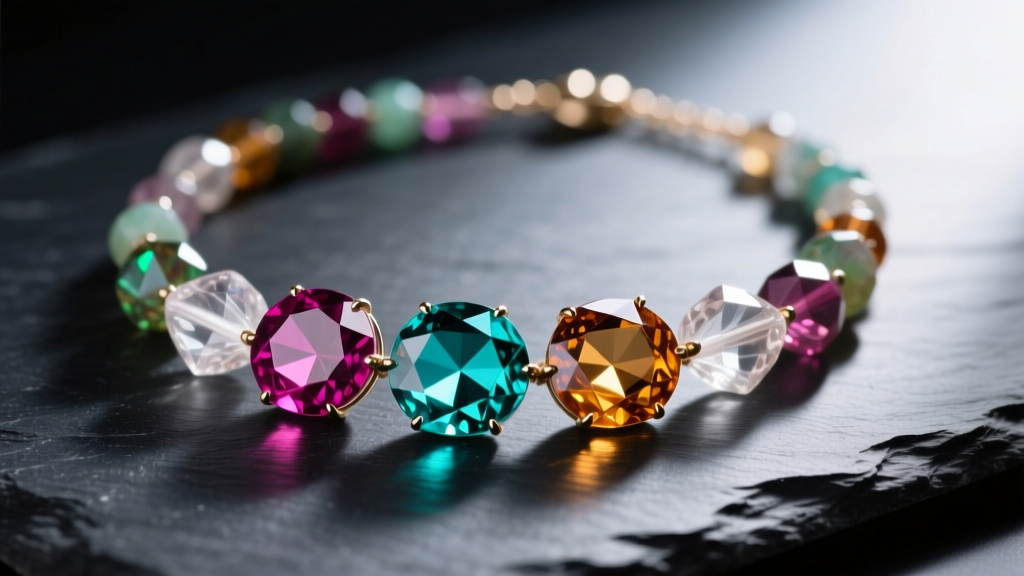
When evaluating a colorful crystal necklace, the untrained eye sees a spectrum of vibrant hues, but a gemologist sees a complex matrix of trace elements, refractive indices, and structural vulnerabilities. In 2026, the market is saturated with both natural multi-gemstone strands and advanced lab-grown alternatives. To navigate this landscape, one must look beyond the color palette and examine the crystallography, stringing mechanics, and load-bearing engineering that dictate the piece's longevity and value.
The Crystallography of Color: Trace Elements and Light Refraction
The vivid spectrum in a high-end colorful crystal necklace is rarely accidental; it is the result of specific transition metals interacting with the crystal lattice during formation. For instance, the deep pinks and greens in natural tourmaline beads are dictated by manganese and iron concentrations, while the purples in amethyst (a quartz variety) stem from iron impurities subjected to natural gamma irradiation.
Lab-grown crystals, such as synthetic spinel or cubic zirconia, achieve color through controlled doping during the Verneuil or Czochralski growth processes. While natural stones often exhibit dichroism—displaying different colors when viewed from different crystallographic axes—synthetic counterparts are typically optically isotropic. According to the Gemological Institute of America (GIA), measuring the refractive index (RI) and specific gravity (SG) remains the definitive method for distinguishing natural beryl or tourmaline from their synthetic or glass imitations in multi-stone strands.
Durability Metrics: Mohs Hardness and Cleavage Planes
A critical failure point in multi-stone jewelry is the mismatch of hardness between adjacent beads. When a colorful crystal necklace combines materials with vastly different Mohs hardness ratings, friction during wear causes the softer stones to abrade. Furthermore, perfect cleavage planes in stones like topaz or fluorite make them highly susceptible to chipping at the drill holes.
| Crystal Material | Mohs Hardness | Cleavage | Necklace Risk Factor |
|---|---|---|---|
| Fluorite (Natural) | 4.0 | Perfect (Octahedral) | High: Prone to chipping and scratching |
| Apatite (Natural) | 5.0 | Poor to Distinct | Moderate: Drill hole fracturing common |
| Quartz / Amethyst | 7.0 | None (Conchoidal) | Low: Excellent durability for daily wear |
| Tourmaline | 7.0 - 7.5 | Indistinct | Low-Moderate: Watch for internal tension |
| Synthetic Spinel | 8.0 | None | Very Low: Highly resistant to abrasion |
Expert jewelers recommend using microscopic polymer spacer beads or knotting techniques between stones with a hardness variance greater than 1.5 on the Mohs scale to prevent catastrophic surface degradation over time.
Stringing Mechanics: Engineering Tension Resistance
The structural integrity of a colorful crystal necklace relies entirely on its stringing medium. Heavy, faceted crystal beads exert significant kinetic force on the stringing material, particularly at the drill holes where sharp internal edges act like microscopic blades.
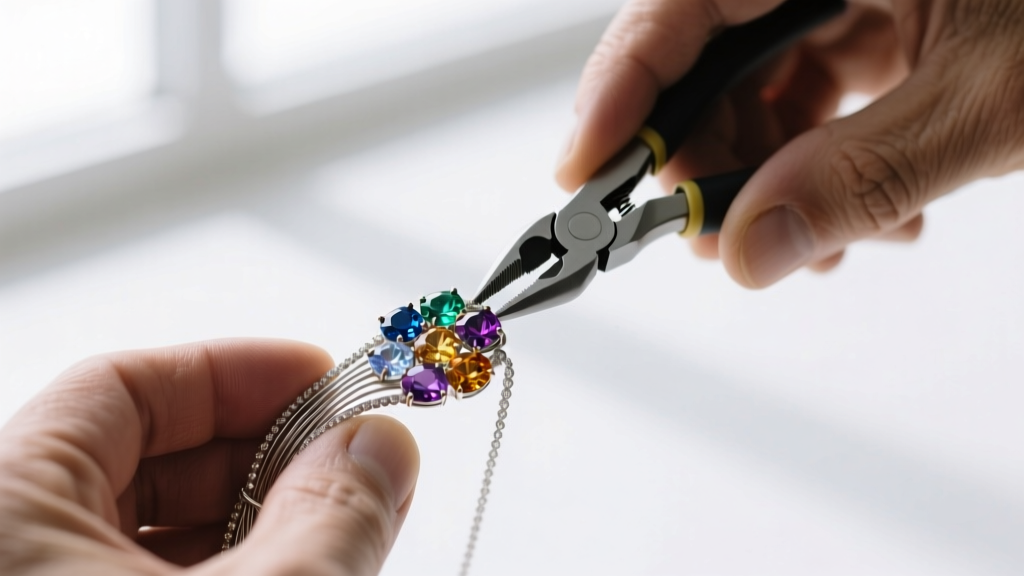
For heavy crystal strands exceeding 45 grams, traditional Size F or G silk thread is obsolete due to its susceptibility to moisture degradation and tensile snapping. Modern gemologists and master stringers utilize 49-strand stainless steel micro-wire (such as 0.018-inch or 0.024-inch Beadalon). The 49-strand configuration provides superior drape and flexibility, mimicking the fluidity of silk while offering a tensile strength exceeding 30 pounds.
- Drill Hole Protection: Always use 14k gold-filled or sterling silver wire guardians (French wire) at the clasp connection points to prevent the wire from bending and fatiguing.
- Crimp Mechanics: Use 2x2mm seamless sterling silver crimp beads. Avoid base metal crimps, which can oxidize and weaken, leading to sudden strand failure.
- Adhesive Calibration: A micro-drop of flexible cyanoacrylate or specialized jewelry epoxy (like G-S Hypo Cement) inside the crimp cover ensures the wire cannot slip under sudden kinetic shock.
Clasp Load-Bearing and Engineering
The clasp on a heavy crystal necklace must manage both static weight and dynamic shear forces. Standard spring-ring clasps are entirely inadequate for strands over 30 grams, as the internal tension spring will inevitably fail or the soldered jump ring will pull apart.
For high-mass colorful crystal necklaces, a solid-cast toggle clasp or a neodymium magnetic clasp (Grade N52 or higher) is required. Magnetic clasps offer the benefit of a self-releasing mechanism if the necklace is snagged, preventing severe neck injury or total strand rupture. However, they must always be paired with a secondary 1.5mm sterling silver safety chain to prevent loss if the magnetic field is compromised by external interference.
Optical Maintenance and Chemical Sensitivities
Maintaining the optical clarity of a multi-gemstone strand requires an understanding of chemical sensitivities. While ultrasonic cleaners are safe for synthetic spinel and pure quartz, they are catastrophic for fracture-filled crystals, dyed agates, or stones with liquid inclusions (such as emerald or certain tourmalines). The high-frequency cavitation can expand internal fractures, causing the bead to shatter.
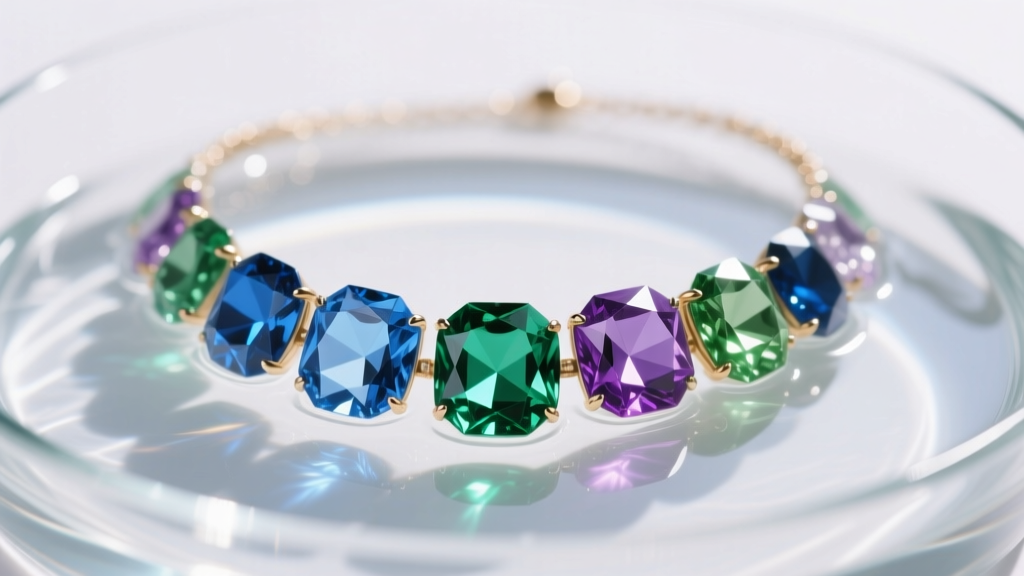
According to mineralogical data from Mindat.org, porous crystals like apatite and fluorite can absorb harsh chemical cleaners, leading to permanent surface etching. The safest, most effective cleaning protocol for a mixed-material colorful crystal necklace involves a brief soak in a lukewarm solution of distilled water and a pH-neutral, phosphate-free surfactant, followed by gentle agitation with a soft-bristled cosmetic brush and immediate drying with a lint-free microfiber cloth to prevent water spot mineral deposits.
Final Calibration: Sourcing and Verification
When investing in fine jewelry, always request a gemological identification report for the primary focal stones in the piece. Understanding the exact mineral species, enhancement status (such as heat treatment or irradiation), and origin not only protects your investment but ensures the structural care protocols you apply are perfectly calibrated to the material's unique crystallographic properties.


