Cross With Lord's Prayer Necklace: Metals, Engraving & Care
Discover expert technical details for a cross with Lord's Prayer necklace, including laser engraving depths, metal grades, and chain pairings.

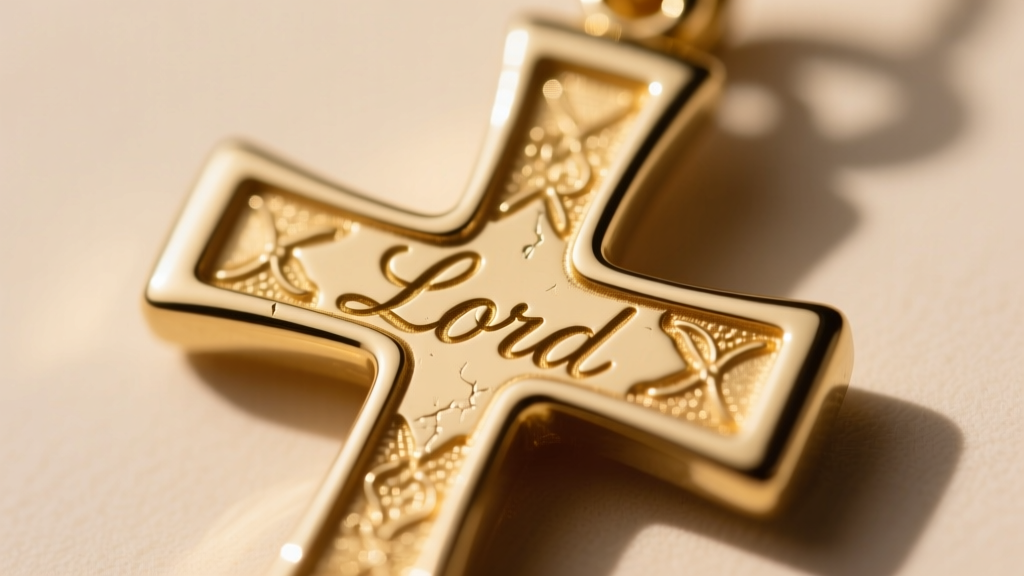
Designing and manufacturing a cross with Lord's Prayer necklace presents a unique intersection of theological reverence and precision metallurgy. The traditional English version of the Lord's Prayer contains approximately 55 to 65 words, translating to roughly 300 to 350 characters depending on the specific translation used. Fitting this volume of text onto a wearable pendant without sacrificing legibility or structural integrity requires a masterful understanding of micro-engraving technologies, metal hardness scales, and dimensional tolerances. This expert deep dive explores the technical specifications required to craft, wear, and maintain a high-quality prayer cross pendant.
The Physics of Micro-Engraving on Precious Metals
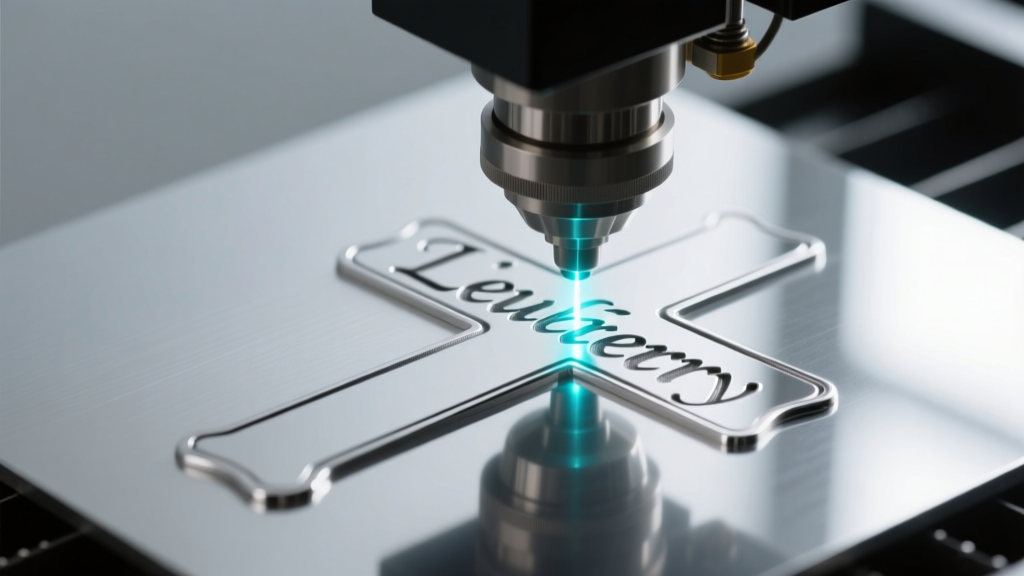
When inscribing a 300-character prayer onto a surface area of less than two square inches, traditional rotary engraving is entirely obsolete. The cutting bit would drag, distort the metal, and render the 4-point typography illegible. Instead, modern jewelers rely on fiber laser technology, specifically 1064 nm wavelength lasers, to mark precious metals at a microscopic level.
There are two primary laser methods used for prayer pendants:
- Ablation: The laser physically vaporizes a microscopic layer of the metal, leaving a tactile indentation. While durable, ablation removes material, which can weaken thin crosses and create crevices where skin oils and dirt accumulate.
- Annealing: The laser heats the metal just below its melting point, causing oxidation that brings carbon and trace elements to the surface. This creates a stark, dark contrast against the polished metal without removing any material. Annealing is the gold standard for a cross with Lord's Prayer necklace, as it preserves the smooth, polished back and front of the pendant while ensuring the text remains flush and comfortable against the skin.
For annealing to work effectively, the laser must be a MOPA (Master Oscillator Power Amplifier) fiber laser, which allows the operator to adjust the pulse width and frequency. Adjusting these parameters is critical when switching between metals of varying thermal conductivity, such as sterling silver versus platinum.
Metal Grade Comparison for Prayer Text Pendants
The success of micro-engraved text relies heavily on the Vickers Hardness (HV) and thermal properties of the chosen alloy. Softer metals can warp under the intense, localized heat of a fiber laser, while highly reflective metals can deflect the beam, resulting in faded or incomplete text. According to metallurgical data referenced by the Gemological Institute of America (GIA), alloy composition drastically alters engraving outcomes.
| Metal Grade | Vickers Hardness (HV) | Laser Method | Edge Sharpness & Contrast | Avg. Price Range (Pendant Only) |
|---|---|---|---|---|
| Sterling Silver (925) | 60 - 80 | Annealing | High contrast (black on white); prone to heat warping if under 1.2mm thick. | $45 - $120 |
| 14K Yellow Gold | 140 - 160 | Annealing | Excellent; optimal hardness prevents warping and yields crisp, dark text. | $250 - $600 |
| 18K Yellow Gold | 120 - 140 | Low-Pulse Annealing | Very good; requires slower laser speed to prevent surface pitting. | $400 - $950 |
| Platinum (950) | 110 - 130 | High-Frequency MOPA | Moderate; high reflectivity requires specialized parameters for dark contrast. | $600 - $1,500+ |
| Stainless Steel (316L) | 150 - 190 | Ablation / Annealing | Superior edge sharpness; highly resistant to thermal distortion. | $25 - $75 |
Dimensional Requirements & Cross Proportions
To fit the entirety of the Lord's Prayer in a legible format, the pendant must meet strict minimum dimensional requirements. A standard, readable micro-font size for jewelry is 3.5 to 4.5 points. At this scale, 320 characters require a continuous engraving block measuring approximately 22mm in height and 28mm in width, assuming tight but legible tracking.
Therefore, the cross itself must have minimum overall dimensions of 35mm tall by 25mm wide to allow for adequate margins (negative space) around the text block. Margins are critical; if the text runs too close to the beveled edges of the cross, the laser's focal length will distort the outer letters, making the beginning and end of the prayer blurry.
Thickness and Gauge Tolerances
Perhaps the most frequently overlooked specification in mass-produced prayer necklaces is metal thickness. Many commercial pendants are stamped from 0.8mm (approx. 20 gauge) sheet metal to save on precious metal costs. However, exposing 0.8mm silver or gold to the thermal shock of a fiber laser will cause the metal to bow or warp, resulting in a concave or convex pendant that no longer lies flat against the chest. For a high-quality cross with Lord's Prayer necklace, the metal must be cast or milled to a minimum thickness of 1.5mm to 1.8mm (approx. 14 to 13 gauge). This mass absorbs the laser's heat evenly, ensuring the pendant remains perfectly planar.
Typography and Layout Constraints
The choice of typeface dictates the legibility of the prayer. While serif fonts (like Times New Roman or Garamond) are traditionally associated with religious texts, their microscopic hairlines and serifs can fill in with skin oils, lotions, and environmental dust over time, creating an illegible dark smudge. Expert jewelers typically utilize optimized sans-serif or slab-serif typefaces (such as Helvetica or Roboto Slab) with slightly widened tracking (letter spacing) and increased leading (line spacing). This ensures that the microscopic valleys between letters remain distinct and easy to clean.
Chain Selection & Bail Engineering
A solid 1.5mm thick gold or silver cross of these dimensions will weigh between 10 and 18 grams. Pairing this weight with a standard 1.0mm chain is a critical failure point; the chain links will stretch, and the clasp spring ring will eventually fail under the pendulum stress of daily wear.
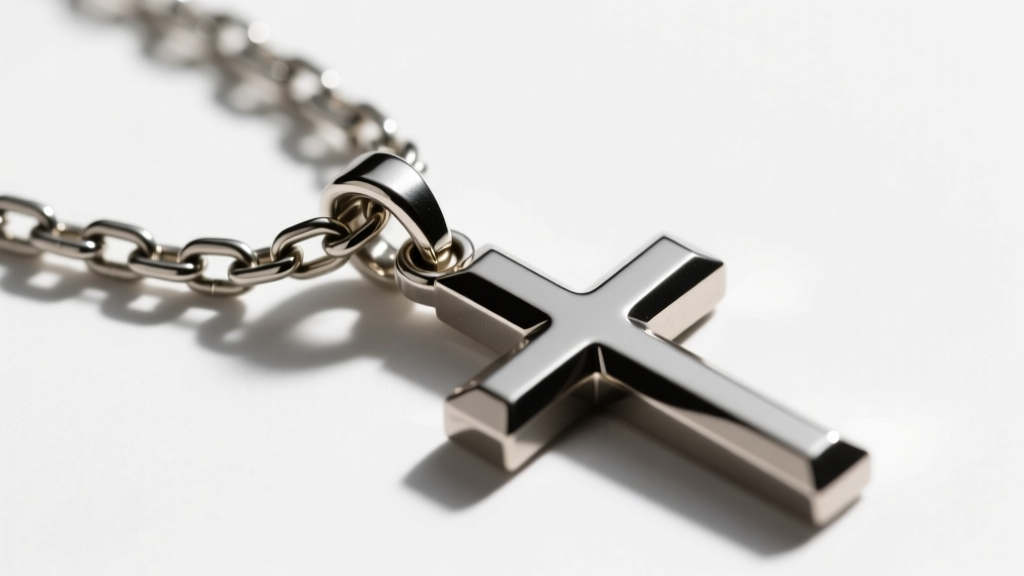
For optimal load distribution, the chain should be a 1.8mm to 2.2mm box chain or rope chain. Box chains are particularly recommended because their flat, interlocking links resist kinking and distribute the pendant's weight evenly across the collarbone. Furthermore, the bail (the loop connecting the cross to the chain) must be hard-soldered or laser-welded to the pendant. Standard glue-set or friction-fit bails will inevitably detach from a heavy prayer cross. A tapered, reinforced bail with an internal diameter of at least 2.5mm is required to accommodate a 2.0mm chain without causing abrasive friction wear on the chain links.
Long-Term Wear & Polishing Risks
Maintaining a micro-engraved pendant requires specific care protocols to prevent the accidental erasure of the text. Because annealed laser marks are essentially controlled surface oxidation, aggressive mechanical polishing will strip the dark contrast right off the metal. Jewelers must never use a polishing wheel or abrasive rouge on the face of a prayer cross. Instead, cleaning should be limited to ultrasonic baths with mild ammonia-free solutions, or gentle scrubbing with a soft-bristled toothbrush and dish soap.
Additionally, while rhodium plating is standard for white gold and sterling silver to prevent tarnish, applying rhodium over laser-annealed text will mute the contrast, turning the crisp black letters into a faint, washed-out gray. If the cross is white gold or silver, the laser engraving must be performed after the rhodium plating process to ensure maximum optical contrast against the bright, reflective surface.
Expert Takeaway: A true heirloom-quality cross with Lord's Prayer necklace is not just a stamped piece of jewelry; it is a precision-engineered artifact. By insisting on 1.5mm+ metal thickness, MOPA fiber laser annealing, and properly gauged chain pairings, you ensure the prayer remains legible and structurally sound for generations.
For further reading on precious metal fabrication and jewelry manufacturing standards, consult the Stuller metallurgical guidelines and specialized jewelry fabrication resources.


