Crystal Necklaces and Meanings: Gemological Wearability Guide
Explore crystal necklaces and meanings through a gemological lens. Learn about Mohs hardness, cleavage, and lapidary cuts for durable daily wear.

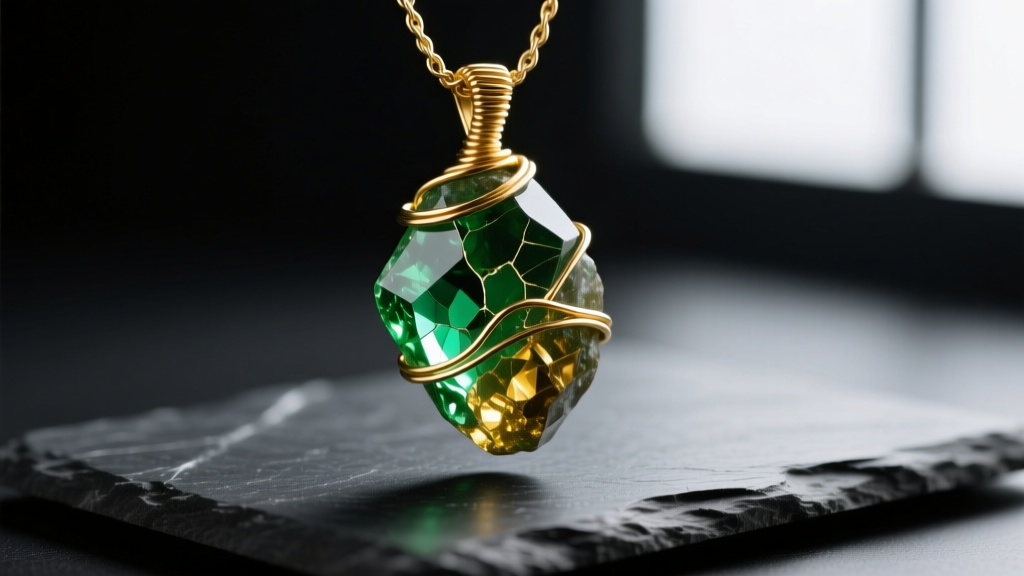
The Intersection of Mineralogy and Metaphysics
When researching crystal necklaces and meanings, most consumers are immediately funneled toward metaphysical properties—amethyst for calm, rose quartz for love, or citrine for abundance. However, as a gemologist and jewelry designer, I approach crystal pendants through a dual lens: the historical symbolism of the stone and its uncompromising mineralogical reality. A crystal's 'energy' means very little if its atomic structure cannot survive the kinetic impacts of daily wear.
In the jewelry industry, the term 'crystal' is often used as a catch-all for any semi-precious gemstone. Mineralogically, however, a true crystal possesses a highly ordered, repeating three-dimensional atomic lattice. This lattice dictates not only how the stone interacts with light (its refractive index and pleochroism) but also its structural vulnerabilities. To build a resilient and meaningful crystal wardrobe in 2026, we must move beyond basic color associations and examine the Mohs hardness scale, cleavage planes, and lapidary mechanics.
Durability Metrics: Mohs Hardness vs. Cleavage
The most common mistake buyers make is assuming that a high Mohs hardness rating guarantees a stone is safe for a necklace pendant. The Mohs scale is ordinal, not linear. For example, Diamond (10) is not just slightly harder than Corundum (9); it is roughly four times harder. More importantly, hardness only measures resistance to scratching. It does not measure toughness or resistance to shattering, which is governed by cleavage and fracture.
Cleavage refers to a mineral's tendency to break cleanly along specific atomic planes of weakness. A pendant swings freely from the neck, frequently colliding with desks, steering wheels, and doorframes. If a stone has perfect cleavage, a single sharp impact at the wrong angle will split it in two, regardless of its Mohs rating.
The Crystal Durability Matrix
| Crystal | Mineral Family | Mohs | Cleavage / Fracture | Wearability | Traditional Meaning |
|---|---|---|---|---|---|
| Amethyst | Quartz | 7 | None (Conchoidal fracture) | Excellent | Mental clarity, peace |
| Labradorite | Feldspar | 6 - 6.5 | Perfect in two directions | Moderate | Intuition, protection |
| Moldavite | Tektite (Glass) | 5.5 | None (Conchoidal fracture) | Poor (Brittle) | Rapid transformation |
| Selenite | Gypsum | 2 | Perfect in one direction | Very Poor | Purification, aura cleansing |
| Black Tourmaline | Silicate | 7 - 7.5 | Uneven fracture | Good | Grounding, EMF shielding |
Notice Selenite in the matrix above. While heavily marketed for its 'purifying' meaning, selenite is a form of gypsum with a Mohs hardness of 2 (it can be scratched by a fingernail) and perfect cleavage. Furthermore, it is slightly water-soluble. Wearing a raw selenite pendant against the skin, where it is exposed to sweat and ambient humidity, will cause the surface to degrade, lose its optical luster, and eventually fracture along its fibrous planes.
Lapidary Cuts and Their Impact on Light Return
The way a crystal is cut (lapidary work) fundamentally alters both its optical performance and its structural integrity. When selecting crystal necklaces and meanings for your collection, the cut should align with how you intend to wear the piece.
- Cabochon (Cab): A smooth, domed, non-faceted cut. This is the safest cut for stones with perfect cleavage or high inclusions, such as labradorite or moonstone. The lack of sharp facet junctions prevents chipping. In metaphysical circles, cabs are said to 'radiate' energy smoothly outward.
- Faceted: Precision-cut flat planes designed to maximize internal light reflection (brilliance). Faceting requires high-clarity material. However, faceting a brittle stone like fluorite (Mohs 4) creates microscopic weak points at the facet intersections, making it highly susceptible to abrasion against clothing or skin.
- Raw / Rough: Uncut crystals retain their natural growth habits. While visually striking and favored by purists who believe the 'unfiltered' geometry holds the strongest vibrational frequency, raw crystals often possess micro-fissures from the mining process. They require specialized, low-tension wire wrapping to prevent catastrophic failure.
Technical Guide to Wire-Wrapping Fragile Crystals
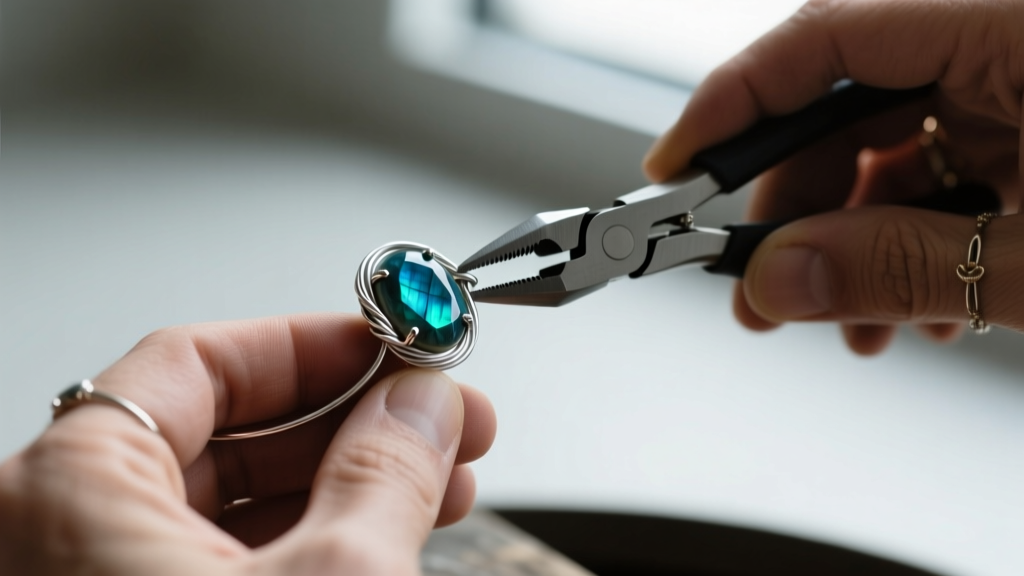
If you are designing or commissioning custom crystal pendants, the setting mechanics are paramount. Traditional prong settings require immense pressure to bend the metal over the stone's girdle, which will instantly crush brittle materials like moldavite or raw kyanite. Wire wrapping is the superior method, but only if the correct wire gauge and temper are utilized.
Wire temper refers to the metal's hardness. 'Dead Soft' wire bends effortlessly and work-hardens as you manipulate it, making it ideal for wrapping irregular, fragile raw stones. 'Half-Hard' wire offers structural rigidity and is best used for the base frames and bail loops that must support the weight of the pendant without warping.
For a standard raw crystal pendant, I recommend a structural frame of 20-gauge half-hard sterling silver or 14k gold-filled wire, paired with 24-gauge or 26-gauge dead-soft wire for the weaving and tension locks. The dead-soft weaving wire distributes pressure evenly across the stone's surface, avoiding the localized stress points that cause internal fractures. Never use full-hard wire for wrapping, as the lack of malleability will transfer kinetic shock directly into the crystal lattice.
Sourcing, Treatments, and Ethical Verification
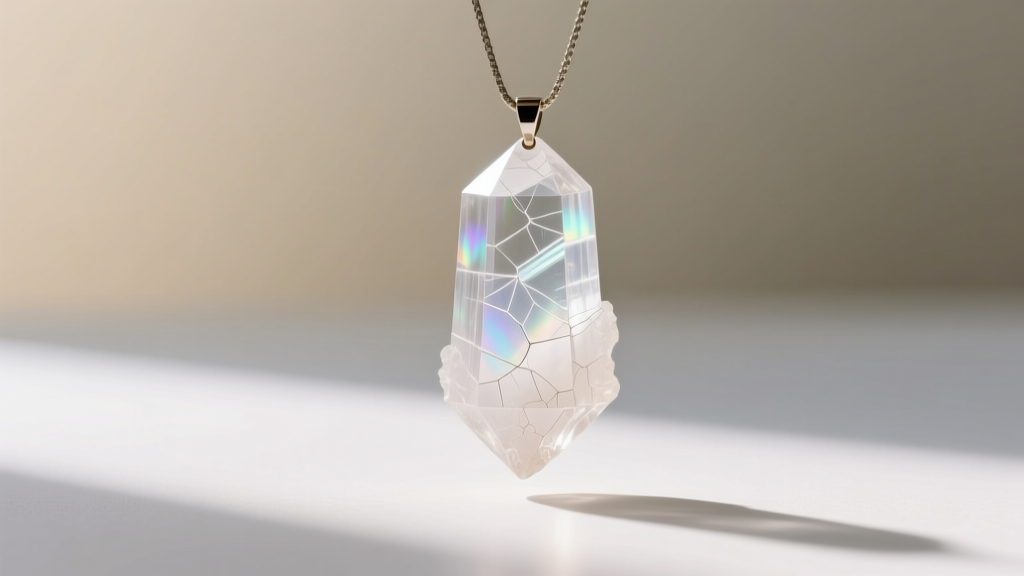
The market for crystal necklaces and meanings is unfortunately saturated with treated stones disguised as natural rarities. Understanding common lapidary treatments is essential for the informed collector.
Common Deceptive Treatments
- Irradiation: Smoky quartz is naturally formed when clear quartz is exposed to natural gamma radiation in the earth. However, much of the commercial 'smoky quartz' on the market is actually clear, low-grade quartz artificially irradiated in a lab to induce the brown/black color. According to the GIA Gem Encyclopedia, this treatment is generally stable but fundamentally alters the stone's natural geological history.
- Dyeing and Fracture Filling: Agate and howlite are highly porous and routinely dyed to mimic lapis lazuli or turquoise. Under a 10x jeweler's loupe, dye will concentrate in the microscopic fractures and crystal boundaries, appearing as spiderweb-like dark veins.
- Heat Treatment: Citrine is rarely found in nature. Over 90% of commercial citrine is actually amethyst that has been heat-treated to around 470°C, which alters the iron impurities and changes the color from purple to yellow-orange. While accepted in the gem trade, purists seeking the specific geological 'meaning' of natural citrine must request unheated specimens, which typically exhibit a paler, smokier yellow hue.
To verify the authenticity of high-value crystals like moldavite, consult the Mindat Mineral Database for specific gravity and refractive index benchmarks. Genuine moldavite contains distinctive 'schlieren' (wavy, worm-like internal gas bubbles) and lechatelierite inclusions (pure silica glass) that are nearly impossible for counterfeit manufacturers to replicate accurately in cast glass.
Conclusion: Building a Resilient Crystal Wardrobe
Aligning crystal necklaces and meanings with your lifestyle requires a pragmatic approach to mineralogy. If your daily routine involves high physical activity, restrict your necklaces to durable, inclusion-free quartz varieties (amethyst, citrine, clear quartz) or tough silicates like black tourmaline, set in protective bezels or low-profile wire wraps. Save the fragile, high-cleavage stones like selenite, fluorite, and raw labradorite for stationary meditation or occasional wear. By respecting the atomic architecture of these stones, you ensure that both their physical beauty and their historical symbolism endure for a lifetime.


