The Cursed Necklace Trend: Styling Dark Gothic & Antique Jewelry
Explore the cursed necklace trend blending dark academia and antique mourning jewelry. Learn to style oxidized metals, raw gems, and occult motifs.

The Anatomy of the “Cursed” Aesthetic: Beyond Minimalism
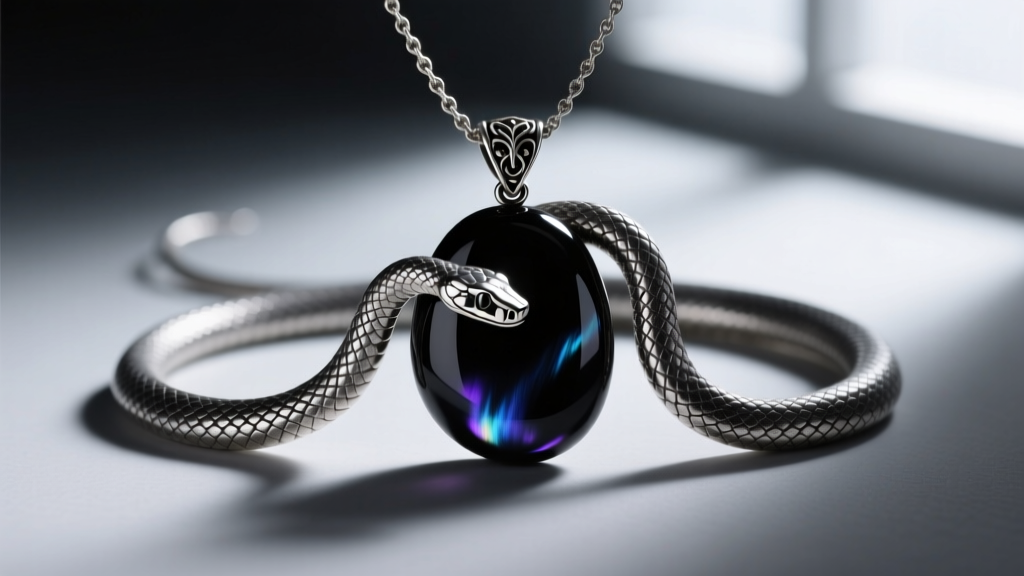
As we navigate the jewelry landscape of 2026, the dominant minimalist “clean girl” aesthetic has fractured, giving way to a rich, narrative-driven counter-movement: the cursed necklace trend. This is not about literal hexes or supernatural dangers. Instead, the term “cursed” has been adopted by the dark academia, witchcore, and gothic revival communities to describe pieces that feel burdened with history, heavy with lore, and visually anchored by occult or memento mori motifs. These are necklaces that look as though they were unearthed from a Victorian estate or pulled from a forgotten grimoire.
The hallmark of a cursed necklace is its visual weight and intentional imperfection. Unlike the high-polish, flawless gold chains of the early 2020s, these pieces rely on deep oxidation, raw or asymmetrical gemstones, and motifs like the ouroboros, weeping willows, urns, and anatomical skulls. The trend represents a shift toward jewelry as a talisman—an object meant to protect, ground, or tell a deeply personal, slightly macabre story.
Material Science: Oxidation, Jet, and Raw Talismans
To authentically curate a cursed necklace stack, you must understand the materials that define the genre. The foundation is almost exclusively oxidized silver. Artisans achieve this deep, blackened patina using liver of sulfur (potassium polysulfide). When applied to 925 sterling silver, it reacts with the copper alloy to create silver sulfide, a black compound that settles into the recesses of the metal. High-end silversmiths then hand-polish the high-relief areas, leaving the crevices pitch-black to create striking, antique-like contrast.
Gemstones in this trend eschew traditional faceted brilliance for raw, unpolished, or deeply saturated opaque stones. Whitby Jet, a fossilized Araucaria wood used extensively in Victorian mourning jewelry, remains the gold standard for dark talismans. However, because authentic antique jet is rare and fragile, modern artisans often turn to raw black obsidian (volcanic glass) or unpolished onyx. It is vital to understand the structural integrity of these stones before wearing them daily.
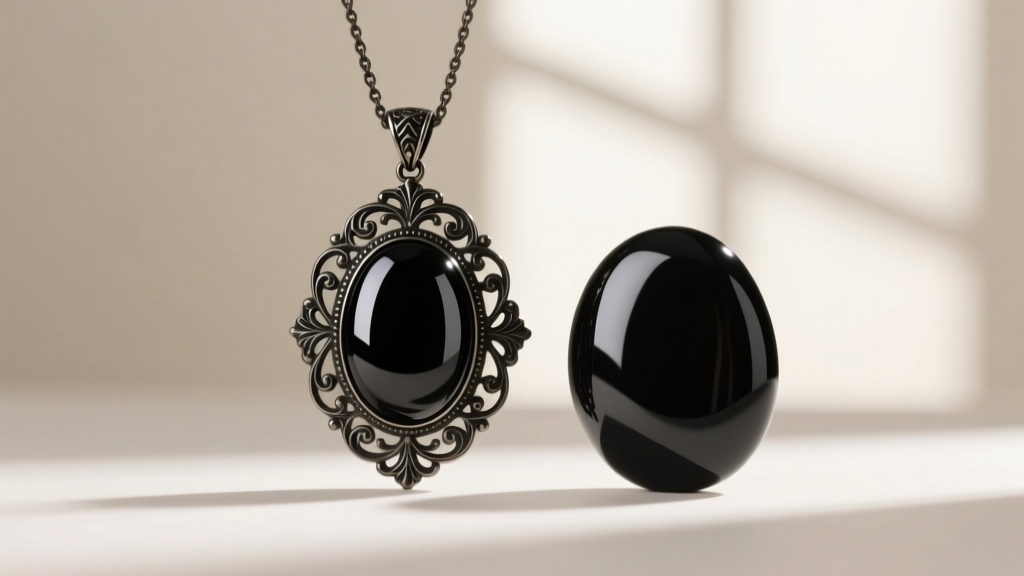
Talismanic Gemstone Durability & Lore Chart
| Stone | Mohs Hardness | Cleavage / Fracture | “Lore” Association | Care Level & Warnings |
|---|---|---|---|---|
| Whitby Jet | 2.5 - 4.0 | None (Conchoidal fracture) | Protection, grief processing, Victorian mourning | High. Keep away from heat, ultrasonic cleaners, and perfume. |
| Black Onyx | 7.0 | None | Grounding, warding off negative energy | Low. Highly durable, safe for daily wear and ultrasonic cleaning. |
| Raw Obsidian | 5.0 - 5.5 | Conchoidal (sharp edges) | Truth-seeking, psychic shielding, shadow work | Medium. Prone to chipping if struck against hard surfaces. |
| Moldavite | 5.5 | None | Rapid transformation, the “curse of change” | High. Extremely brittle; requires protective bezel settings. |
Source: Gemological Institute of America (GIA) gemstone hardness and care guidelines (GIA.edu).
Layering the Occult: Chain Gauges and Lengths
A single cursed necklace rarely achieves the desired aesthetic; the trend relies heavily on layered, asymmetrical stacks that mimic the accumulation of talismans over a lifetime. However, layering heavy, solid silver pendants requires an understanding of chain gauges and clasp mechanics to prevent catastrophic breakage.
- The Base (14” - 16”): Start with a 1.5mm to 2.0mm oxidized rope chain or a delicate snake chain. This sits at the collarbone and typically holds a lightweight motif, such as a small evil eye or a simple crescent moon. Use a standard 5mm spring ring clasp here.
- The Anchor (18” - 20”): Move to a 2.5mm to 3.0mm curb or Figaro chain. This length rests on the upper chest and supports medium-weight pendants like an ouroboros or a raw obsidian teardrop. Upgrade to a 10mm lobster clasp for security.
- The Statement (24” - 28”): The lowest layer requires a heavy 4.0mm to 6.0mm chain, such as a thick Cuban link or a heavy Figaro. This supports large, 30g+ memento mori pendants or elaborate reliquary lockets. Crucial: Never use a spring ring or small lobster clasp for this layer. The pendulum effect of a heavy pendant will snap a weak clasp. Use a heavy-duty 15mm lobster clasp or a reinforced toggle clasp.
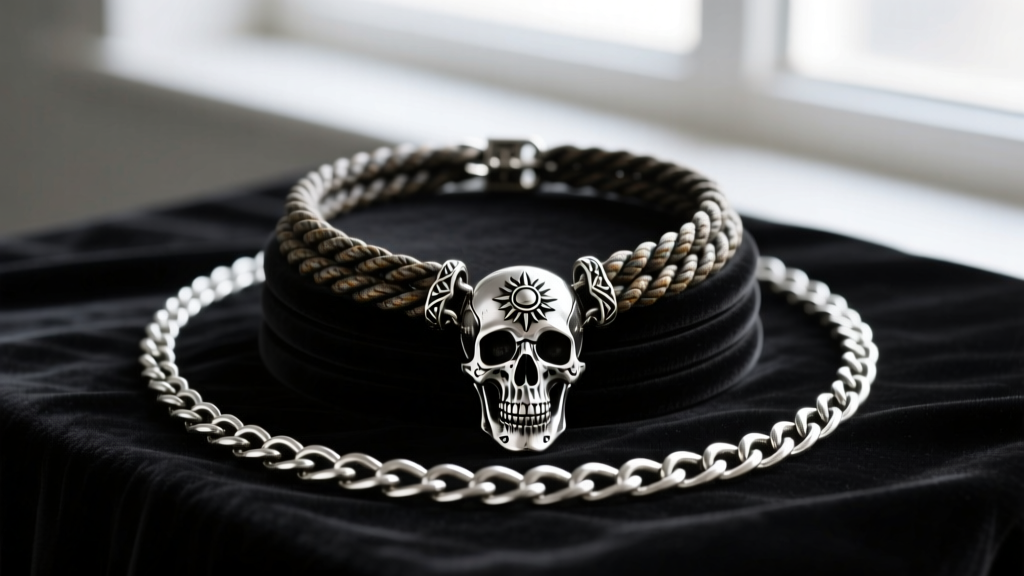
Sourcing Authenticity: Victorian Mourning vs. Modern Artisan
The market is currently flooded with mass-produced “gothic” jewelry made from zinc alloys and brass with thin electroplating. These pieces not only lack the tactile weight required for the trend, but they frequently cause contact dermatitis due to hidden nickel content. When building a curated archive of cursed necklaces, buyers generally fall into two distinct sourcing categories:
1. The Estate Hunter: Authentic Victorian Mourning Jewelry (1837–1901)
True antique mourning jewelry carries the ultimate “cursed” provenance, often featuring woven human hair, black enamel, and seed pearls (representing tears). According to the Victoria and Albert Museum, authentic pieces from this era will feature C-clasps, tube hinges, and lack modern safety catches. Genuine Whitby Jet will feel surprisingly warm and lightweight to the touch, unlike cold, heavy French Jet (which is actually black glass). Expect to pay between $400 and $2,000+ for authentic, hallmarked Victorian pendants and lockets.
2. The Modern Archivist: Artisan Silversmiths
For those who prefer structural integrity and modern wearability, small-batch artisan silversmiths are the best route. These creators cast in solid 925 sterling silver and hand-apply liver of sulfur oxidation. Look for maker’s marks and quality stamps. Pricing for modern artisan cursed necklaces typically ranges from $150 to $600, depending on the complexity of the lost-wax casting and the rarity of the raw gemstones used.
Preserving the Patina: Care for Oxidized Silver
The most common mistake new collectors make is treating oxidized silver like traditional bright silver. Never use liquid silver dip or ultrasonic cleaners on a cursed necklace. These chemical baths are designed to strip silver sulfide—the exact compound that creates the blackened, antique patina you paid for. Doing so will leave your piece looking flat, gray, and artificially bright.
To care for these pieces, simply wipe them with a soft, dry microfiber cloth after wearing to remove skin oils and environmental moisture. If the high-polish areas begin to tarnish, use a treated silver polishing cloth only on the raised surfaces, deliberately avoiding the blackened recesses to maintain the three-dimensional contrast.
The Psychology of the Lore
Why are we drawn to jewelry that feels haunted, cursed, or burdened? In an era dominated by algorithmic trends and disposable fast fashion, a “cursed” necklace offers a sense of permanence and narrative weight. It acts as a modern amulet. Whether you are wearing a raw moldavite pendant to invite chaotic transformation, or an antique mourning locket to feel connected to the passage of time, these pieces serve as intimate, wearable anchors in a rapidly shifting world. The curse is simply the story you choose to tell.


