How to Design and Style a Custom Name in Gold Necklace
Learn how to design, order, and style a custom name in gold necklace. Expert tips on karats, chain lengths, fonts, and layering techniques.

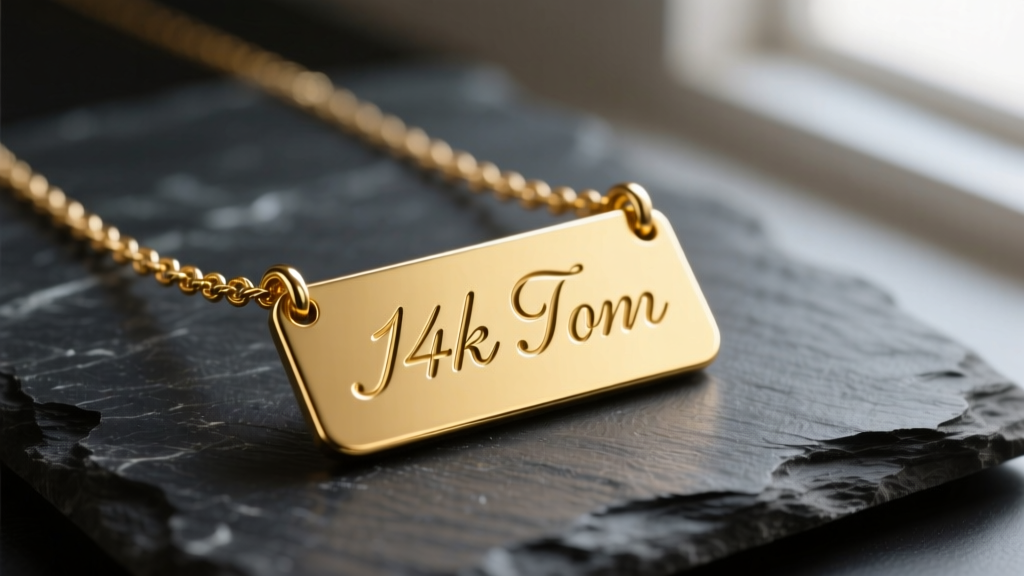
The nameplate necklace has transcended its mid-century roots and early-2000s pop culture moments to become a permanent staple in fine jewelry. However, commissioning a piece that feels both deeply personal and structurally sound requires more than just typing your name into a text box. When designing a custom name in gold necklace, you must navigate metal alloys, typographic proportions, and chain mechanics to ensure the piece lasts a lifetime.
This step-by-step guide breaks down the exact specifications, material grades, and styling frameworks you need to create a flawless, heirloom-quality nameplate.
Step 1: Selecting the Right Gold Karat and Color
The most critical decision in the design process is selecting the gold alloy. Pure 24k gold is entirely unsuitable for nameplates; it is far too soft and will warp under the tension of a chain or the weight of the letters. According to the Gemological Institute of America (GIA), alloying gold with metals like copper, silver, and zinc is essential for durability.
- 14k Gold (58.5% Pure): The industry standard for nameplates. It offers the perfect balance of tensile strength and rich color. The higher alloy content provides the rigidity needed to support delicate cursive tails and intricate script loops without bending.
- 18k Gold (75% Pure): Offers a deeper, more saturated yellow hue but is noticeably softer. If you choose 18k, you must opt for a thicker metal gauge and avoid elongated, sweeping script fonts that are prone to snagging and snapping.
For color, yellow gold remains the most traditional and legible choice. White gold (which requires rhodium plating that will eventually wear off on the high-friction edges of letters) and rose gold (which can sometimes reduce the contrast of the script against certain skin tones) are secondary options that require more maintenance.
Step 2: Choosing Typography and Script Proportions
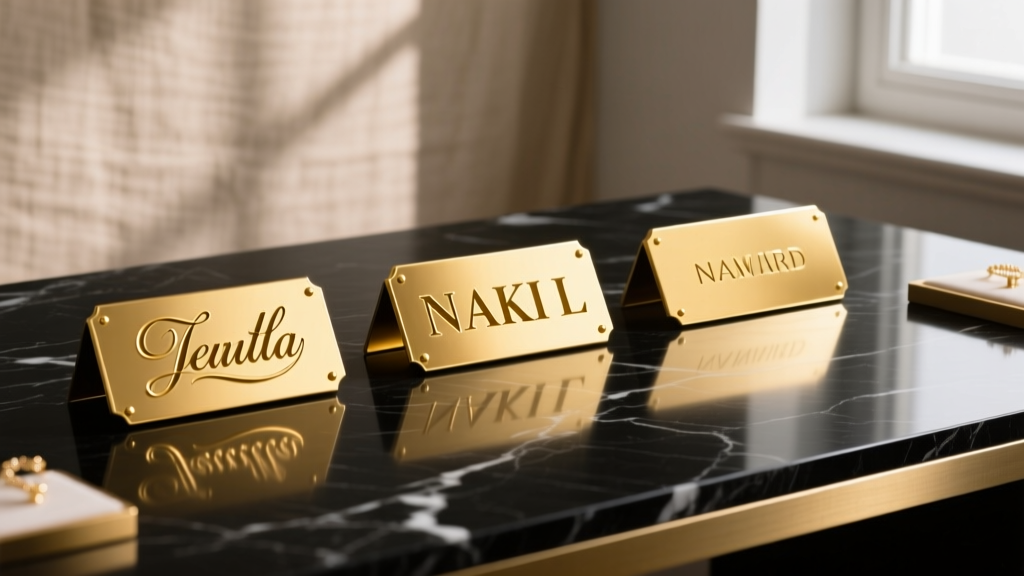
The typography dictates the structural vulnerability of your necklace. Jewelers typically categorize nameplate fonts into three distinct styles, each with specific engineering requirements.
Classic Cursive Script
Inspired by the iconic 'Carrie' necklace, cursive scripts feature interconnected letters and sweeping tails. Design Rule: Ensure the connecting loops between letters are at least 1.5mm thick. If the loops are too thin, the laser-cutting process can leave micro-fractures that snap during daily wear.
Block and Old English
These styles feature disconnected, bold letters. Because they lack the structural support of interconnected cursive loops, block letters require a thicker base plate or a hidden supporting bar beneath the text to prevent individual letters from warping or rotating upside down on the chain.
Modern Minimalist
Sans-serif, lowercase, and widely spaced letters offer a contemporary look. To maintain legibility, the metal depth should not exceed 1.2mm, keeping the piece lightweight and flush against the collarbone.
Step 3: Sizing, Dimensions, and Chain Selection
Proportion is everything. A nameplate that is too large will look costume-like, while one that is too small will be illegible. A standard nameplate height ranges from 5mm to 8mm for delicate aesthetics, and 10mm to 15mm for bold, statement pieces. The metal thickness (depth) should never be less than 1.2mm.
Equally important is the chain. The chain must support the weight of the gold plate without overpowering the delicate lettering. Below is a comparison of the most reliable chain styles for nameplates:
| Chain Style | Recommended Thickness | Durability | Best For |
|---|---|---|---|
| Cable Chain | 1.2mm - 1.5mm | High | Classic cursive scripts; lightweight plates |
| Box Chain | 1.5mm - 2.0mm | Very High | Block letters; heavier, longer names |
| Rope Chain | 1.5mm - 2.5mm | Moderate | Layering; vintage-inspired aesthetics |
| Figaro Chain | 2.0mm - 3.0mm | High | Streetwear styles; bold Old English fonts |
Expert Tip: Always specify a 16-inch chain with a 2-inch extender. This allows you to adjust the necklace to sit perfectly on the collarbone or slightly lower, depending on the neckline of your outfit.
Step 4: The Ordering Process and Quality Assurance
When submitting your design to a custom jeweler, do not rely solely on automated website renderings. Request a CAD (Computer-Aided Design) file or a high-resolution vector proof before casting.
Always verify that the jeweler uses a lobster clasp rather than a spring-ring clasp. Lobster clasps feature a solid internal spring mechanism that is significantly less likely to fail or catch on hair and clothing.
Upon receiving the piece, inspect the soldering points where the jump rings attach the nameplate to the chain. These joints should be smooth, seamless, and free of any dark oxidation or pitting. Additionally, check the back of the clasp and the jump ring for a '14K' or '585' hallmark, which guarantees the metal purity.
Step 5: Styling and Layering Your Nameplate
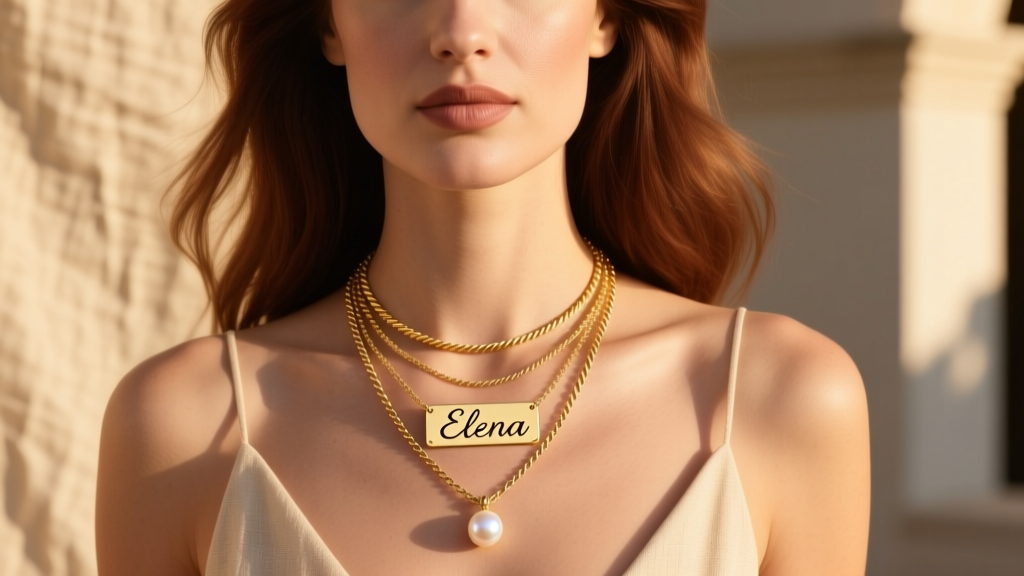
A name in gold necklace is a highly versatile anchor piece for layering. To create a cohesive, high-end stack, follow the 'Rule of Three' and maintain strict spatial separation.
- The Anchor (14-16 inches): Your custom nameplate sits closest to the neck. Keep it relatively short so the text remains legible and centered on the upper chest.
- The Complement (18 inches): Add a contrasting texture, such as a delicate rope chain or a chain featuring small, bezel-set diamond stations. This adds sparkle without competing with the solid gold script.
- The Pendant (20-22 inches): Finish the stack with a larger, singular focal point, such as a vintage coin pendant, a pearl drop, or a geometric gemstone. This draws the eye downward and creates a cascading visual effect.
Avoid layering your nameplate with other initial or letter charms, as this creates visual clutter and diminishes the impact of your custom nameplate.
Troubleshooting and Long-Term Care
Even the most meticulously crafted nameplates require specific maintenance. According to Jewelers of America, improper cleaning is the leading cause of damage to delicate gold jewelry.
Common Issues and Solutions
Issue: The script tail snaps.
Solution: Do not attempt to glue or use a standard jeweler's torch, which will melt the surrounding thin letters. Take the piece to a specialist who uses laser welding. Laser welders can fuse microscopic gold joints with pinpoint accuracy, leaving no visible seam.
Issue: The nameplate constantly flips upside down.
Solution: This happens when the center of gravity is off, or the chain is too thick and rigid. Have a jeweler add a tiny, transparent silicone o-ring to the jump ring, or switch to a softer, more fluid chain like a cable or snake chain that allows the plate to hang naturally.
Cleaning Protocols
Never use ultrasonic cleaners on nameplate necklaces. The high-frequency vibrations can easily fracture the thin connecting loops of cursive scripts. Instead, soak the necklace in a bowl of warm water with a few drops of mild dish soap for 10 minutes. Gently agitate the water, rinse thoroughly, and dry with a microfiber cloth. For stubborn tarnish in the crevices of the letters, use an extra-soft baby toothbrush, brushing strictly in the direction of the script to avoid bending the gold.


