Domino Necklace Value Guide: Are Diamond Pendants Worth It?
Evaluate the true cost of a diamond domino necklace in 2026. We break down gold weights, melee diamond grades, and custom vs. retail pricing.

The domino necklace has transcended its streetwear and hip-hop origins to become a staple in contemporary fine jewelry. Symbolizing luck, risk, and strategic gaming, the domino pendant offers a unique geometric canvas for jewelers. However, as the trend has matureed, the market has become saturated with everything from $40 brass knockoffs to $40,000 bespoke high-jewelry pieces. For the discerning buyer in 2026, separating intrinsic value from brand markup is critical. In this comprehensive budget and value assessment, we deconstruct the domino necklace to help you determine exactly what you should be paying for materials, craftsmanship, and design.
The Anatomy of a Fine Jewelry Domino Pendant
Before assessing value, you must understand the structural components that dictate the price of a domino necklace. A standard domino pendant typically measures between 20mm x 10mm (a subtle, everyday size) and 35mm x 17mm (a bold, statement piece). The value is anchored in three main areas:
- The Body (Base Metal): Whether cast in solid 14k gold, 18k gold, or platinum. Hollowed-out backs reduce gold weight and cost but compromise durability and long-term value.
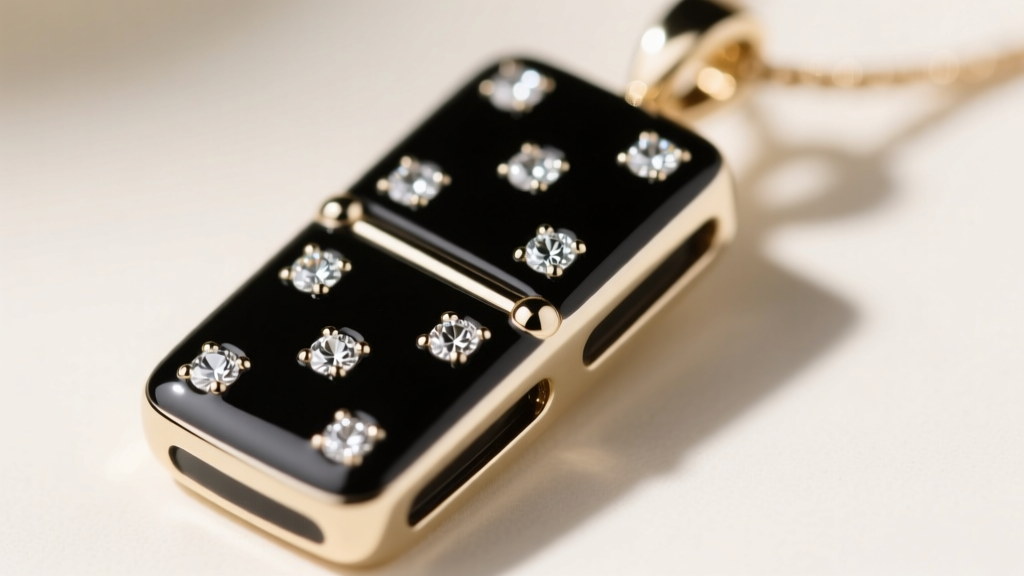
- The Dots (Pips): The iconic dots on a domino (such as the classic double-six, which features 14 dots) are either carved out, filled with enamel, or set with melee diamonds.
- The Bail and Hardware: The loop that connects the pendant to the chain. A hidden bail offers a seamless look, while a standard soldered bail is more utilitarian.
According to the Jewelers of America, transparency in metal weight and gemstone origin is the primary indicator of a reputable seller. When evaluating a domino pendant, always request the exact gram weight of the gold and the total carat weight (TCW) of the diamonds.
Price Breakdown: Custom vs. Designer vs. Mass Market
The pricing spectrum for a domino necklace is vast. Below is a 2026 market assessment categorizing the typical price tiers you will encounter, based on a standard 25mm x 12mm double-six domino design.
| Market Tier | Material Specifications | Estimated Price Range | Value Proposition |
|---|---|---|---|
| Fashion / Plated | Brass or Sterling Silver base, gold vermeil, cubic zirconia dots | $50 - $250 | Low intrinsic value; high risk of tarnishing and plating wear within 12 months. |
| Solid Gold (No Diamonds) | Solid 10k or 14k gold, carved or enameled dots | $450 - $950 | Excellent everyday value; retains melt value and resists tarnish. |
| Fine Jewelry (Diamond Pave) | Solid 14k/18k gold, 0.30ct - 0.80ct TCW natural or lab-grown melee diamonds | $1,200 - $3,800 | The sweet spot for luxury buyers; balances material cost with high-end aesthetics. |
| Designer / Bespoke VVS | 18k gold or Platinum, 1.00ct+ TCW VVS/VS clarity diamonds, vitreous enamel | $5,500 - $15,000+ | Premium pricing driven by brand prestige, master-level stone setting, and rarity. |
Material Grades and True Intrinsic Value
When you pay over $1,000 for a diamond domino necklace, you are primarily paying for the diamonds and the labor required to set them. Understanding how jewelers grade these specific materials will protect your budget.
The Melee Diamond Factor
The 'dots' on a diamond domino are typically set with melee diamonds—small stones usually weighing between 0.01 and 0.03 carats each. Because they are small, jewelers often use lower clarity grades (SI1 or SI2) since inclusions are invisible to the naked eye at this scale. However, color matters immensely. If the diamonds are set in white gold or platinum, insist on G or H color melee. If the jeweler uses J or K color melee, the dots will look yellowish against the white metal, severely diminishing the pendant's visual value. For authoritative grading standards, always refer to the Gemological Institute of America (GIA) guidelines on melee consistency.
The Enamel Variable: Cold vs. Vitreous
If you prefer a domino necklace with colored dots rather than diamonds, the type of enamel used drastically affects both the price and the longevity of the piece.
- Cold Enamel (Epoxy Resin): A liquid resin painted into the recesses and cured. It is inexpensive but prone to chipping, yellowing, and shrinking over time. Avoid paying fine jewelry prices for cold enamel.
- Vitreous Enamel (Kiln-Fired): Made from finely ground glass that is fused to the gold at temperatures exceeding 1,400°F. It is incredibly durable, scratch-resistant, and possesses a depth of color that resin cannot mimic. Vitreous enamel adds $200 to $500 to the manufacturing cost but ensures the piece becomes an heirloom.
Chain Pairing and Hidden Hardware Costs
A domino pendant is only half the equation; the chain you pair it with dictates the overall drape, durability, and final budget. The bail of a domino pendant is usually relatively small, meaning thick, heavy chains will not fit without custom modifications.
For a 25mm domino pendant, a 2.5mm to 4.0mm chain is optimal. A Cuban link chain offers a streetwear edge and provides immense tensile strength, making it ideal for heavier solid gold pendants. A Rope chain offers superior light refraction, complementing a diamond-set domino by adding secondary sparkle. When budgeting, allocate at least 30% of your total necklace budget to a high-quality chain. A $2,000 diamond domino suspended on a flimsy, hollow 10k chain is a structural failure waiting to happen.
Friction and Wear: A Troubleshooting Insight
A common failure mode with domino necklaces is bail wear. Because the domino is a flat, rectangular slab, it tends to flip and slide against the chest. This constant motion causes the chain to act like a saw against the inside of the bail. To mitigate this, ensure your jeweler uses a reinforced bail or a stainless steel/white gold inner lining if the pendant is crafted in softer 24k or high-karat 22k gold.
Resale Value and Investment Assessment
From a purely financial perspective, no diamond jewelry should be bought strictly as an investment. When you purchase a diamond domino necklace from a retail jeweler, you are paying for the design, the labor of the stone setter, and the retail overhead. If you attempt to sell it the next day, you will likely be offered only the 'melt value' of the gold and a fraction of the wholesale value of the melee diamonds.
The Value Rule of Thumb: Melee diamonds (under 0.10ct each) hold virtually no secondary market resale value. You are paying for the aesthetic, not the asset. Buy a domino necklace because you love the design and the cultural significance, not as a vehicle for wealth storage.
However, solid gold domino pendants without diamonds retain a much higher percentage of their purchase price upon resale, as their value is directly tethered to the daily spot price of gold. In the current 2026 precious metals market, solid gold pieces remain a reliable hedge against inflation compared to their diamond-encrusted counterparts.
Final Verdict: How to Budget for Your Domino Pendant
If your budget is under $500, focus on a solid 10k or 14k gold domino with carved or cold-enamel dots. Avoid gold-plated brass, as the skin acids will degrade the plating rapidly. If your budget allows for $1,500 to $3,000, you enter the sweet spot of fine jewelry: a solid 14k gold base featuring G-H color, SI1 clarity melee diamonds set in a double-six configuration. Always demand a detailed receipt specifying the exact gold weight and diamond TCW, ensuring your domino necklace is not just a game of chance, but a calculated acquisition of enduring style.


