Diamond Necklace Marie Antoinette: Value & Appraisal
Explore the budget and value assessment of the infamous diamond necklace Marie Antoinette never wore, analyzing its 18th-century cost and modern appraisal.

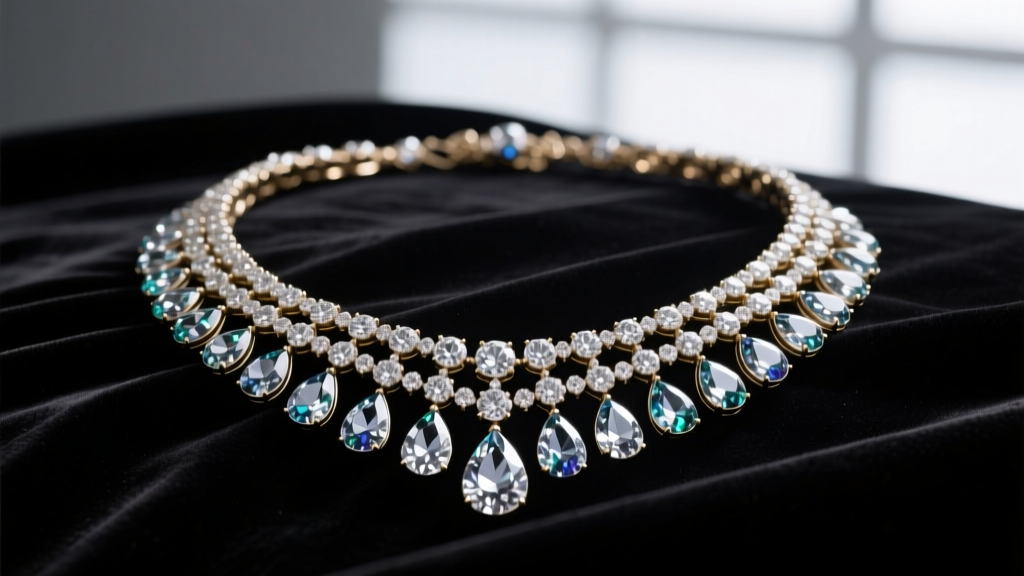
The Infamous Commission: Original Cost and Carat Weight
When historians and gemologists discuss the diamond necklace Marie Antoinette was falsely accused of acquiring, they are referencing one of the most spectacular and financially ruinous pieces of jewelry ever conceived. Commissioned by Louis XV for his mistress Madame du Barry, the piece was crafted by Parisian jewelers Charles Auguste Böhmer and Paul Bassange. However, the king died before payment was made, leaving the jewelers with an astronomical debt and a masterpiece that would eventually trigger the 'Affair of the Diamond Necklace'—a scandal that severely damaged the Queen's reputation and accelerated the French Revolution.
From a budget and value assessment perspective, the original invoice was staggering. Böhmer and Bassange priced the piece at 1.6 million livres. To contextualize this 18th-century budget, a skilled laborer in Paris at the time earned roughly 300 to 500 livres per year. The necklace's cost was equivalent to the lifetime earnings of over 3,000 workers, or roughly the annual operating budget of a small French province. The jewelers attempted to sell it to Marie Antoinette on an installment plan of 400,000 livres every six months over two years, a payment structure that ultimately made it vulnerable to the elaborate fraud orchestrated by Jeanne de Valois-Saint-Rémy.
Gemological Breakdown: Deconstructing the 2,800-Carat Masterpiece
To accurately appraise a historical piece, we must look past the scandal and examine the gemological architecture. According to archival records from the Britannica historical archives, the necklace was a marvel of pre-industrial lapidary work. It was not a single delicate chain, but a massive, multi-strand collar featuring festoons, tassels, and a central three-row fringe.
Unlike modern high jewelry, which relies heavily on the standardized round brilliant cut to maximize light return, the Böhmer-Bassange necklace utilized a mixture of rose cuts, table cuts, and early cushion-shaped old mine cuts. The Gemological Institute of America (GIA) notes that 18th-century diamond cutting prioritized carat weight retention over optical brilliance, meaning the stones were cut to follow the natural octahedral shape of the rough diamond.
| Metric | Historical Specification | Modern High-Jewelry Equivalent |
|---|---|---|
| Total Carat Weight | ~2,800 Carats | Rarely exceeds 500-800 carats in modern collars |
| Stone Count | 647 Individual Diamonds | Varies, but large stones are preferred over high counts |
| Primary Cut | Rose Cut & Old Mine Cut | Modern Round Brilliant & Pear Modified Brilliant |
| Setting Material | Silver with Gold Backing | Platinum or 18k White Gold |
| Original Price | 1.6 Million Livres (1772) | $15M - $25M (Base Material Value) |
A crucial detail for antique jewelry collectors is the metallurgy of the setting. The diamonds were set in silver to enhance their perceived whiteness—a common practice before the advent of rhodium plating and white gold. However, because silver tarnishes and stains the skin black upon contact with sweat, the reverse of the settings were backed with a thin wash of yellow gold. This bi-metal construction is a primary authentication marker for appraisers evaluating surviving 18th-century French court jewelry today.
Modern Appraisal: What Would It Cost in Today's Market?
Because the necklace was dismantled and the stones smuggled to London to be sold off individually by the conspirators, the intact piece no longer exists. But as a thought experiment in value assessment, what would the diamond necklace Marie Antoinette was meant to wear fetch at a Sotheby's or Christie's auction in 2026?
Base Material Value vs. Provenance Multiplier
If we assess the 2,800 carats purely on the modern wholesale diamond market, assuming an average quality of G-H color and VS clarity (typical for top-tier historical stones that have been recut or preserved), the base material value would sit between $35 million and $55 million. Antique rose cuts currently trade at a slight discount to modern brilliants due to their lower scintillation, though they command a premium among purist collectors.
However, high-jewelry valuation is rarely about raw materials; it is about provenance. We can look to the 2018 Sotheby's Geneva auction, where a single natural pearl and diamond pendant that actually belonged to Marie Antoinette sold for $36.1 million. That pendant contained less than 10 carats of diamond and a modestly sized pearl. The 'Marie Antoinette Provenance Multiplier' effectively inflated the value by over 1,000% above its intrinsic gemological worth.
If the intact 2,800-carat diamond necklace had survived and crossed the auction block in 2026, the intersection of its massive carat weight, its direct link to the catalyst of the French Revolution, and its status as a legendary 'lost' treasure would easily shatter all jewelry auction records. Conservative appraisals place its hypothetical hammer price between $150 million and $250 million, rivaling the GDP of small island nations.
Investing in High-Jewelry Necklaces: A Buyer's Framework
While few collectors have the budget for a royal French commission, the principles used to assess the Böhmer-Bassange necklace apply directly to modern high-jewelry investments. When evaluating luxury diamond collars and statement necklaces, professional appraisers use a strict framework that separates emotional pricing from tangible asset value.
- The 20% Rule of Provenance: A documented history of royal or celebrity ownership typically adds a 20% to 40% premium to the base auction estimate. However, this premium is highly volatile and depends on the current cultural relevance of the historical figure.
- Metallurgical Integrity: For antique pieces, the original setting is paramount. If a historical necklace has been remounted into modern platinum, it loses up to 30% of its antique collector value, even if the diamonds remain untouched.
- Carat Weight Distribution: A 100-carat necklace featuring one 50-carat center stone and 50 carats of melee is vastly more valuable than a 100-carat necklace comprised of 500 tiny 0.20-carat stones. Value scales exponentially with individual stone size, not just aggregate weight.
- Fluorescence and Milkiness: In antique diamonds, strong blue fluorescence was sometimes sought after to make lower-color stones appear whiter in candlelight. Today, strong fluorescence in D-F color stones can result in a 10% to 15% discount due to the risk of a 'milky' appearance in UV-heavy environments.
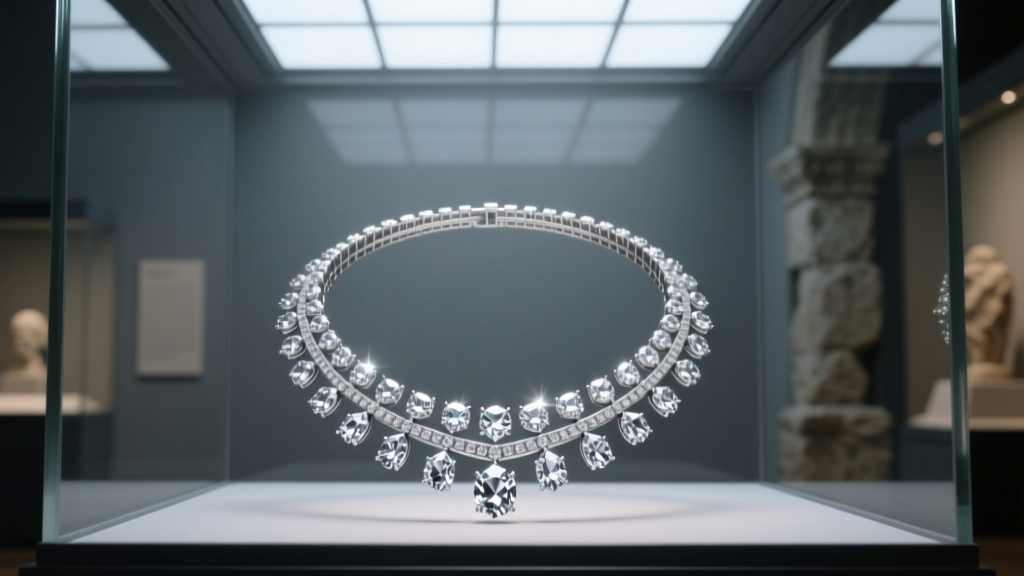
Lessons for the Modern Collector
The tragedy of Böhmer and Bassange serves as a brutal lesson in liquidity and market demand. The jewelers bankrupted themselves by creating a piece so expensive that only a monarch could afford it, yet they failed to secure a binding contract before completion. In today's high-jewelry market, bespoke commissions of this scale are heavily structured with non-refundable deposits and milestone payments to protect the artisans.
For the modern investor allocating capital to investment-grade diamond necklaces, the takeaway is clear: provenance and historical documentation are just as critical as the 4Cs. A 50-carat diamond collar with a verifiable paper trail linking it to a significant historical event will consistently outperform a 100-carat collar with no history, especially as synthetic diamonds continue to compress the baseline pricing of modern, unprovenanced stones. Understanding the intersection of history, gemology, and market psychology is the only way to accurately assess the true value of the world's most legendary jewels.


