Anatomy of an Eclipse Necklace: Gemology, Metals & Mechanics
Explore the technical anatomy of an eclipse necklace. Learn about half-moon gem cuts, overlapping metal solder joints, and chain pairing mechanics.

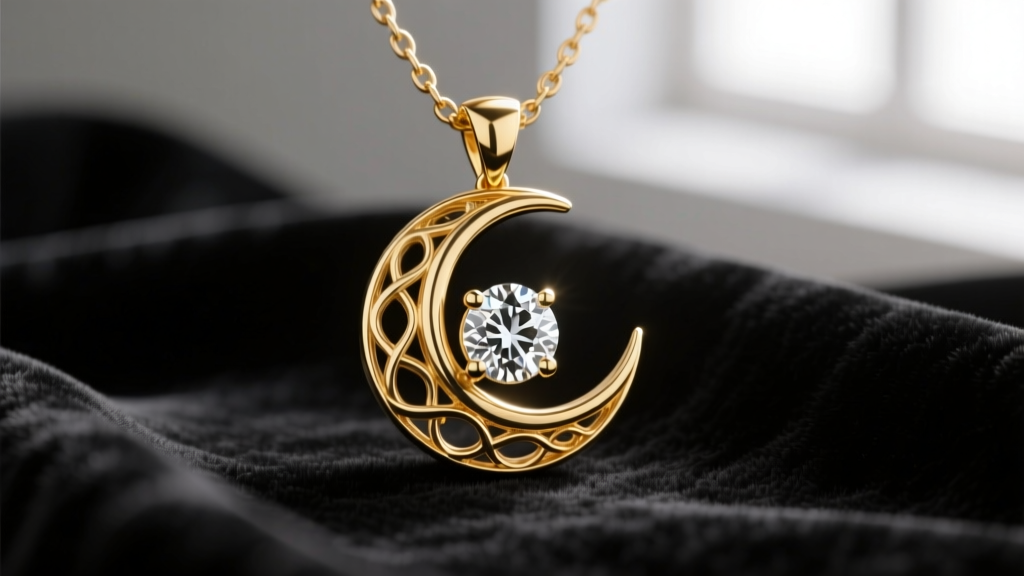
The Geometric Tension of the Eclipse Motif
The eclipse necklace is far more than a passing celestial trend; it is a rigorous exercise in asymmetrical balance and geometric tension. In fine jewelry, the 'eclipse' motif typically manifests in two distinct ways: the gemological pairing of a half-moon cut stone overlapping a round brilliant, or the metallurgical overlapping of two distinct metallic discs or domes. Both iterations require advanced engineering to ensure structural integrity, optical symmetry, and proper kinetic movement when worn. This deep dive explores the precise manufacturing tolerances, material science, and mechanical considerations that separate a master-crafted eclipse pendant from a mass-produced novelty.
Gemological Anatomy: The Half-Moon and Round Brilliant Pairing
When an eclipse necklace features diamonds or colored gemstones, the design relies heavily on the half-moon cut. While often relegated to the role of side-stones in three-stone engagement rings, the half-moon takes center stage in an eclipse pendant. According to the Gemological Institute of America (GIA), fancy shapes require specific facet arrangements to maximize light return. A half-moon is essentially a round brilliant cleaved along its diameter, but simply cutting a round stone in half yields poor optical performance due to the disruption of the pavilion's radial symmetry.
Master cutters must re-engineer the pavilion main facets on the straight edge of the half-moon to prevent light leakage. In a high-end eclipse necklace, the straight edge of the half-moon must sit perfectly flush against the girdle or bezel of the adjacent round brilliant. The gap tolerance between the two stones must not exceed 0.05 millimeters. Any wider, and the shadow line breaks the visual illusion of an eclipse; any tighter, and thermal expansion or minor impacts could cause the girdles to chip against one another.
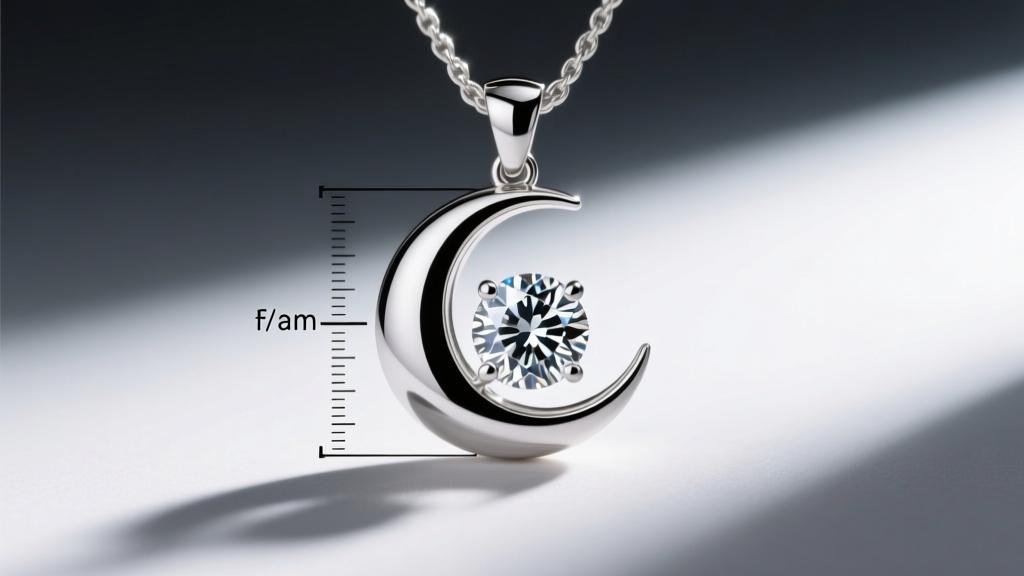
Cut Tolerances and Optical Symmetry
Matching the color and clarity of a half-moon to a round brilliant is notoriously difficult because the light paths differ. The half-moon tends to face up slightly darker due to its truncated pavilion. Therefore, expert bench jewelers will typically select a half-moon that is one color grade higher than the round brilliant to achieve visual parity.
| Parameter | Round Brilliant | Half-Moon | Eclipse Match Tolerance |
|---|---|---|---|
| Table Percentage | 54% - 57% | 58% - 62% | Visual face-up parity |
| Girdle Thickness | Thin to Slightly Thick | Thin to Slightly Thick | Exact match (±0.02mm) |
| Pavilion Angle | 40.6° - 41.0° | 41.2° - 41.8° (Adjusted) | Compensated for light leak |
| Color Grade | Base Grade (e.g., G) | +1 Grade (e.g., F) | Visual face-up matching |
Metallurgy and Structural Soldering
For metal-only eclipse necklaces—often featuring a smaller, textured disc overlapping a larger, high-polish disc—the primary failure mode is joint fatigue. The overlapping area is subjected to continuous torsional stress as the pendant moves against the wearer's chest. If traditional torch soldering is used with standard hard solder, the heat-affected zone (HAZ) can anneal the surrounding metal, softening it and making it prone to warping or tearing at the bail attachment point.
Modern manufacturing of luxury eclipse pendants relies heavily on Nd:YAG (Neodymium-doped Yttrium Aluminum Garnet) laser welding. Laser welding allows the jeweler to fuse the overlapping 14k or 18k gold discs with a microscopic, high-intensity beam. This creates a joint that is often stronger than the parent metal itself, with a heat-affected zone of less than 0.2 millimeters. This preserves the work-hardened temper of the surrounding discs, ensuring the pendant maintains its structural rigidity over decades of wear. Resources like Jewelers of America frequently highlight laser welding as the standard for high-precision, multi-layered jewelry assembly.
Oxidation and Galvanic Corrosion Risks
If the eclipse design incorporates mixed metals—such as an oxidized sterling silver moon overlapping a 14k yellow gold sun—bench jewelers must be wary of galvanic corrosion. When two dissimilar metals are in direct physical contact in the presence of an electrolyte (like human sweat or high humidity), the less noble metal (silver) will corrode at an accelerated rate. To prevent this, expert fabricators will apply a microscopic dielectric barrier, such as a clear nano-ceramic coating or a specialized jeweler's epoxy, at the exact point of overlap before final laser tacking.
Bail Engineering and Center of Gravity
The most common design flaw in poorly engineered eclipse necklaces is the failure to account for the asymmetrical center of gravity. Because the overlapping elements (whether stones or metal discs) are offset, the pendant is inherently top-heavy on one side. If a standard, centered bail is soldered to the back, the pendant will perpetually list to the heavier side, sliding along the chain and failing to sit flat against the sternum.

The Offset Articulated Bail
To counteract this, master jewelers utilize an offset, articulated hidden bail. By calculating the specific gravity and exact mass of the overlapping components, the bail is positioned off-center on the reverse side of the primary disc. Furthermore, the bail is often hinged (articulated), allowing the pendant to pivot independently of the chain. This ensures that gravity naturally pulls the heavier side down, while the chain remains perfectly centered on the wearer's neck. For heavy gemstone eclipse pendants exceeding 4.0 carats total weight, a reinforced 'slide' bail with an internal Teflon or 18k gold sleeve is used to reduce friction and prevent premature wear on the chain's jump ring.
Maintenance and Ultrasonic Risks
Cleaning an eclipse necklace requires specific protocols, particularly for gemstone iterations. The microscopic seam where the half-moon meets the round brilliant is a trap for skin oils, lotions, and environmental dust. While ultrasonic cleaners are standard for diamond jewelry, they pose a severe risk to eclipse pendants if the bezel or prong settings are not perfectly burnished. The high-frequency cavitation bubbles can penetrate the sub-millimeter gap between the stones, potentially loosening the setting adhesive or vibrating the stones against each other, leading to girdle abrasion.
Instead, professional maintenance should involve steam cleaning combined with a soft-bristled brush and a mild, non-ionic surfactant. For metal-only eclipse designs with deep overlapping crevices, a wooden orangewood stick is preferred over metal tweezers or picks to remove debris without scratching the high-polish undercarriage of the overlapping discs. By understanding the precise mechanical and gemological nuances of the eclipse motif, collectors and wearers can ensure their pieces remain structurally sound and optically brilliant for generations.


