Expert Guide to Selecting an Emerald Baguette Necklace
Discover the technical nuances of buying an emerald baguette necklace. Learn about step-cut facets, clarity grades, settings, and chain pairings.

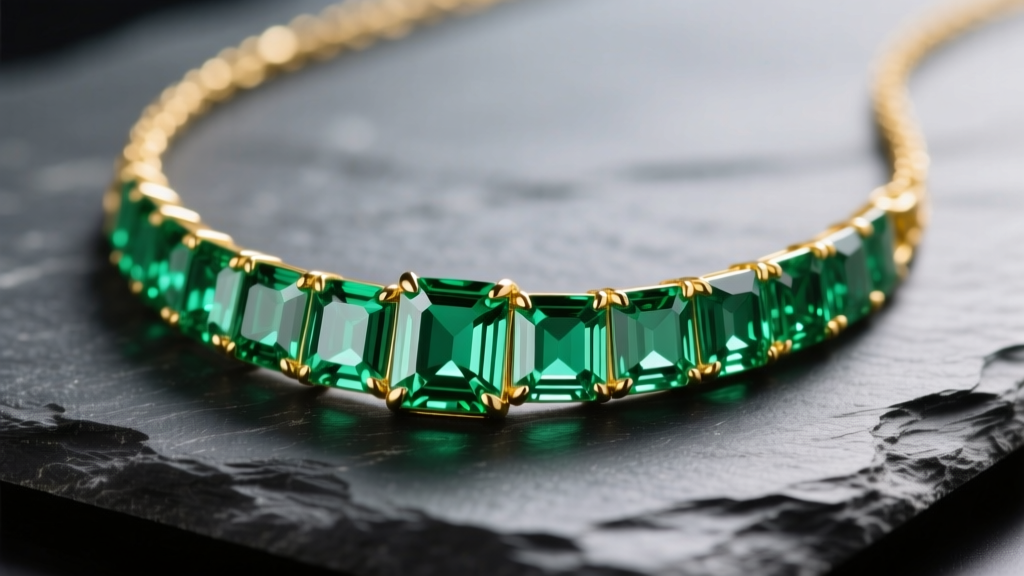
The Gemological Profile of the Baguette Cut
When evaluating an emerald baguette necklace, understanding the precise geometry of the baguette cut is paramount. Unlike brilliant cuts that rely on 57 or 58 facets to scatter light into fiery flashes, the baguette is a step cut. Typically featuring only 14 facets arranged in parallel rows, this cut creates a 'hall of mirrors' effect. It emphasizes the gemstone's clarity, color saturation, and crystalline transparency rather than its sparkle.
Length-to-Width Ratios and Tapered Variations
The classic straight baguette maintains a length-to-width (L/W) ratio between 1.5:1 and 2.5:1. Ratios exceeding 3:1 are generally classified as bullet or long baguette cuts. In high-end emerald baguette necklaces, you will also frequently encounter tapered baguettes. These stones narrow at one end, creating a trapezoidal silhouette that is heavily utilized in Art Deco revival pieces and geometric pendant halos. The precision of the taper's symmetry is a primary indicator of the lapidary's skill; asymmetrical tapers will cause visible light leakage in the finished necklace.

Evaluating Emerald Quality in Step Cuts
Because step cuts lack the light-dispersing brilliance of round cuts, they act as a window directly into the stone's internal characteristics. According to GIA's Emerald Quality Factors, emeralds are classified as Type III gemstones, meaning they are almost always included. However, the baguette cut is entirely unforgiving of heavy inclusions.
- Color Saturation: The most prized emeralds exhibit a vivid, deeply saturated green with a medium-dark tone (GIA tone 5-6). In a baguette cut, the large, open table facet requires intense color saturation; pale stones will look washed out and glassy.
- Clarity and Jardin: While the 'jardin' (internal inclusions) is accepted in emeralds, a baguette cut requires a relatively clean table. Inclusions that break the surface or disrupt the parallel step facets will destroy the mirror effect and compromise the stone's structural integrity.
- Origin Markers: Colombian emeralds (specifically from the Muzo and Chivor mines) often feature a warm, blue-green undertone that excels in step cuts. Zambian emeralds tend to be cooler and more bluish, offering a highly modern aesthetic when set in platinum or white gold.
The Critical Role of Treatments and Durability
Over 90% of the emeralds on the market undergo clarity enhancement. Because the baguette cut's large table makes internal fractures highly visible, lapidaries frequently treat the stones to improve their apparent clarity. Understanding these treatments is vital for the long-term care of your necklace.
| Treatment Type | Durability & Stability | Market Value Impact |
|---|---|---|
| None (No Oil) | Highly stable; requires no special maintenance. | Commands a massive premium (often 5x-10x oiled equivalents). |
| Minor Cedar Oil | Moderate; can dry out over years; heat sensitive. | Industry standard; minor impact on value if disclosed. |
| Moderate/Heavy Oil | Low; oil can leak or attract dirt; requires re-oiling. | Significantly reduces value; requires strict care. |
| Resin/Polymer (Opticon) | High stability but difficult to remove; alters refractive index. | Heavily penalized in the collector market; acceptable in commercial jewelry. |
Never subject an emerald baguette necklace to ultrasonic or steam cleaning. The high-frequency vibrations will shatter the stone along its natural fracture lines, and the heat will boil out the cedar oil, leaving the emerald cloudy and heavily fractured.
Setting Architectures for Vulnerable Corners
Emeralds rank 7.5 to 8 on the Mohs scale of hardness, but their toughness is notably poor due to internal inclusions. The sharp 90-degree corners of a straight baguette are the most vulnerable points on the stone. A single hard impact against a metal surface can chip the corner entirely.

When selecting your necklace, scrutinize the setting architecture:
- V-Prong Settings: The gold standard for baguettes. V-prongs wrap around the sharp 90-degree corners, encasing the weakest points in metal while leaving the step facets exposed to light.
- Full Bezel: Offers maximum protection by wrapping the entire perimeter of the stone in metal. However, a bezel will block light from entering the crown edges, slightly darkening the emerald's overall appearance.
- Channel Settings: Often used for baguette accents on the necklace bail or chain links. Ensure the channel walls are perfectly flush; any gap will allow the baguette to rattle and eventually fracture against the metal.
Chain Metallurgy and Pendant Pairing
The metal alloy and chain style dictate both the aesthetic and the physical safety of the pendant. For emerald baguette necklaces, 18k yellow gold remains the premier choice among gemologists. The warm, rich yellow of the gold provides a complementary color contrast that enhances the green saturation of the emerald. Conversely, 18k white gold or platinum offers a stark, icy contrast that highlights the bluish undertones of Zambian stones.
Regarding chain selection, the weight of the baguette pendant requires a structurally sound chain. Box chains and Wheat (Spiga) chains are highly recommended due to their interlocking link structures, which distribute the pendant's weight evenly and resist kinking. Avoid snake chains entirely; their continuous tubular structure is prone to permanent kinking, and the rigid bending can place torsional stress on the pendant's bail, eventually snapping the solder joint.
Pricing Matrices and Market Value
Pricing an emerald baguette necklace requires analyzing the yield loss during the cutting process. Cutting a rectangular baguette from a hexagonal or irregular emerald crystal results in significant rough material waste. Consequently, large, center-stone baguettes (over 3.00 carats) with high clarity command a steep premium per carat compared to standard emerald cuts. As detailed in the GIA's Emerald Description, the combination of high color saturation, minimal visible jardin, and precise step-cut symmetry places a baguette emerald in the upper echelon of collector-grade jewelry. Expect to pay between $4,500 to $12,000 per carat for fine-quality, minor-oiled Colombian baguettes, while untreated specimens easily exceed $25,000 per carat at auction.


