EMF Necklace Protection: Material Science and Style
Explore the real material science behind EMF necklace protection trends. We analyze shungite, orgonite, and copper properties for informed jewelry choices.

The Wellness Trend Meets Material Science
The contemporary jewelry market is currently saturated with consumer interest in emf necklace protection. As individuals seek ways to mitigate their daily exposure to electromagnetic fields (EMF) from Wi-Fi routers, smartphones, and dense urban infrastructure, a niche sector of the jewelry industry has responded with pendants crafted from shungite, orgonite, and conductive metals. However, as material scientists and jewelry experts, we must separate marketing pseudoscience from genuine geological and metallurgical value. While a localized pendant cannot alter the physics of ambient radiation, the materials utilized in these trending pieces possess fascinating physical, chemical, and aesthetic properties that make them worthy of serious jewelry design.
The Physics of EMF and Jewelry: Separating Fact from Fiction
To understand the material appeal of these necklaces, we must first address the physics of electromagnetic fields. According to the World Health Organization (WHO), everyday electronic devices emit non-ionizing radiation, which lacks the energy to break chemical bonds or directly damage DNA. The primary mechanism for blocking or redirecting electromagnetic waves is a Faraday cage—an enclosure made of conductive material that completely surrounds the object being protected.
A necklace pendant, by definition, does not enclose the human body or the brain. Therefore, claims that a single piece of shungite or a copper coil pendant can 'block' or 'neutralize' ambient 5G or Wi-Fi signals defy the inverse-square law of radiation and basic electromagnetic theory. The Environmental Protection Agency (EPA) similarly notes that non-ionizing radiation from consumer electronics is generally considered safe at standard exposure levels. Yet, dismissing these necklaces entirely ignores the profound material beauty of carbon allotropes, mixed-media resins, and highly conductive metals. When purchased for their geological rarity and metallurgical properties rather than pseudoscientific health claims, these materials offer incredible styling opportunities.
Material Breakdown: Properties of Popular 'Protection' Stones & Metals
The appeal of EMF-themed jewelry lies heavily in the unique physical characteristics of its core materials. Here is a deep dive into the material science of the most popular components.
Shungite (The Carbon Allotrope)
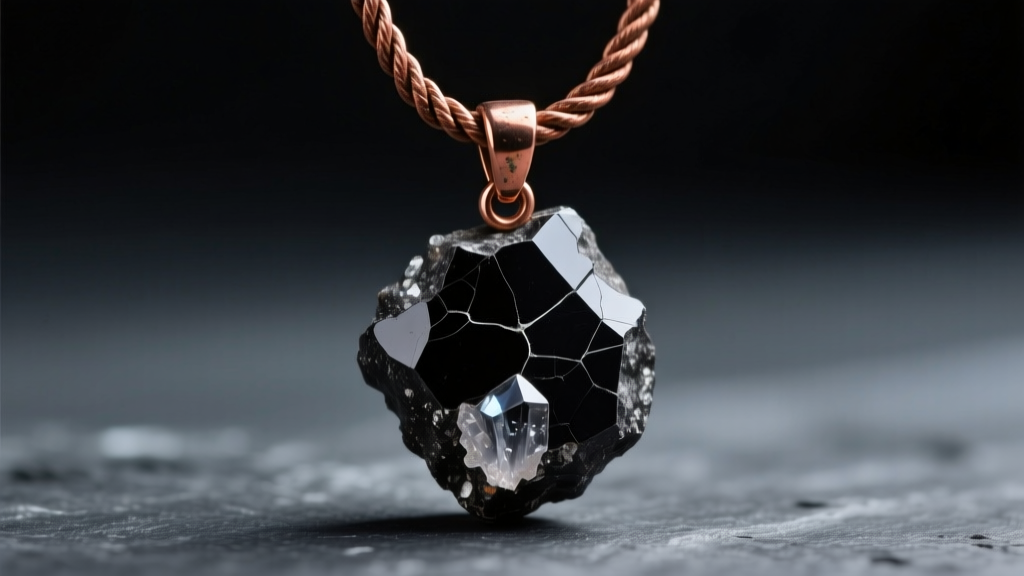
Shungite is a rare, black, lustrous mineraloid composed primarily of carbon, found almost exclusively in the Karelia region of Russia. It is famous in materials science for containing fullerenes (C60), a unique molecular structure of carbon that has applications in nanotechnology and advanced materials engineering.
- Type 1 (Elite/Noble): Contains up to 98% carbon. It is highly brittle, lightweight, and possesses a metallic luster. It is rarely tumbled because it fractures easily, meaning most Elite shungite pendants are raw, geometric chips wrapped in wire or capped with metal.
- Type 2 (Black): Contains 30% to 50% carbon mixed with silicate minerals. It is harder and more durable, allowing it to be cut into smooth cabochons or faceted beads.
- Wearability & Care: Shungite ranks between 3.5 and 5.5 on the Mohs hardness scale. It is notorious for leaving a black carbon residue on skin and clothing when unsealed. High-quality jewelers will tumble-polish Type 2 shungite and seal it with a micro-crystalline wax to prevent carbon transfer while maintaining its matte, charcoal-grey aesthetic.
Orgonite (The Resin-Metal Matrix)
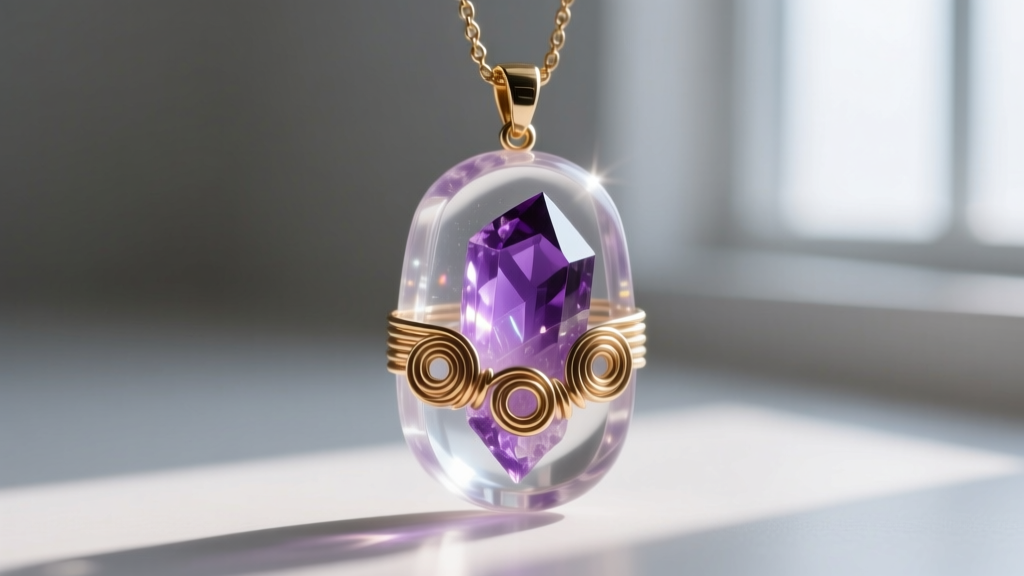
Orgonite is not a naturally occurring mineral, but rather a synthetic composite material. It is created by suspending metal shavings (typically brass, copper, or aluminum) and quartz crystals in a polymer resin matrix. From a materials science perspective, orgonite is a particulate-reinforced composite.
- Curing & Off-Gassing: The creation of orgonite involves an exothermic (heat-releasing) chemical reaction. If the resin is poured too thickly or the catalyst ratio is incorrect, the internal heat can fracture the embedded quartz or cause the piece to warp. Furthermore, poorly cured polyester resins can off-gas volatile organic compounds (VOCs) for weeks, causing skin irritation. Buyers should seek pieces made with fully cured, UV-stabilized epoxy resin.
- Durability: The Mohs hardness of orgonite is dictated by its resin base, typically ranking around 2.0 to 3.0. It is highly susceptible to scratching from everyday wear and will yellow over time if exposed to direct sunlight without UV inhibitors.
Copper & Silver (Conductive Metals)
Metals like copper and silver are frequently used in EMF-themed jewelry due to their high electrical conductivity. While wearing a copper ring does not ground your body's electrical system in any medically significant way, the metallurgical properties of these metals are undeniable.
- Copper: Copper is the baseline for electrical conductivity (100% IACS). In jewelry, it is prized for its warm, salmon-pink hue. However, copper reacts readily with oxygen, moisture, and the acids in human sweat to form copper carbonate—the familiar green patina that stains the skin. To prevent this, copper pendants are often coated with a clear lacquer or intentionally oxidized to a dark brown and sealed.
- Sterling Silver: Composed of 92.5% silver and 7.5% copper, sterling silver offers brilliant thermal and electrical conductivity. It is highly malleable, making it ideal for intricate wire-wrapping around raw shungite stones. Its primary vulnerability is tarnishing (silver sulfide formation) when exposed to sulfur compounds in the air.
Comparative Matrix: Durability, Care, and Wearability
When selecting a necklace based on these trending materials, it is crucial to understand how they will withstand daily wear. The table below outlines the physical properties and maintenance requirements of each material.
| Material | Mohs Hardness | Oxidation / Tarnish | Skin Contact Reaction | Primary Vulnerability |
|---|---|---|---|---|
| Type 1 Shungite | 3.5 - 4.0 | None (Inert Carbon) | May leave black carbon dust | High brittleness; shatters on impact |
| Type 2 Shungite | 4.5 - 5.5 | None | Safe if wax-sealed | Scratching from harder minerals |
| Orgonite (Epoxy) | 2.0 - 3.0 | Resin yellows (UV) | Safe if fully cured | Deep scratching; heat warping |
| Raw Copper | 2.5 - 3.0 | Rapid (Green/Black) | Green skin staining (carbonate) | Acidic sweat; cosmetic degradation |
| Sterling Silver | 2.5 - 3.0 | Moderate (Black sulfide) | Hypoallergenic (usually) | Chemical tarnish; bending |
Styling and Layering Carbon-Based & Conductive Pendants
Styling these unique materials requires an understanding of their visual weight and structural limitations. Because shungite and orgonite pendants are often cut into raw, asymmetrical, or chunky geometric shapes, they serve as bold statement pieces rather than delicate accents.
Chain Selection and Gauge Sizing
Never pair a heavy, raw shungite pendant with a delicate 1.0mm silver chain; the friction and weight will cause the chain links to stretch and eventually snap. For pendants weighing over 15 grams, opt for a 2.5mm to 3.5mm wheat chain or a heavy-gauge copper rope chain. Wheat chains distribute weight evenly across their interlocking figure-eight links, providing the tensile strength required for dense carbon stones.
Mixed Metal Layering
Copper and silver are frequently combined in 'protection' jewelry, but layering them requires deliberate styling to avoid a cluttered look. If you are layering a copper orgonite pendant with a silver chain, use the rule of contrasting lengths. Wear the copper piece on a 16-inch choker-length chain to sit at the collarbone, and layer a sleek, minimalist sterling silver geometric pendant on a 20-inch chain. This creates a cascading effect that highlights the warm, earthy tones of the copper against the cool, reflective brilliance of the silver.
Care and Maintenance Protocols
Ultrasonic jewelry cleaners are the enemy of both orgonite and shungite. The high-frequency vibrations will micro-fracture the resin matrix of orgonite and can shatter brittle Type 1 shungite. Instead, clean these materials using a dry, untreated microfiber cloth. For raw copper elements that have developed an unwanted patina, a gentle polish with a mild citric acid solution (like lemon juice and salt) will restore the bright, salmon-pink finish, followed by a thorough rinse and immediate drying to prevent flash-rusting of any iron inclusions.
The Verdict: Buying for Material Beauty Over Pseudoscience
The conversation surrounding EMF necklace protection is often clouded by unverified health claims. However, when we strip away the pseudoscience, we are left with a remarkable palette of jewelry materials. Shungite offers a rare glimpse into ancient carbon structures and fullerenes; orgonite provides a canvas for striking mixed-media composite art; and copper delivers unmatched warmth and electrical conductivity. By understanding the Mohs hardness, oxidation rates, and structural vulnerabilities of these materials, you can curate a jewelry collection that is geologically fascinating, aesthetically striking, and built to withstand the realities of daily wear. Embrace these pieces not as invisible shields, but as tangible celebrations of earth's unique mineralogy and human metallurgical ingenuity.


