Enewton Cross Necklaces: The Ultimate 2026 Buying Guide
Discover everything about enewton cross necklaces in our 2026 buying guide. Learn about materials, sizing, chain types, and layering techniques.


The Enduring Appeal of e.newton Cross Necklaces
In the landscape of everyday fine jewelry, e.newton has carved out a definitive niche, particularly with their highly sought-after cross pendants. As we move through 2026, the trend of "quiet luxury" and micro-spiritual motifs continues to dominate, making enewton cross necklaces a staple for both minimalist stackers and those seeking a subtle expression of faith or personal meaning. Unlike heavy, traditional religious jewelry, e.newton designs focus on architectural precision, delicate proportions, and high-quality metallurgy. However, navigating their collections requires an understanding of material grades, chain mechanics, and visual weight. This comprehensive buying guide will dissect exactly what to look for when investing in these pieces, ensuring you select a necklace that aligns with your lifestyle and aesthetic goals.
Material Science: Gold Fill vs. Solid Gold vs. Sterling Silver
The foundation of any e.newton piece is its material composition. The brand primarily operates across three distinct metallurgical tiers, each with specific wear characteristics, price points, and care requirements. Understanding the difference between gold plate and gold fill is critical; according to the GIA Gem Encyclopedia, gold fill involves a mechanical bonding process where a thick layer of karat gold is heat- and pressure-bonded to a base metal core, whereas gold plate is merely a microscopic electroplated flash that wears away quickly.
| Material Grade | Composition & Core | Thickness / Purity | Avg. Price Range (2026) | Longevity & Care |
|---|---|---|---|---|
| 14k Gold Fill | 1/20 14k Gold over Brass | 5% total weight is 14k gold | $65 - $95 | 5-10+ years; avoid chlorine |
| Sterling Silver | .925 Silver (often Rhodium plated) | 92.5% pure silver | $55 - $85 | Lifetime; requires anti-tarnish storage |
| 14k Solid Gold | Solid 14k Yellow or White Gold | 58.5% pure gold alloy | $280 - $450+ | Lifetime; waterproof, heirloom quality |
For daily wearers who frequently expose their jewelry to humidity and skin oils, 14k gold fill offers the best ROI. The brass core provides rigidity, preventing the delicate cross pendants from bending, while the thick gold exterior resists flaking. If you have highly acidic skin chemistry that accelerates brass oxidation, upgrading to 14k solid gold is the only foolproof long-term solution.
Sizing the Cross: Dimensions and Visual Weight
e.newton cross pendants are not one-size-fits-all. The visual weight of the cross drastically alters the necklace's overall impact, shifting it from an invisible layering piece to a standalone focal point. When browsing, pay strict attention to the millimeter (mm) dimensions listed in the product specifications.

The Micro Cross (4mm - 6mm)
These ultra-delicate pendants are designed to sit flush against the sternum. They are practically weightless and serve as a subtle glint of light. Micro crosses are ideal for high-neckline blouses, professional corporate environments, or as the foundational 14-inch choker layer in a complex stack. Because of their small surface area, they are almost exclusively paired with ultra-fine 0.9mm cable chains.
The Classic Cross (8mm - 11mm)
The classic proportion is the brand's bestseller. An 8mm to 11mm cross offers enough surface area to catch the light and be recognized from a conversational distance, without overwhelming the neckline. This size bridges the gap between casual daytime wear and evening elegance, pairing beautifully with standard 16-inch to 18-inch lengths.
The Statement Cross (12mm - 15mm+)
Reserved for those who want their jewelry to make a definitive statement, the larger crosses feature thicker profiles and sometimes incorporate textured or diamond-cut edges. These require a sturdier chain gauge (1.2mm or higher) to support the pendant's weight and prevent the chain from kinking at the jump ring.
Chain Profiles: Selecting the Right Drape
The chain is the unsung hero of any pendant necklace. e.newton utilizes several distinct chain profiles, each dictating how the cross pendant hangs and moves. Cable chains consist of uniform oval links and offer a traditional, fluid drape that allows the cross to slide freely and lay flat. Bead chains (or ball chains) feature small metal spheres linked by short wire connectors. Bead chains offer a modern, industrial edge and are highly resistant to tangling, making them an excellent choice for travelers. However, they have a lower tensile strength than cable chains; a sharp tug can snap the wire connectors. Rolo chains feature interlocking circular links that provide a slightly heavier, more textured look, adding a vintage feel to the delicate cross pendant.
Layering Frameworks for 2026
Layering enewton cross necklaces requires an understanding of spatial distribution. The golden rule of necklace stacking is the "Two-Inch Drop," ensuring each subsequent necklace is exactly two inches longer than the one above it to prevent the clasps and pendants from tangling into a single knot.
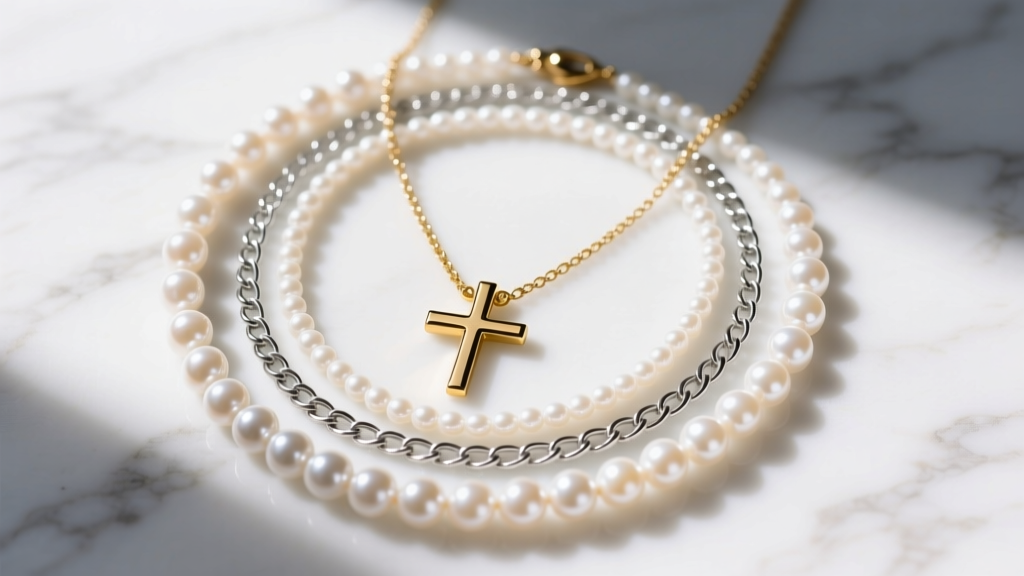
- Layer 1 (The Anchor): 14-inch or 15-inch gold fill micro cross on a delicate cable chain. This sits at the base of the throat.
- Layer 2 (The Texture): 16-inch or 17-inch strand of baroque freshwater pearls or a mixed-metal bead chain. This adds organic contrast to the geometric cross.
- Layer 3 (The Frame): 18-inch or 20-inch sterling silver paperclip or rolo chain without a pendant. This frames the stack and draws the eye downward.
When mixing metals—a massive trend in 2026—use the cross pendant as your bridge. If you are wearing a yellow gold cross, introduce a silver chain that features small yellow gold accent links to tie the disparate metals together cohesively.
Troubleshooting: Clasp Failure and Jump Ring Integrity
A common point of failure in delicate jewelry is the jump ring—the small circular wire loop that connects the cross pendant to the chain. Because e.newton pendants are lightweight, the jump rings used are often very thin (around 0.3mm wire gauge). If the necklace is snagged on a sweater or pulled, an unsoldered jump ring will pull apart. When your piece arrives, inspect the jump ring immediately. If you see a visible seam that is not soldered shut, take it to a local jeweler to have it laser-welded or soldered for a few dollars. Furthermore, ensure the lobster clasp spring mechanism is snappy; a sluggish clasp indicates a compromised internal spring, which should be replaced under the brand's warranty.
Authenticity and Care Protocols
To maintain the brilliance of your gold fill or sterling silver cross, proper storage is non-negotiable. The Jewelers of America Care Guide emphasizes that exposure to ambient humidity and sulfur in the air is the primary catalyst for silver tarnish and gold fill dulling. Always store your e.newton necklaces in an airtight anti-tarnish ziplock bag with a silica gel packet or a 3M anti-tarnish strip. Never use ultrasonic cleaners or harsh chemical dips on gold fill jewelry, as the high-frequency vibrations can fracture the mechanical bond between the gold layer and the brass core. Instead, use a few drops of mild dish soap, warm water, and a baby-soft toothbrush to gently lift sebum and lotion buildup from the crevices of the cross pendant, patting it completely dry with a microfiber cloth before storage.
Pro-Tip: Always put your jewelry on after applying perfume, hairspray, and lotions. The alcohols and emulsifiers in cosmetics can degrade the rhodium plating on sterling silver and accelerate the wear of gold fill over time.


