Technical Guide to Choosing the Perfect N Initial Necklace
Discover the technical details of choosing an n initial necklace. Learn about metal grades, structural anatomy, chain pairing, and expert care tips.

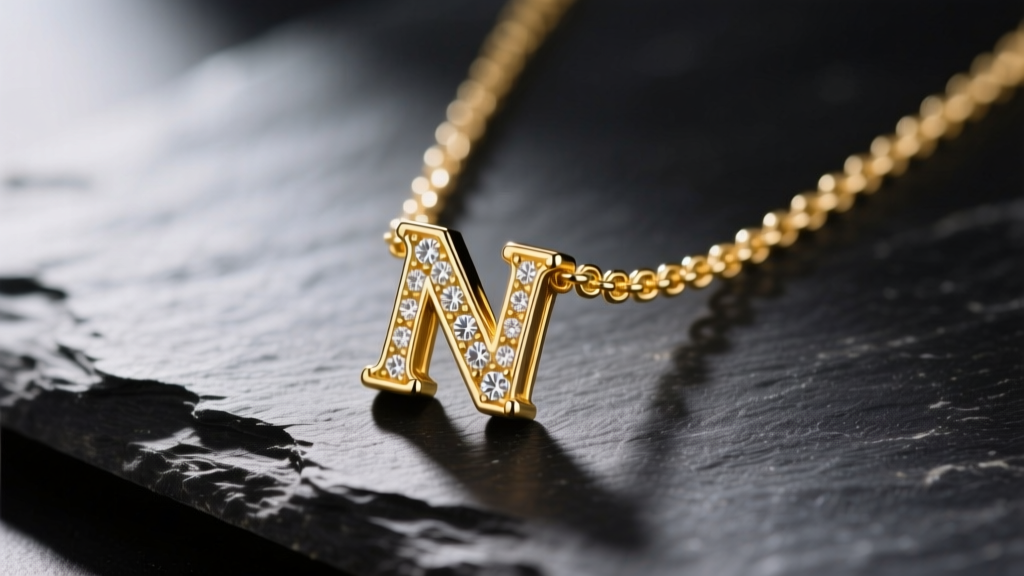
When evaluating personalized jewelry, the n initial necklace presents unique structural and aesthetic challenges that mass-market buyers often overlook. The letter 'N' is not merely a typographic symbol; in metallurgy and jewelry design, it is a complex geometric structure featuring two vertical stems and a high-stress diagonal crossbar. Choosing a high-quality piece requires a deep understanding of lost-wax casting mechanics, material hardness, and chain-to-bail friction. This expert deep dive explores the technical specifications you need to consider before investing in an 'N' pendant, ensuring your piece is both structurally sound and visually striking.
The Structural Anatomy of the Letter 'N' in Jewelry Design
Unlike the letter 'O' or 'C', which distribute stress evenly across a continuous curve, the 'N' relies on sharp angles and intersecting planes. In CAD/CAM jewelry design, the diagonal stroke of the 'N' is the most vulnerable point for casting porosity and structural failure. When molten metal flows into the silicone mold, it must navigate the sharp 45-degree angles of the diagonal crossbar. If the wax model is too thin, the metal cools too quickly, resulting in microscopic voids known as porosity.
Serif vs. Sans-Serif: A Durability Analysis
The typography of your pendant dictates its physical resilience. Serif 'N' pendants (featuring small decorative strokes at the terminals) require a minimum metal thickness of 1.5mm to prevent the delicate feet from snapping under everyday tension. Conversely, a block sans-serif 'N' distributes weight more evenly, allowing for a sleeker 1.0mm profile without sacrificing structural integrity.
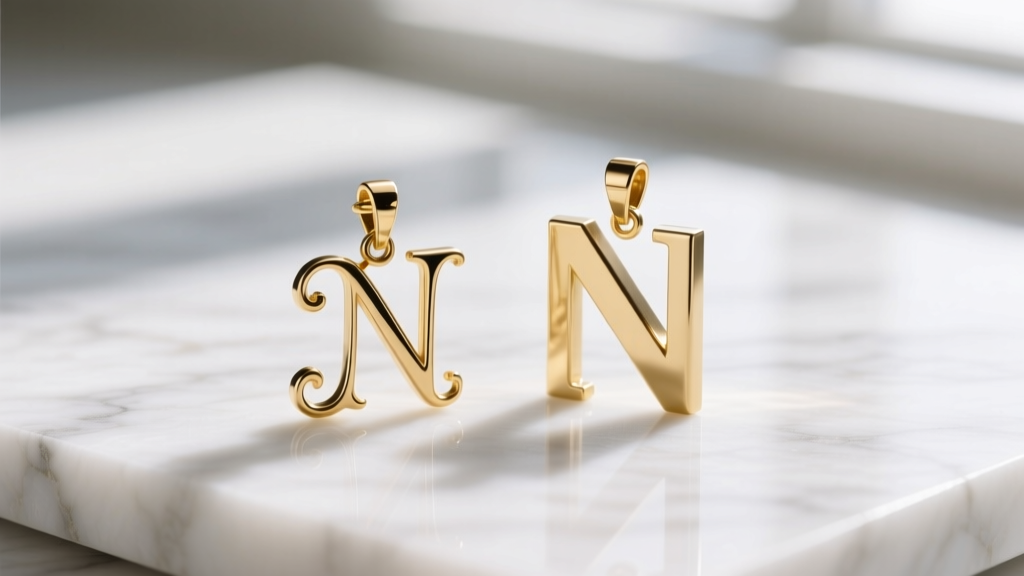
Expert Insight: During the lost-wax casting process, the 'sprue' (the channel where molten metal enters the mold) should always be attached to the thickest vertical stem of the 'N'. Attaching the sprue to the diagonal stroke or a delicate serif causes localized shrinkage and weakens the entire pendant.
Metallurgy and Material Grades for Initial Pendants
The longevity of your pendant is directly tied to the Vickers Hardness (HV) of the chosen alloy. While 18k gold offers a richer, deeper yellow hue, its higher gold content makes it softer and more prone to bending if the 'N' is designed with a wide, thin profile. 14k gold, alloyed with copper and silver, provides superior tensile strength, making it the metallurgical ideal for sharp, geometric initial pendants. According to the Gemological Institute of America (GIA), understanding alloy composition is critical for predicting how a piece will wear over decades.
| Material Grade | Vickers Hardness (HV) | Casting Shrinkage | Ideal Pendant Weight | Market Price Range (USD) |
|---|---|---|---|---|
| 14k Yellow Gold | 120 - 150 HV | 1.5% - 1.7% | 2.5g - 5.0g | $250 - $600 |
| 18k Yellow Gold | 100 - 120 HV | 1.3% - 1.5% | 3.0g - 6.0g | $400 - $950 |
| 950 Platinum | 110 - 130 HV (Work-hardens) | 2.0% - 2.5% | 4.0g - 8.0g | $600 - $1,400 |
| 925 Sterling Silver | 60 - 80 HV | 1.8% - 2.0% | 2.0g - 4.5g | $40 - $120 |
For buyers seeking a white metal, 950 Platinum is vastly superior to white gold for initial pendants. White gold requires rhodium plating, which eventually wears off on the high-friction edges of the letter 'N', revealing the yellowish underlying alloy. Platinum, while heavier and more expensive, develops a desirable patina and never requires replating, a fact widely corroborated by Jewelers of America care guidelines.
Chain Pairing: Gauge, Weave, and Clasp Mechanics
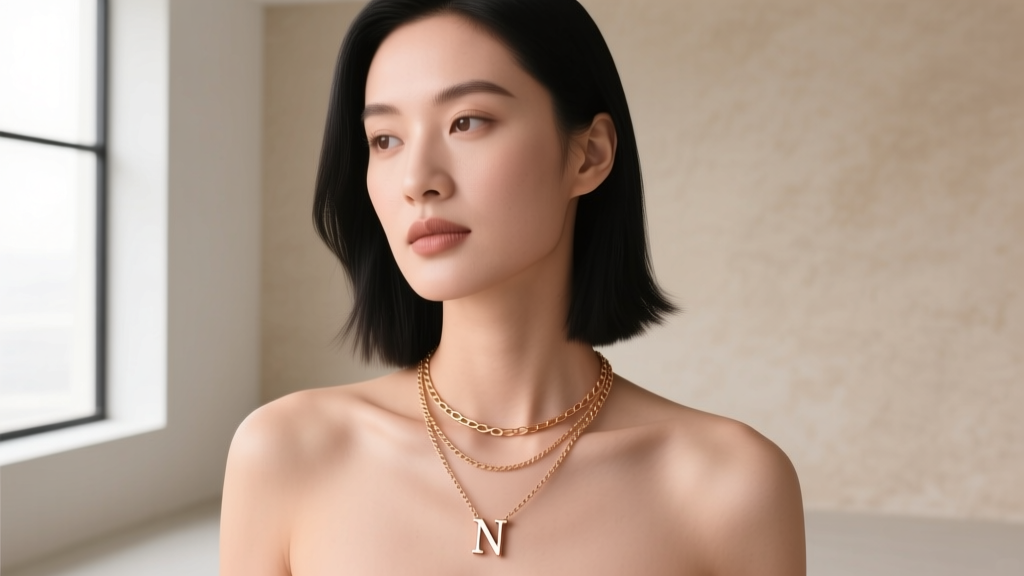
An 'N' pendant requires careful chain selection to balance visual weight and prevent bail wear. The bail—the loop connecting the pendant to the chain—is a high-friction zone. If you pair a heavy, solid 18k gold 'N' pendant (weighing over 4 grams) with a delicate 0.9mm cable chain, the friction will act like a saw, eventually cutting through the chain links or the bail itself.
Recommended Chain Weaves
- Box Chain (1.2mm - 1.5mm): The flat, interlocking square links provide a smooth surface that minimizes friction against the bail. Ideal for medium-weight 'N' pendants.
- Cable Chain (1.5mm - 2.0mm): A classic choice, but ensure the links are soldered closed. Unsoldered cable links can pull apart under the pendulum-like swinging motion of an initial pendant.
- Paperclip Chain (2.5mm+): Excellent for layering, but the large, open links can sometimes catch on the sharp bottom corners of a block 'N' pendant if the bail is too wide.
When selecting a clasp, avoid standard spring rings for pendants over 3 grams. The internal tension spring in a spring ring is prone to failure over time. Instead, opt for a lobster clasp with a minimum length of 12mm, or a high-quality neodymium magnetic clasp equipped with a secondary safety figure-eight catch.
Diamond Accents and Stone Setting Techniques
Adding diamond accents to an 'N' initial necklace elevates the piece but introduces structural risks. The diagonal stroke of the 'N' is under constant torsional stress. If a jeweler uses a traditional prong setting on this diagonal crossbar, the removal of metal to create the prong seats can compromise the structural integrity of the stroke.
For stone-set 'N' pendants, bezel settings or flush (gypsy) settings are highly recommended. These techniques require the metal to be displaced rather than removed, maintaining the tensile strength of the letter's stems. If you prefer the look of micro-pavé, ensure the diamonds are set only on the vertical stems, leaving the diagonal crossbar solid and unbroken to act as a structural bridge.
Expert Maintenance and Troubleshooting
Proper maintenance of an initial pendant requires specific techniques to preserve the sharp, geometric lines of the letter. Mass-market jewelry cleaners often recommend ultrasonic machines, but these can be dangerous if your 'N' pendant features fracture-filled diamonds or tension settings.
- Polishing Protocols: Never use a high-speed rotary tumbler to polish a block 'N' pendant. The steel shot in the tumbler will aggressively round off the sharp 90-degree corners of the letter, ruining the crisp typography. Always request hand-polishing with a soft muslin wheel and fine jeweler's rouge.
- Bail Inspection: Every six months, inspect the interior of the bail with a 10x jeweler's loupe. Look for a 'groove' worn into the metal by the chain. If the groove exceeds 30% of the bail's thickness, take it to a professional for a laser weld reinforcement.
- Chemical Exposure: Chlorine in swimming pools reacts violently with the copper and zinc alloys in 14k and 18k gold, causing 'stress corrosion cracking.' This is particularly fatal to the solder joints where the bail meets the top of the 'N'. Always remove your necklace before entering chlorinated water.
By understanding the metallurgical properties, casting mechanics, and structural vulnerabilities of the letter 'N', you can select a piece of personalized jewelry that is not only deeply meaningful but engineered to last a lifetime. For further technical specifications on jewelry manufacturing and alloy behaviors, resources from Rio Grande Jewelry Supply offer invaluable insights for both consumers and bench jewelers alike.


