Troubleshooting Your Daily Faith Cross Necklace: Fixes & Care
Is your faith cross necklace flipping, tarnishing, or breaking? Discover expert troubleshooting tips, metal grades, and chain repair solutions.


The Hidden Mechanics of Daily Cross Pendant Wear
Wearing a faith cross necklace is a deeply personal choice, often meant to be a permanent or semi-permanent fixture in your daily life. However, the reality of 24/7 wear introduces a host of mechanical and chemical challenges. From the pendant constantly flipping upside down to the chain snapping at the clasp, daily friction, sweat, and snagging take a severe toll on fine jewelry. In 2026, jewelers see thousands of preventable repairs related to religious pendants. By understanding the specific physics of cross silhouettes and the metallurgy of chain alloys, you can troubleshoot these common issues and extend the lifespan of your necklace by decades.
Problem 1: The Cross Keeps Flipping Upside Down
The most frequent annoyance reported by wearers of a faith cross necklace is the pendant's tendency to flip upside down, hiding the front face against the skin. This is not a defect in the jewelry; it is a matter of physics. The traditional Latin cross is inherently top-heavy. When suspended from a standard loop bail, the center of gravity forces the longer bottom arm to swing backward, causing the cross to invert.
Troubleshooting the Bail-to-Chain Ratio
The flip is often exacerbated by a mismatch between the chain thickness and the bail opening. If your chain is 1.2mm thick but the interior of the bail is 4.0mm, the pendant has too much lateral movement. To solve this, you have three actionable options:
- Upgrade the Chain Width: Switch to a chain that fills at least 75% of the bail's interior width. A 3.0mm wheat (Spiga) chain will restrict the lateral swinging that causes the flip.
- Install a Silicone O-Ring: Thread a tiny, 1.5mm inner-diameter silicone jewelry O-ring onto the chain inside the bail. This acts as a friction stopper, holding the bail centered without scratching the metal.
- Swap to a Tube Bail: If your cross allows for it, have a jeweler replace the standard loop bail with a horizontal tube bail. Tube bails force the chain to pass directly through the pendant's upper axis, completely neutralizing the top-heavy swing.
Problem 2: Chain Snapping and Jump Ring Failure
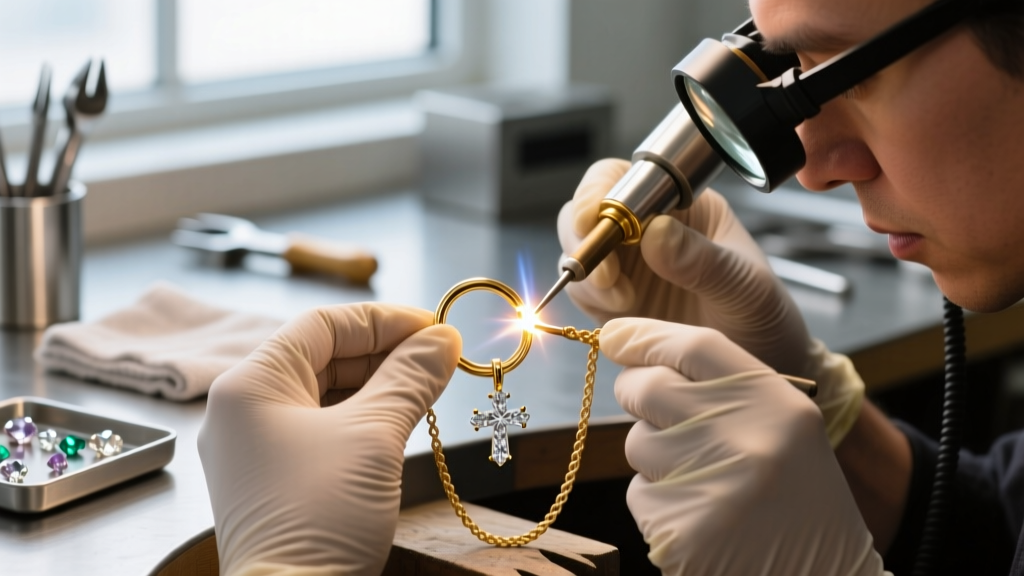
When a faith cross necklace breaks, it rarely snaps in the middle of the chain. According to the Jewelers of America, over 85% of chain failures occur at the jump ring connecting the clasp, or the jump ring attaching the pendant to the chain. Standard mass-market jewelry often uses 20-gauge (0.8mm) wire for jump rings, which is simply too thin to withstand the tensile stress of a solid metal cross catching on a sweater or towel.
Gauge Thickness and Soldering Protocols
If your chain frequently pulls apart at the connection points, you must address the structural integrity of the jump rings. Ask your jeweler to upgrade the pendant's jump ring to an 18-gauge (1.0mm) or 16-gauge (1.3mm) wire. More importantly, request a soldered jump ring. A soldered ring has no seam, meaning it cannot be pulled open by tension; it will only break if the metal itself snaps, which requires significantly more force.
Furthermore, the style of chain you choose dictates its survival rate. Snake chains, while sleek, are notorious for kinking and snapping if bent past a 45-degree angle. For heavy daily wear, structural chains are mandatory.
Chain Style Durability Matrix
| Chain Style | Tensile Strength | Kink Resistance | Best For Cross Pendants? |
|---|---|---|---|
| Cable (Round Links) | High | Excellent | Yes (Classic, durable) |
| Wheat (Spiga) | Very High | Excellent | Yes (Best for heavy crosses) |
| Snake | Low | Poor | No (Prone to permanent kinks) |
| Box (Venetian) | Medium | Good | Yes (Modern, geometric look) |
| Rope | Medium-High | Good | Yes (Adds texture and weight) |
Problem 3: Tarnishing, Green Skin, and Allergic Reactions
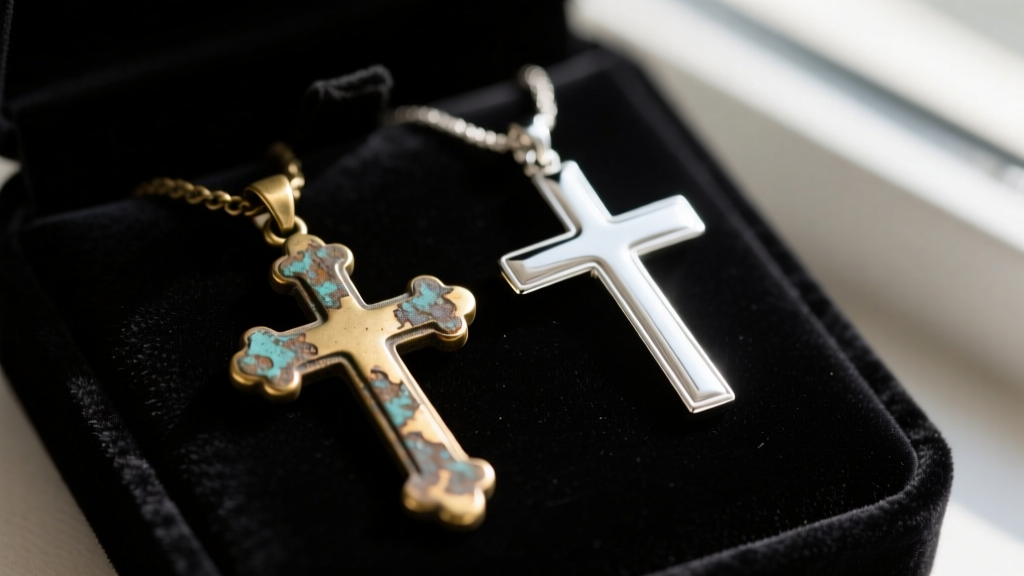
A faith cross necklace rests directly against the sternum, an area prone to sweating and friction. If your skin is turning green or the cross is developing a dark, sulfurous patina, you are experiencing a chemical reaction with the alloy metals in your jewelry. Pure silver and pure gold are too soft for daily wear, so they are alloyed with other metals. In standard 925 sterling silver, the remaining 7.5% is usually copper. Copper reacts with the sulfur in human sweat and the environment, causing rapid tarnishing and skin discoloration.
Upgrading Your Metal Grade
To permanently solve the tarnish and allergy problem, you must upgrade the metallurgy of your necklace. The Gemological Institute of America (GIA) notes that modern silver alloys have vastly improved upon traditional sterling. Look for Argentium Silver (960). Argentium replaces the copper with germanium, which creates a transparent, self-healing layer of germanium dioxide on the surface. This makes it highly tarnish-resistant and hypoallergenic.
If you prefer gold, ensure you are buying solid 14k or 18k gold, or high-quality vermeil. Standard gold plating is often less than 0.5 microns thick and will wear through to the brass or copper base metal within months of daily wear. True gold vermeil must have a sterling silver base and a gold layer of at least 2.5 microns. If your vermeil cross is causing a rash, the plating has likely worn through, exposing the base metal to your skin.
Safe Cleaning and Maintenance Protocols
When your faith cross necklace loses its luster, the instinct is to drop it into an ultrasonic cleaner or use harsh chemical dips. This is a critical mistake that can ruin specific gemstone settings often found in cross pendants.
- Avoid Ultrasonic Cleaners for Porous Gems: If your cross features turquoise, opal, pearls, or emeralds, ultrasonic vibrations will shatter or cloud the stones. Furthermore, if your diamonds are "fracture-filled" (a common treatment for lower-clarity diamonds), the heat and vibrations will melt the filler, ruining the stone's appearance.
- The Warm Soap Soak: The safest, most effective method for cleaning a diamond or plain metal cross is a soak in warm water with a few drops of mild, phosphate-free dish soap. Use a soft-bristled baby toothbrush to gently agitate the dirt trapped behind the bail and under the gemstone settings.
- Polishing Cloths: For plain silver or gold crosses without gemstones, use a jeweler's rouge-impregnated polishing cloth. Do not use tissue paper or paper towels, as the wood fibers can cause micro-scratches on high-polish gold surfaces.
When to Seek Professional Jeweler Intervention
While swapping a chain or adding an O-ring are easy DIY fixes, certain issues require a professional bench jeweler. If the bail itself has worn completely through (a common issue where the chain acts like a saw against the soft metal of the bail over several years), it must be laser-welded or entirely replaced. Attempting to bend a worn bail back into shape will result in immediate metal fatigue and snapping. Similarly, if the prongs holding diamonds into your cross pendant are catching on your clothing, the metal has worn down and requires professional re-tipping to prevent the catastrophic loss of your gemstones.
Conclusion
A faith cross necklace is meant to be a lasting symbol, not a source of daily frustration. By matching the correct chain width to your bail, upgrading to soldered jump rings, and selecting advanced alloys like Argentium silver, you can eliminate flipping, breaking, and tarnishing. Treat the mechanics of your jewelry with the same respect as its meaning, and it will comfortably endure a lifetime of daily wear.


