Avoiding Fake Gems: The Story The Necklace by Guy de Maupassant
Learn how to avoid Mathilde Loisel's tragic mistake. We break down gemological troubleshooting to tell real diamonds from paste and fakes.

The Ultimate Jewelry Cautionary Tale
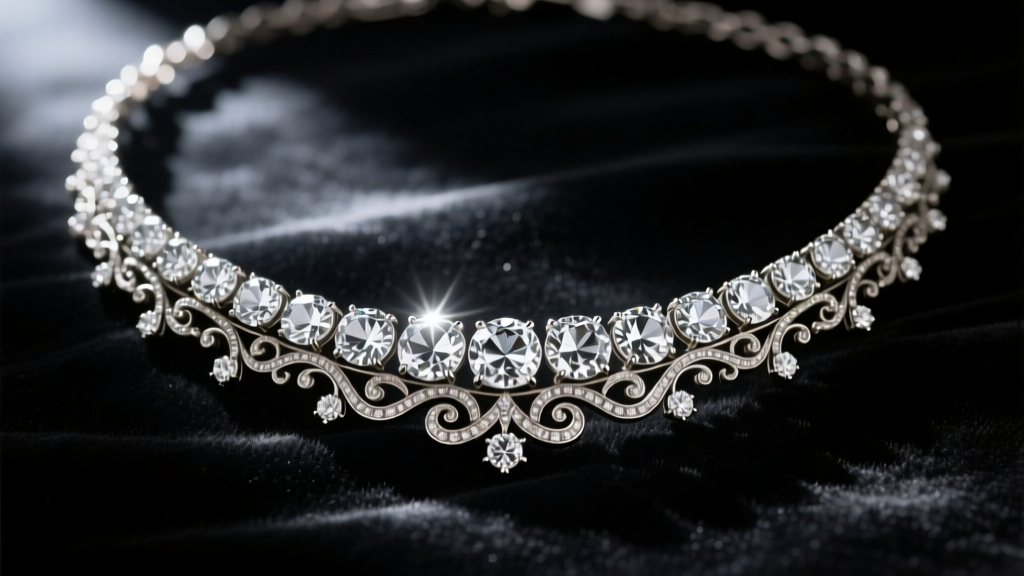
For jewelers, gemologists, and vintage estate collectors, the story the necklace by guy de maupassant serves as the ultimate cautionary tale about gemstone misidentification and the catastrophic financial consequences of assuming authenticity. Published in 1884, the narrative follows Mathilde Loisel, a woman who borrows what she believes to be a stunning diamond rivière necklace from a wealthy friend, only to lose it. Rather than confessing, she and her husband take on crippling debt to purchase a replacement for 36,000 francs. After ten years of grueling poverty to pay off the loans, she discovers the original borrowed piece was merely 'paste'—a high-end glass simulant worth at most 500 francs.
While literature students often analyze the story the necklace by guy de maupassant for its themes of vanity, pride, and class disparity, jewelry professionals read it as a masterclass in verification failure. Mathilde’s tragic flaw was not just her vanity, but her complete lack of gemological literacy. In today’s market, where sophisticated simulants, lab-grown diamonds, and high-quality cubic zirconia (CZ) flood the secondary market, the ability to troubleshoot and authenticate gemstones is more critical than ever. This guide breaks down the exact problem-solving frameworks gemologists use to separate natural diamonds from historical paste and modern simulants, ensuring you never repeat Mathilde Loisel’s devastating mistake.
The 'Mathilde Loisel' Failure Mode: Misidentifying Paste
In the late 19th century, 'paste' jewelry was not considered cheap costume wear; it was a highly respected craft. Paste referred to high-lead glass that was meticulously hand-cut and polished to mimic the brilliance of diamonds. Lead glass has a higher refractive index (RI) than standard glass, allowing it to bend light more effectively and produce a convincing sparkle under the gaslight and candlelight of the 1880s. However, paste lacks the optical and physical properties of crystalline carbon.
The primary failure mode in identifying vintage paste is relying solely on visual 'sparkle' or the weight of the setting. Mathilde assumed that because the necklace was set in what appeared to be precious metal and belonged to a wealthy socialite, the stones must be genuine. Today, estate buyers frequently fall into the same trap when purchasing unverified antique jewelry at auction or inheriting family pieces. The visual similarity between well-cut lead glass and a brilliant-cut diamond can easily fool the untrained eye, especially when the stones are set in intricate, closed-back foil settings designed to artificially enhance brilliance and color.
Optical Properties: Glass vs. Diamond
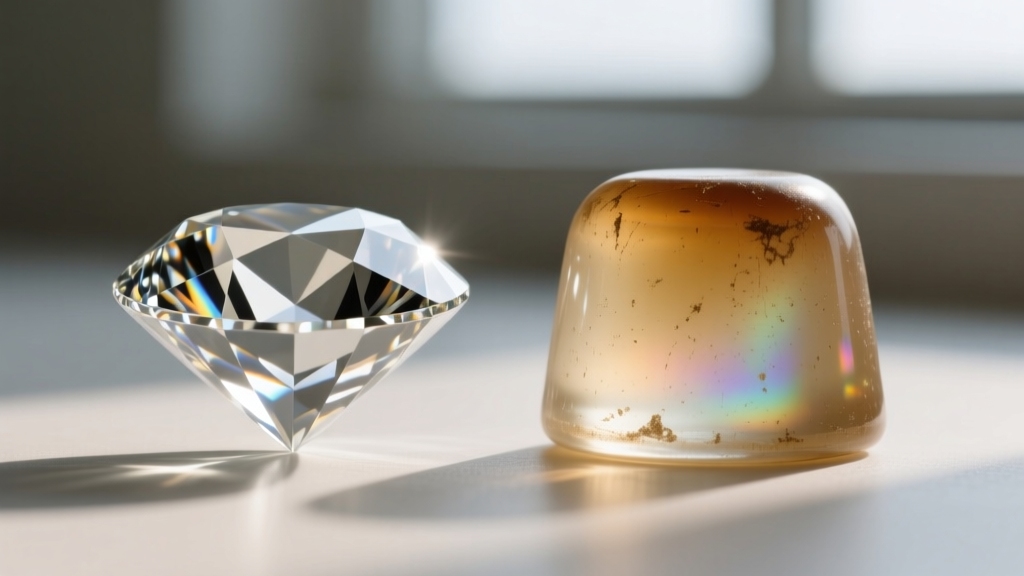
To troubleshoot a suspected paste necklace, one must understand the physics of light return. A natural diamond possesses a refractive index of 2.42 and a dispersion rate of 0.044. This specific combination creates the signature 'fire' (flashes of spectral color) and 'brilliance' (white light return) that diamonds are famous for. Paste glass, by contrast, typically has an RI of around 1.70. While it may look bright face-up, it lacks the deep, internal light return of a diamond. When viewed from the side or pavilion, paste stones often appear flat, glassy, or 'sleepy,' lacking the sharp, crisp facet reflections seen in genuine crystalline structures.
According to the GIA Gem Encyclopedia, the distinction between amorphous glass and crystalline diamond is most easily observed through the sharpness of facet junctions and the presence of wear along the girdle.
Troubleshooting Diamond Simulants: A Gemologist's Toolkit
When authenticating a necklace, whether it is a historical piece or a modern acquisition, gemologists rely on a structured troubleshooting protocol rather than visual guesswork. Below is a comparative data table outlining the physical and optical properties of common diamond simulants you will encounter in the wild.
| Material | Refractive Index (RI) | Dispersion | Mohs Hardness | Thermal Conductivity |
|---|---|---|---|---|
| Natural Diamond | 2.42 | 0.044 | 10 | Extremely High |
| Moissanite | 2.65 | 0.104 | 9.25 | High |
| Cubic Zirconia (CZ) | 2.15 | 0.058 | 8.5 | Low |
| High-Lead Paste | 1.70 | 0.030 | 5.5 | Very Low |

The 10x Loupe Inspection: What to Look For
The first step in troubleshooting any diamond necklace is a meticulous inspection with a 10x triplet loupe. Because paste and CZ are significantly softer than diamond (Mohs 5.5 and 8.5 respectively, compared to diamond's 10), they exhibit distinct wear patterns over time. When examining the girdle and facet junctions of a suspect stone, look for 'abrasions' or 'frosting' along the edges. A genuine diamond will have razor-sharp facet junctions that remain crisp even after a century of wear. Paste and CZ, however, will show rounded, chipped, or worn edges where the stones have rubbed against their settings or other jewelry.
Additionally, examine the stone for internal characteristics. Diamonds often contain natural inclusions such as carbon spots, feathers, or pinpoint crystals. High-quality CZ and paste are typically flawless, though older paste may contain spherical gas bubbles or 'flow lines' from the glass manufacturing process. Spotting a single spherical bubble immediately identifies the stone as glass, saving you from a catastrophic financial misjudgment.
The Fog Test and Thermal Conductivity
If you are troubleshooting a necklace in a non-laboratory setting, the 'fog test' is a rapid, non-destructive method to rule out glass and CZ. Diamonds are exceptional thermal conductors; they dissipate heat almost instantly. If you breathe on a diamond, the condensation will evaporate in one to two seconds. If you breathe on paste or CZ, the fog will linger for several seconds because glass and cubic zirconia are thermal insulators. For definitive results, modern jewelers use electronic thermal conductivity testers, such as the Presidium DiamondMate, which measure the rate of heat transfer through the stone to instantly differentiate diamond from non-diamond simulants.
Modern Equivalents: Lab-Grown vs. Natural vs. Simulant
While Mathilde Loisel’s dilemma centered on 19th-century paste, the 2026 jewelry market presents a far more complex web of identification challenges. Today, the secondary market is saturated with lab-grown diamonds (created via CVD or HPHT processes) and moissanite. Unlike paste or CZ, lab-grown diamonds share the exact same chemical, physical, and optical properties as natural diamonds. A standard thermal tester will read a lab-grown diamond as a 'diamond,' which can lead to massive valuation errors if the buyer assumes they are purchasing a rare, earth-mined stone.
To troubleshoot this, gemologists must look for specific strain patterns using advanced UV fluorescence imaging or check the girdle for microscopic laser inscriptions. The Federal Trade Commission Jewelry Guides strictly mandate that lab-grown diamonds be clearly disclosed and inscribed to prevent consumer deception. If you are evaluating an inherited or estate diamond necklace, assuming it is natural without a modern GIA or IGI grading report is a financial risk akin to Mathilde’s fatal assumption.
The Pave Setting Problem: Melee Fraud
Another critical troubleshooting area in modern necklaces is the pave setting. 'Melee' refers to the tiny diamonds (usually under 0.15 carats) used to accent a central pendant or cover a chain. Because individual melee stones are too small to be economically graded or laser-inscribed, they are highly susceptible to fraud. It is an open secret in the secondary market that unscrupulous sellers will swap out natural diamond melee with high-quality CZ or moissanite. When evaluating a heavily paved diamond necklace, use a reflectivity scope or a specialized moissanite tester that checks for electrical conductivity (since moissanite is a semiconductor, while diamond is an insulator) to ensure the entire piece is authentic.
Appraisals and Insurance: Preventing a Decade of Debt
The ultimate tragedy in Maupassant’s story was not just the misidentification of the stones, but the lack of communication and proper insurance protocols. Mathilde never asked her friend where the necklace was purchased, nor did she seek a professional appraisal before taking on a decade of ruinous debt. In the modern era, the solution to this problem is rigorous documentation.
Whenever you borrow, inherit, or purchase a high-value necklace, the immediate next step must be an independent appraisal by a certified gemologist (such as a GIA Graduate Gemologist). An appraisal provides a detailed breakdown of the metal purity, stone weights, and crucially, the identity of the gemstones. Furthermore, scheduling the item on a specialized jewelry insurance policy ensures that if the piece is lost or stolen, the replacement cost is covered by the underwriter, not your personal savings. Relying on a store receipt or a verbal estimate is the modern equivalent of Mathilde’s blind faith in her friend's jewelry box.
Final Thoughts on Verification
The enduring legacy of the story the necklace by guy de maupassant is a stark reminder that visual perception is entirely insufficient for valuing precious gems. Whether you are examining a Victorian-era riviere necklace for hidden paste, or navigating the complex waters of lab-grown diamonds and moissanite simulants in 2026, the rules of gemological troubleshooting remain absolute. Trust the data, use the proper optical and thermal tools, and always demand independent verification. By applying these rigorous problem-solving frameworks, you protect your investments and ensure that a lost or damaged necklace remains a minor inconvenience, rather than a life-altering tragedy.


