Fix Your 14k Gold Necklace with Pendant: Tangling & Flipping
Is your 14k gold necklace with pendant constantly tangling or flipping? Learn expert troubleshooting for bail sizing, chain weight, and clasp failures.

The Hidden Physics of Jewelry Mechanics
There are few things more frustrating than investing in a beautiful piece of fine jewelry, only to spend half your day adjusting it. If your 14k gold necklace with pendant constantly flips upside down, tangles into impossible knots, or slides so the clasp rests awkwardly under your chin, you are not dealing with bad luck—you are dealing with physics. While 14k gold is an exceptionally durable alloy (comprising 58.5% pure gold and 41.5% strengthening metals like copper, silver, and zinc), material durability does not negate the laws of gravity, tension, and friction.
As of 2026, modern jewelry manufacturing has introduced precision laser-welding and micro-milled chains, but the fundamental mechanics of how a pendant hangs from a chain remain unchanged. Troubleshooting these daily annoyances requires looking past the aesthetic design and analyzing the structural relationship between the chain gauge, the bail diameter, and the pendant's center of gravity. Below is a master jeweler's guide to diagnosing and permanently fixing the most common wearability issues.
Diagnosing the 'Upside-Down Pendant' Flip
The most frequent complaint regarding a 14k gold necklace with pendant is the pendant flipping backward, hiding its face against the wearer's skin. This is almost never a defect in the pendant itself; rather, it is a mismatch between the chain thickness and the bail's inner diameter.
The Bail-to-Chain Ratio Rule
The bail is the loop that connects the pendant to the chain. For a pendant to hang flat and move fluidly, the inner diameter of the bail must be 20% to 30% larger than the width of the chain. If you thread a 2.5mm box chain through a bail with a 2.6mm inner diameter, the metal-on-metal friction will lock the pendant in place. When you move, the chain will twist instead of gliding through the bail, eventually forcing the pendant to flip upside down to release the torsion.
- Micro-Chains (0.8mm - 1.2mm): Require bails with at least a 1.5mm inner diameter.
- Standard Chains (1.5mm - 2.5mm): Require bails with a 2.5mm to 3.5mm inner diameter.
- Heavy Chains (3.0mm+): Require custom-soldered oversized bails or a hidden euro-shank bail mechanism.
Expert Fix: Take your necklace to a bench jeweler and ask them to measure the bail with digital calipers. If the bail is too tight, they can use a specialized tapered mandrel to gently stretch the 14k gold bail without compromising its structural integrity.
Center of Gravity Issues
If the bail ratio is correct but the pendant still flips, examine the pendant's top-heavy design. Pendants with large, heavy gemstones set high in the bezel will naturally want to invert. A jeweler can solder a small, discreet 14k gold counterweight bead to the bottom back of the pendant bezel to lower the center of gravity.
Chain Tangling Matrix: Matching Styles to Pendants
Not all 14k gold chains are created equal when it comes to knotting. The geometry of the chain links dictates how they interact with the pendant bail and with each other. According to the Jewelers of America Care Guide, regular maintenance and understanding your chain's link structure can prevent micro-knots that lead to metal fatigue and snapping.
| Chain Style | Tangling Propensity | Pendant Compatibility | Troubleshooting Tip |
|---|---|---|---|
| Box Chain | Low | Excellent for heavy pendants | Ensure links are fully soldered; open box links will catch on the bail and cause severe tangling. |
| Cable Chain | Medium | Best for lightweight, small charms | Use a lobster clasp instead of a spring ring to add slight weight at the back, reducing forward sliding. |
| Herringbone | Extremely High | Poor (Not recommended) | Herringbone chains kink permanently. Never wear them with pendants; the bail will crush the flat links. |
| Rope Chain | Medium-High | Good for medium pendants | The twisted links act like tiny gears. Ensure the bail interior is highly polished to prevent friction snagging. |
Solving Clasp Migration (The Center-Front Slide)
If the clasp of your 14k gold necklace with pendant continually slides from the nape of your neck to the front, resting right next to the pendant, you have a weight distribution problem. This happens when the pendant is significantly heavier than the chain itself.
The 60% Weight Rule
For a necklace to sit perfectly balanced, the chain should weigh at least 60% of the pendant's total weight. If you have a 5-gram solid gold pendant hanging on a delicate 1.5-gram chain, gravity will constantly pull the heavy pendant downward, dragging the lightweight chain—and the clasp—along with it.
"A necklace is a mobile sculpture. If the anchor (the clasp) is lighter than the focal point (the pendant), the sculpture will always rotate to find the lowest center of mass." — Master Bench Jeweler
Expert Fixes:
- The Counterweight Method: Have a jeweler solder a small, decorative 14k gold bead or a customized branding tag near the clasp to act as an anchor.
- Silicone Stoppers: For a non-permanent, budget-friendly fix, use microscopic clear silicone jewelry stoppers (often sold for earring backs) on the chain near the clasp to create friction against the skin and hair, slowing the migration.
- Upgrade the Chain: Swap the delicate chain for a heavier gauge (e.g., moving from a 1mm to a 1.8mm wheat chain) to naturally balance the scales.
Bail Wear and Tear: Preventing the Snap
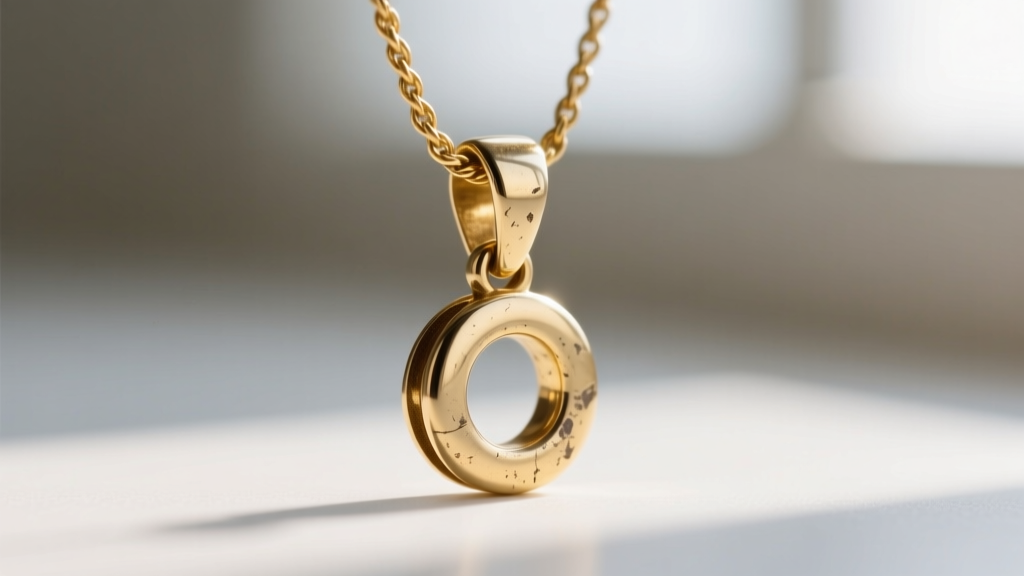
Because 14k gold is alloyed for strength, it is highly resistant to bending. However, it is still susceptible to friction wear. The Gemological Institute of America (GIA) notes that while gold alloys are durable, continuous micro-abrasion from harder metals or rough chain edges can thin the bail over time.
If your pendant is attached via a jump ring rather than a solid cast bail, the constant opening and closing of the ring (or the friction of the chain rubbing against the seam) can cause the metal to fatigue. A bail that originally measured 1.2mm in thickness can wear down to a dangerous 0.6mm over three years of daily wear.
The Caliper Test
Once a year, inspect the thinnest part of your pendant's bail. If you do not have digital calipers, a local jeweler will check this for free during a routine ultrasonic cleaning. If the metal thickness has dropped below 0.8mm, the bail is at a critical failure point. In 2026, jewelers can use micro-laser welding to add fresh 14k gold filler to the worn friction point without heating or damaging any gemstones set in the pendant.
Your Annual Troubleshooting Checklist
To ensure your 14k gold necklace with pendant remains a joy to wear rather than a daily nuisance, run through this quick diagnostic checklist every six months:
- The Slide Test: Hold the chain taut and let the pendant slide. It should glide smoothly without catching. If it stutters, the bail needs polishing or resizing.
- The Balance Test: Hold the necklace by the clasp and let it hang. If the pendant immediately pulls the chain into a severe, tight V-shape, your chain is too light and requires a counterweight.
- The Clasp Check: Inspect the spring ring or lobster claw. If the internal spring is weak, the clasp will open slightly during wear, allowing the chain to bunch up and tangle near the neck.
By understanding the mechanical relationship between your chain, bail, and pendant, you can transform a frustrating piece of jewelry into a flawless, everyday staple.


