Troubleshooting Your Pink Pendant Necklace: Fading & Care
Is your pink pendant necklace fading or causing skin irritation? Learn expert troubleshooting for rose quartz, morganite, enamel, and chain care.

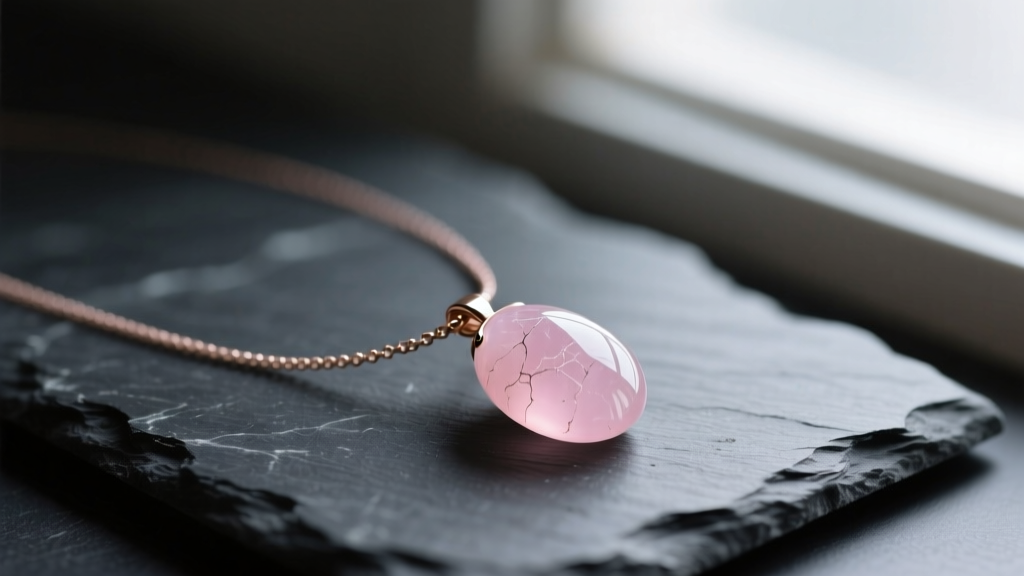
The Chemistry of Pink: Why Your Pendant is Fading
A pink pendant necklace is a versatile staple, but the specific materials used to achieve that blush, fuchsia, or pastel hue dictate its longevity. When customers report that their pink jewelry is "fading," the culprit is rarely the metal; it is almost always the gemstone or the enamel coating. Understanding the mineralogy and chemistry behind your pendant is the first step in troubleshooting its appearance.
Rose Quartz and UV Degradation
Rose quartz (Mohs hardness 7) derives its delicate pink color from trace amounts of titanium, iron, or manganese, and sometimes from microscopic dumortierite inclusions. However, prolonged exposure to ultraviolet (UV) light can alter these color centers. If you frequently wear your rose quartz pendant necklace outdoors in direct sunlight, or store it on a sunlit windowsill, the stone will gradually lose its saturation, turning a milky, translucent white. According to the Gemological Institute of America (GIA), rose quartz should always be stored in a dark, lined jewelry box to preserve its chromophores.
Morganite: Cloudiness vs. Fading
Morganite (a pink variety of beryl, Mohs 7.5-8) is highly stable and does not fade in sunlight. However, morganite is notoriously oleophilic, meaning it attracts oils and lotions from the skin. Over time, a film of sebum and cosmetics builds up on the pavilion (the bottom facets) of the stone. This prevents light from entering and reflecting back to the eye, making the pendant look dull, cloudy, and "faded." The stone hasn't lost its color; it has simply lost its brilliance.
Cold Enamel Yellowing
If your pink pendant is made of enameled metal rather than a gemstone, check the manufacturing method. High-end vitreous enamel (fired glass) is impervious to UV light. However, most affordable jewelry uses cold enamel (an epoxy-based resin). Epoxy resins are highly susceptible to photodegradation. After 12 to 18 months of daily wear, the UV exposure causes the clear resin matrix to yellow, which visually shifts a bright bubblegum pink into a murky, salmon-orange tone.
Identifying Synthetic vs. Natural Pink Stones
When troubleshooting color issues, it is vital to know if your stone is natural or synthetic. Hydrothermal synthetic pink quartz is grown in a lab and often features a more uniform, hyper-saturated pink that lacks the natural cloudy inclusions of mined quartz. While synthetic stones are chemically identical, some lower-grade dyed synthetic stones (often sold as "cherry quartz") are merely glass infused with pink dyes. These dyed glass pendants will rapidly fade when exposed to the acidic pH of human sweat or harsh household cleaners.
Troubleshooting Skin Irritation and the "Green Neck" Effect
A common complaint with pink jewelry—especially pieces marketed as "rose gold"—is skin irritation or a green discoloration on the décolletage. This is not an allergic reaction to the pink stone itself, but a chemical reaction involving the metal alloy.
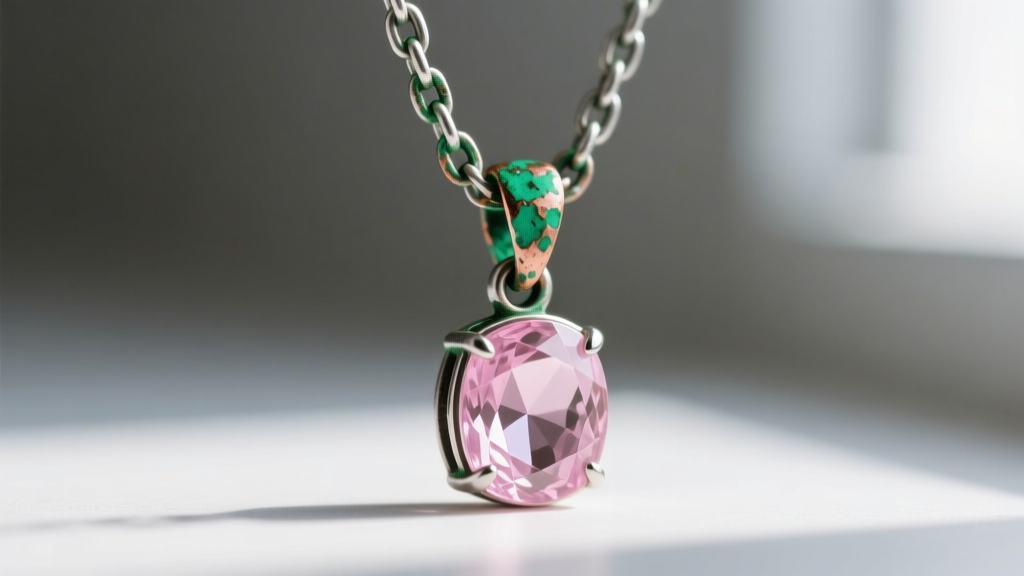
The Copper Factor in Rose Gold
True 14k or 18k rose gold achieves its pink hue by alloying pure yellow gold with a high percentage of copper (up to 25% in 14k rose gold). When copper reacts with the salts, water, and acidic pH (typically between 4.0 and 7.0) in human sweat, it produces copper chloride and copper sulfate. These compounds are bright green and easily transfer to the skin. If you live in a humid climate or wear your pink pendant necklace during workouts, this oxidation is nearly inevitable.
The Fix: Apply a thin coat of clear, hypoallergenic nail polish to the back of the pendant where it touches the skin. Alternatively, upgrade to a platinum or 18k yellow gold setting, and rely solely on the pink gemstone for color, bypassing copper-heavy metals entirely.
Nickel Allergies in Clasps
If your skin is itching, turning red, or flaking specifically around the nape of your neck, the issue is likely the clasp. Many manufacturers use base-metal spring ring clasps plated with a thin layer of silver or gold. These base metals frequently contain nickel as a hardening agent. Nickel contact dermatitis is one of the most common jewelry allergies. Always inspect the clasp; if it lacks a "925" or "14k" stamp, replace it with a solid sterling silver or gold-filled lobster clasp.
The Chain Reaction: Fixing Tangles and Weak Clasps
The structural integrity of a pink pendant necklace relies heavily on the chain gauge and link style. A heavy morganite or tourmaline pendant (often weighing between 8 and 15 grams) will easily snap a delicate chain, leading to lost stones.
Matching Chain Gauge to Pendant Weight
Chain thickness is measured in millimeters (mm). A standard 0.8mm cable chain is suitable only for lightweight pendants (under 5 grams). For a substantial pink gemstone pendant, you need a minimum of a 1.2mm to 1.5mm chain. Furthermore, the jump ring (the small loop connecting the pendant to the chain) is the most common point of failure. If the jump ring is not soldered shut, the weight of the pendant will slowly pull the gap open over time, causing the stone to slide off and drop.
Quick-Fix Table: Chain Link Types and Breakage Rates
| Chain Style | Recommended Gauge | Tangle Risk | Structural Weakness |
|---|---|---|---|
| Cable Chain | 1.2mm - 1.5mm | Low | Jump ring separation |
| Snake Chain | 1.5mm - 2.0mm | High (Hair snagging) | Kinking and permanent bending |
| Box Chain | 1.0mm - 1.5mm | Very Low | Link stretching under heavy weight |
| Wheat Chain | 1.2mm - 1.8mm | Low | Difficult to repair if snapped |
For heavy pink pendants, a 1.5mm box chain or wheat chain offers the best combination of tensile strength and tangle resistance. Avoid snake chains entirely if you have long hair or wear textured fabrics, as the microscopic gaps between the links act like a comb, catching and pulling hair strands.
Step-by-Step Restoration Guide for Pink Gemstones
If your pink pendant necklace has lost its luster, do not immediately reach for commercial silver dips or ultrasonic cleaners. Many pink gemstones have specific structural vulnerabilities that can be catastrophically damaged by improper cleaning.
The Safe Cleaning Protocol
According to the American Gem Society, the safest cleaning method for almost all gemstones involves mild surfactants and lukewarm water. Follow this precise protocol to restore your pendant:
- Step 1: Mix three drops of mild, phosphate-free dish soap (like Dawn) into a bowl of lukewarm distilled water. Avoid hot water, which can cause thermal shock in stones with internal fractures.
- Step 2: Submerge the pink pendant for exactly 5 minutes. This loosens sebum and cosmetic buildup without degrading the metal.
- Step 3: Use a brand-new, ultra-soft baby toothbrush to gently agitate the pavilion (back) of the stone. Never scrub the table (top) of the stone aggressively, as accumulated dust contains quartz particles (Mohs 7) that can scratch softer pink stones like opal or pearl.
- Step 4: Rinse under a gentle stream of lukewarm water, ensuring the drain is securely plugged.
- Step 5: Pat dry with a lint-free microfiber cloth. Do not air dry, as hard water minerals will leave white, chalky spots on the metal and stone.
The Ultrasonic Danger Zone
Never place a pink tourmaline, pink opal, or mystic topaz pendant into an ultrasonic cleaner. Tourmaline is heavily included and prone to internal fracturing; the high-frequency vibrations of an ultrasonic bath can literally shatter the stone from the inside out. Mystic topaz relies on a delicate titanium vapor-deposition coating on the pavilion; ultrasonic waves will strip this coating away, ruining the pink iridescence permanently.
When to Seek Professional Jeweler Intervention
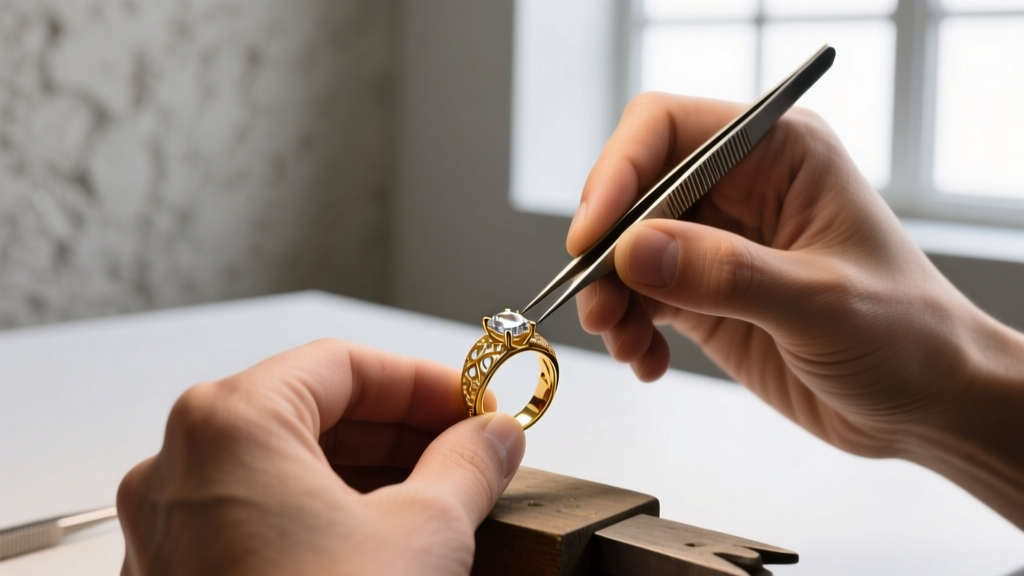
While home troubleshooting can resolve surface dirt and minor metal oxidation, certain issues require a professional bench jeweler. If your pink pendant necklace features a cracked gemstone, a severely kinked snake chain, or chipped vitreous enamel, DIY repairs will only worsen the damage.
A jeweler can perform a "laser weld" to fix a broken chain link without applying heat to the adjacent pink gemstone, preventing thermal shock. They can also re-polish a scratched rose quartz cabochon using specialized cerium oxide laps, restoring the glassy luster that fades over years of wear. Finally, if your pendant's prongs are catching on your clothing, a jeweler can re-tip the prongs in under ten minutes, securing your valuable pink stone against accidental loss. Regular bi-annual check-ups ensure that the structural integrity of your necklace matches its enduring aesthetic appeal.


