Fixing a Flipping or Tangling Crescent and Star Necklace
Is your crescent and star necklace constantly flipping or tangling? Learn expert troubleshooting tips to fix weight distribution and chain knots.

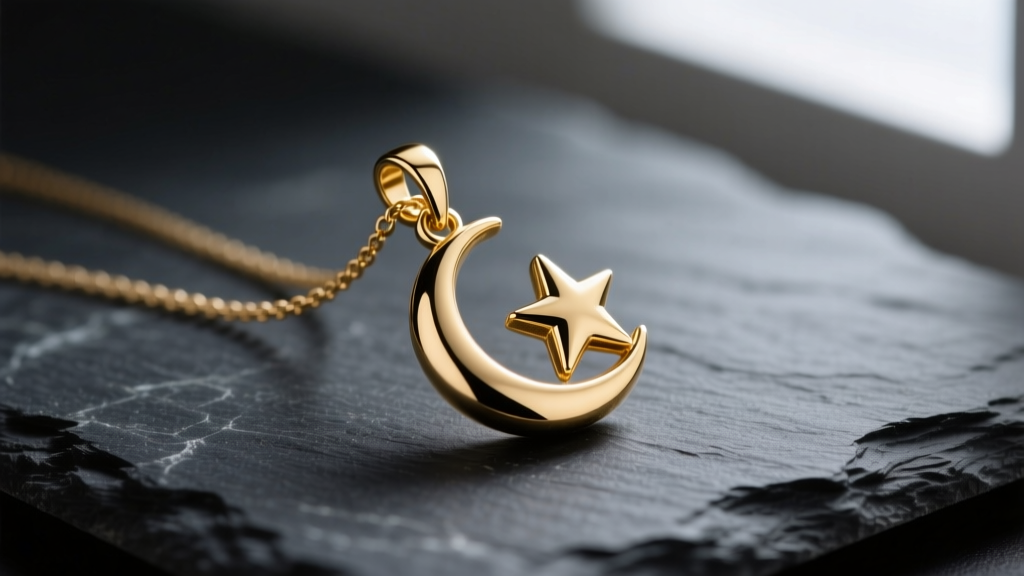
Celestial jewelry remains a dominant force in the accessory market, but the beloved crescent and star necklace presents unique structural challenges that frustrate even the most dedicated collectors. Unlike symmetrical pendants, celestial motifs feature uneven weight distribution, delicate chain pairings, and intricate micro-details that are highly susceptible to daily wear and tear. If your favorite piece is constantly flipping backward, tangling into micro-knots, or suffering from premature tarnish, the issue is rarely a defect in the design itself. Instead, it is usually a mismatch between the pendant's center of gravity, the chain gauge, and the clasp mechanics.
In this comprehensive troubleshooting guide, we will break down the physics behind pendant rotation, diagnose chain tangling based on specific weave structures, and provide actionable, jeweler-approved solutions to restore your celestial jewelry to its intended glory.
The Physics of the Flip: Why Celestial Pendants Rotate
The most common complaint regarding a crescent and star necklace is the "pendant flip"—where the piece rotates 180 degrees, displaying the flat, unpolished back against the wearer's skin. This is not a matter of bad luck; it is a strict issue of physics and center of mass.
A crescent moon is inherently asymmetrical. The bottom "horn" of the crescent often contains more metal mass than the top tapering edge. If the bail (the loop that connects the pendant to the chain) is soldered exactly at the geometric top center rather than the center of gravity, the heavier bottom horn will pull downward. This causes the pendant to swing forward and flip over as it seeks equilibrium against the chest.

Troubleshooting the Bail and Jump Ring
To fix a flipping pendant, you must alter the suspension point. Take your necklace to a bench jeweler and request a bail repositioning. The jeweler will use a digital caliper to find the exact gravitational balance point of the crescent and star motif. They will then desolder the existing bail and attach a new one slightly offset toward the heavier side.
Alternatively, if the pendant uses a free-floating jump ring instead of a fixed bail, the issue may be the jump ring's internal diameter. If a 4mm jump ring is used on a 1.5mm flat box chain, the excess space allows the pendant to twist freely. Downgrading to a 2.5mm or 3mm jump ring (while ensuring it still slides smoothly) restricts lateral movement and significantly reduces flipping.
Solving the Micro-Knot Crisis in Delicate Chains
Celestial pendants are typically lightweight, ranging from 1.5 to 4 grams. To maintain a cohesive aesthetic, manufacturers pair them with ultra-delicate chains, usually between 0.8mm and 1.2mm in width. While visually appealing, these micro-chains are notorious for tangling, especially when subjected to the friction of clothing and skin oils.
Chain Weave and Tangle Propensity
Not all delicate chains tangle at the same rate. The structural geometry of the links dictates how easily they will interlock and form micro-knots. Below is a diagnostic table to help you identify your chain type and its inherent vulnerabilities.
| Chain Type | Typical Gauge/Width | Tangle Risk | Troubleshooting Solution |
|---|---|---|---|
| Cable Chain | 20g - 22g (0.8mm) | High | Upgrade to a slightly thicker 18g cable or apply a micro-coating of jewelry wax to reduce link friction. |
| Box Chain | 1.0mm - 1.2mm | Medium | Ensure the clasp swivel is functioning; box chains kink when twisted. Never sleep in a box chain. |
| Rope Chain | 1.5mm | Low | Rope chains resist tangling but trap skin oils. Clean monthly with an ultrasonic bath to maintain flexibility. |
| Snake Chain | 1.0mm | Low (but high kink risk) | Do not attempt to untangle a kinked snake chain with needles; it will permanently crease. Seek professional steam pressing. |
If your crescent and star necklace features a cable chain that constantly knots at the clasp, the culprit is often a static charge combined with a rigid spring-ring clasp. Swapping the spring-ring for a lightweight 5mm lobster clasp with a built-in swivel joint allows the chain to rotate 360 degrees naturally, dissipating the torsional tension that leads to knotting.
Metal Fatigue and Tarnish: Material-Specific Fixes
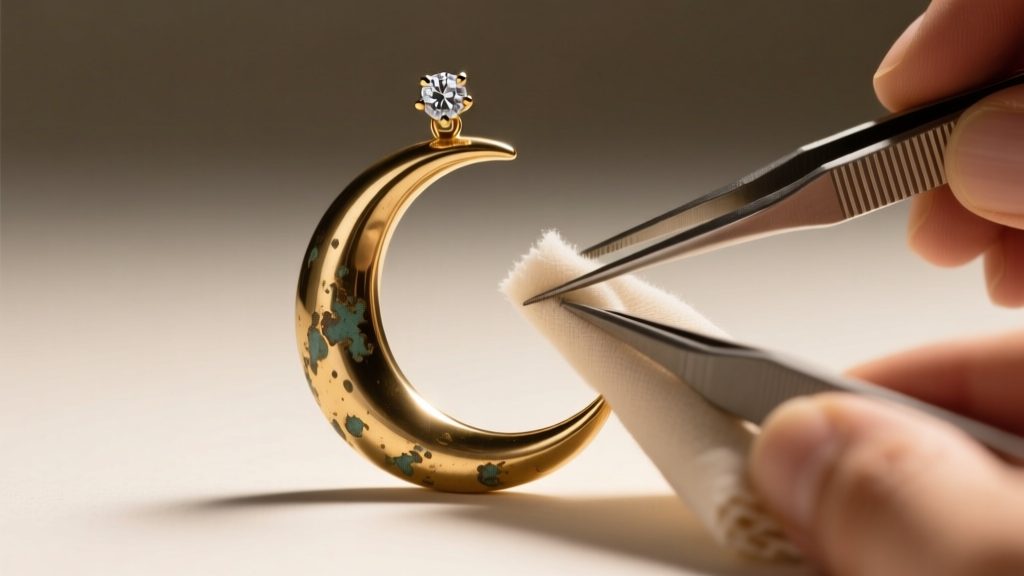
The celestial trend has flooded the market with affordable, fashion-grade jewelry. Many crescent and star necklaces are crafted from brass or copper alloys with a microscopic flash-plating of gold or rhodium. According to the Gemological Institute of America (GIA), flash plating is often less than 0.5 microns thick. The high-friction areas of a necklace—specifically the bail loop and the clasp contact points—will wear through this plating in a matter of weeks, exposing the reactive base metal to sweat and oxygen.
Addressing Plating Wear and Base Metal Oxidation
When the brass core of a crescent pendant is exposed, it reacts with the sulfur in human sweat, creating a green or black tarnish that can stain the skin and degrade the structural integrity of the bail. If your necklace is suffering from this, polishing will not fix it; it will only remove more of the remaining plating.
The Fix: You have two viable options. First, take the piece to a professional electroplater to have it re-plated with a minimum of 2.5 microns of hard gold or rhodium, which is the industry standard for durable jewelry plating. Second, if the piece is solid sterling silver and simply suffering from silver sulfide tarnish, use a specialized silver dip solution for exactly 10 seconds, followed by a thorough rinse in distilled water and a gentle buff with a microfiber cloth. Avoid abrasive pastes, as they will strip the oxidized detailing often used in the crevices of star and moon motifs to create contrast.
Clasp Slippage and Jump Ring Gauge Mismatches
A subtle but catastrophic failure point in delicate necklaces is the mismatch between the clasp mechanism and the terminal jump rings. Many mass-produced crescent and star necklaces use a 4mm spring-ring clasp paired with a 5mm open jump ring. Over time, the tension in the open jump ring relaxes, creating a microscopic gap. The thin wire of the spring-ring can easily slip through this gap, resulting in the loss of the pendant.
According to repair guidelines from Jewelers of America, all terminal jump rings on fine chains should be soldered closed, or at the very least, upgraded to a split ring (which functions like a miniature keyring). If your necklace features an open jump ring at the clasp, use a pair of chain-nose pliers to twist the ring closed laterally—never pull the ends apart outward, as this weakens the metal's temper and guarantees future failure.
Step-by-Step Restoration Guide
If your celestial necklace requires a full structural overhaul, follow this systematic approach to restore its functionality and aesthetics:
- Step 1: Ultrasonic Degreasing. Place the necklace in an ultrasonic cleaner with a mild, ammonia-free jewelry solution for 3 minutes. This removes accumulated sebum and cosmetics that stiffen the chain links and contribute to tangling. (Note: Do not use ultrasonic cleaners if your star or moon features fracture-filled diamonds or soft gemstones like opals or turquoise).
- Step 2: Bail Realignment. Assess the pendant's center of gravity. Mark the true balance point with a jeweler's scribe and have a professional resolder the bail to this exact coordinate.
- Step 3: Hardware Upgrade. Replace the factory spring-ring clasp with a 5mm or 6mm lobster clasp equipped with a 360-degree swivel. Solder the terminal jump rings permanently closed.
- Step 4: Surface Refinishing. If the gold or rhodium plating has worn thin at the friction points, send the piece to a specialized plating facility for a 2.5-micron heavy electroplate application.
- Step 5: Friction Reduction. Apply a microscopic layer of Renaissance Wax to the chain links. This museum-grade microcrystalline wax reduces metal-on-metal friction, preventing micro-knots while providing a temporary barrier against moisture and skin acids.
Expert Sourcing and Preventative Care
The ultimate solution to the structural flaws inherent in poorly engineered celestial jewelry is to invest in pieces designed with horological precision. When shopping for a new crescent and star necklace, look for brands that utilize fixed, integrated bails rather than free-floating jump rings, and those that specify their chain gauge and plating thickness. A well-engineered celestial pendant will feature a bail that is cast as a single unit with the moon or star, eliminating the weakest solder joint on the piece.
By understanding the mechanical and material realities of your jewelry, you can transition from constantly untangling and flipping your necklace to enjoying a flawless, enduring symbol of the cosmos. Proper maintenance, strategic hardware upgrades, and an understanding of center-of-mass physics will ensure your celestial pieces remain as timeless as the stars they represent.


