How to Stop Your Square Initial Necklace From Flipping
Is your square initial necklace constantly flipping? Discover expert troubleshooting tips to fix pendant rotation, chain tangling, and metal tarnish.

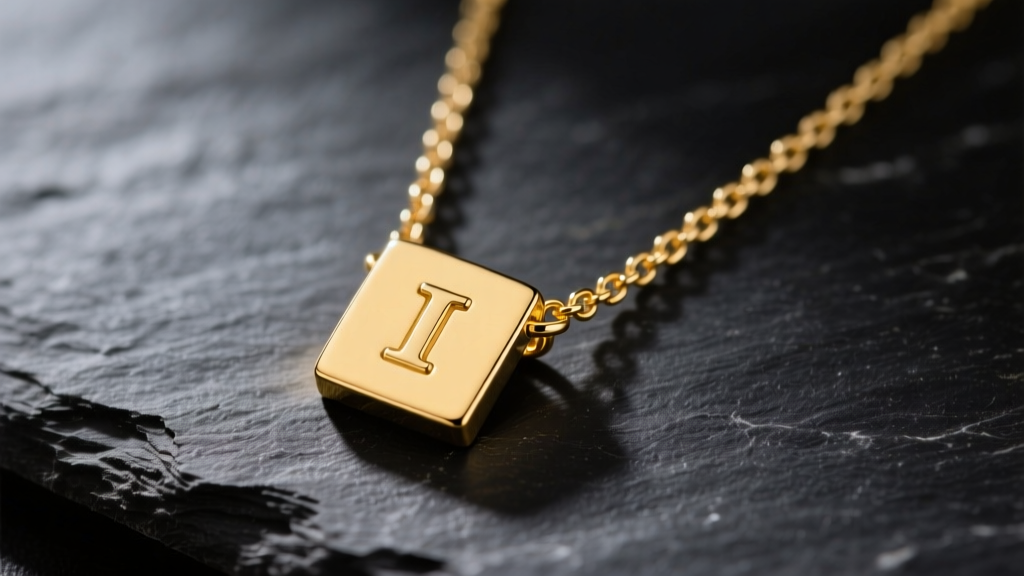
There is a unique frustration reserved for jewelry lovers who reach down to admire their personalized accessories, only to find the blank, unengraved back of their pendant staring back at them. The square initial necklace is a staple of modern minimalist jewelry, offering a sharp, geometric alternative to traditional circular monograms. However, its very shape creates a distinct set of mechanical and metallurgical problems. If your square initial necklace is constantly flipping, tangling, or showing premature wear at the corners, you are not dealing with bad luck—you are dealing with basic physics and jewelry engineering.
In this comprehensive troubleshooting guide, we will diagnose the exact reasons your square pendant refuses to lay flat, explore the metallurgy of corner tarnish, and provide actionable, jeweler-approved solutions to fix your favorite piece.
The Physics of the Flip: Why Square Pendants Rotate
Unlike circular pendants, which possess a uniform center of gravity and continuous radial symmetry, a square pendant has four distinct corners and a higher moment of inertia. When you move, the corners catch on your clothing or skin, creating rotational torque.
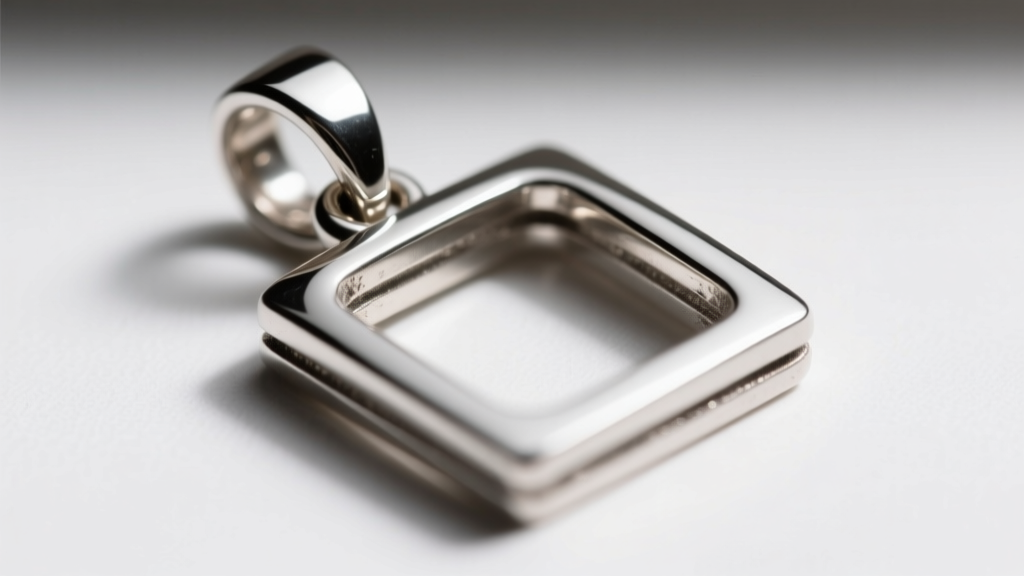
The primary culprit for the 'flip' is the bail—the loop that connects the pendant to the chain. Most mass-produced square initial necklaces use a simple soldered jump ring at the top center. According to engineering principles discussed by the Gemological Institute of America (GIA) regarding jewelry durability and wear, if the inner diameter of the bail is significantly larger than the thickness of the chain, the pendant gains a 180-degree pivot axis. Once the pendant flips backward, the flat back rests against your chest, and the chain settles into the new center of gravity, effectively locking it in the flipped position until you manually correct it.
The Clavicle Friction Factor
Square pendants typically measure between 12mm and 18mm across. At this size, the bottom corners often rest directly on the clavicle or the slope of the bust. Every time you breathe or shift your posture, the fabric of your shirt pushes against the bottom corners, acting as a lever that forces the top of the pendant (and the bail) to rotate forward over the chain.
Chain Selection: The Hidden Culprit of Tangling
The chain you pair with a square initial necklace dictates its torsional rigidity. Flimsy chains twist upon themselves, creating a spiral effect that forces the pendant to rotate. To solve the flipping issue, you must match the chain's structural integrity to the pendant's weight (usually 2.5 to 4.5 grams for solid metals).
| Chain Type | Gauge Recommendation | Torsional Rigidity | Flipping Risk | Tangling Risk |
|---|---|---|---|---|
| Cable Chain | 0.8mm - 1.0mm | Low | High | Medium |
| Box Chain | 1.1mm - 1.5mm | High | Low | Low |
| Wheat Chain | 1.0mm - 1.2mm | Medium | Medium | High |
| Rope Chain | 1.2mm - 1.6mm | Medium | Medium | High |
| Figaro Chain | 1.5mm+ | High | Low | Low |
The Fix: Swap your standard cable chain for a 1.2mm Box Chain. Box chains are constructed from square, interlocking links that lay completely flat and resist twisting. This structural stability prevents the chain from spiraling, drastically reducing the kinetic energy transferred to the pendant's bail.
Troubleshooting Metal Tarnish & Engraving Fade
Beyond mechanical flipping, square initial necklaces suffer from accelerated wear at their four corners. Corners are high-friction impact zones. If your necklace is gold vermeil (gold plated over sterling silver or brass) or gold-filled, the plating will inevitably wear off at the corners first, exposing the base metal to oxygen and skin acids.
Laser vs. Diamond-Drag Engraving Durability
How the initial is applied to the square face determines its lifespan.
- Laser Engraving: Uses a focused light beam to burn the surface. On plated metals, this often burns through the gold layer entirely, exposing the brass underneath and leading to rapid localized tarnishing.
- Diamond-Drag Engraving: Uses a physical diamond-tipped tool to carve into the metal. According to manufacturing standards from Rio Grande Jewelry Supply, diamond-drag is vastly superior for solid 14k gold because it displaces the metal rather than burning it away, ensuring the initial never 'fades' or changes color.
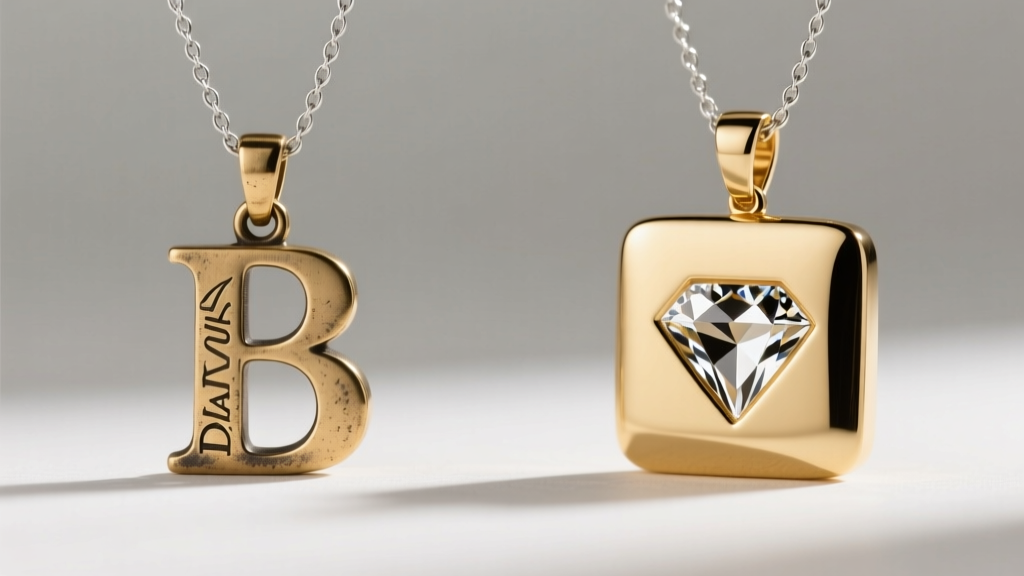
If your initial is fading, it is likely a laser-etched plated piece. The only permanent fix is to have a professional jeweler re-engrave the piece using a diamond-drag machine, provided the base metal is solid and not hollow or heavily plated.
Step-by-Step Fixes for Your Existing Necklace
You do not necessarily need to throw away a flipping square initial necklace. Here are three actionable troubleshooting steps, ranging from free DIY hacks to professional jeweler modifications.
1. The Counterweight Bead Trick (DIY)
Thread a small, 2mm to 3mm solid gold or sterling silver bead onto your chain. Slide the bead to the exact back of your neck, directly opposite the square pendant. This bead acts as a counterweight, altering the center of mass of the entire necklace system. The weight of the bead at the nape of your neck pulls the chain taut, creating enough tension at the front to restrict the bail's ability to rotate 180 degrees.
2. Upgrade to a Channel Bail (Jeweler Required)
Take your pendant to a local bench jeweler and ask them to remove the standard jump ring and solder on a channel bail or tube bail. Unlike a ring, a channel bail is a hollow rectangular or cylindrical tube that the chain passes directly through. This physically locks the pendant to the horizontal axis of the chain, making it mechanically impossible for the square to flip backward without the entire chain twisting.
3. The Clear Enamel Friction Mod (DIY)
Apply a microscopic, nearly invisible dot of clear jewelry-safe enamel (not standard nail polish, which contains harsh solvents that can react with copper alloys) to the two bottom corners on the back of the square pendant. This increases the friction coefficient against your skin and clothing, preventing the corners from sliding and initiating the flip.
Sourcing a Flawless Replacement: What to Look For
If your current square initial necklace is beyond repair—perhaps the plating has completely worn off the corners, or the initial was laser-etched too shallowly—it is time to source a replacement. When shopping for a square initial necklace that will not flip or tarnish, use this E-E-A-T checklist:
'A well-engineered square pendant requires a low-profile bail and a chain with high torsional memory. Never pair a heavy geometric pendant with a fluid, high-drape chain like a snake chain; the mechanics will always fail.' — Master Bench Jeweler
- Material: Opt for solid 14k gold (yellow or white) or 316L surgical stainless steel. Avoid gold-plated brass entirely for square shapes due to corner friction wear.
- Bail Type: Look for product photos that show a 'hidden bail' (soldered flush to the back of the square) or a 'V-bail'. These keep the pendant anchored flat against the chest.
- Thickness: Ensure the square pendant is at least 1.2mm thick. Thinner, stamped sheet-metal pendants (often 0.6mm) are prone to warping and bending at the corners when caught on a sweater.
Final Verdict
A flipping square initial necklace is a failure of mechanical pairing, not a defect in the jewelry itself. By understanding the physics of geometric pendants, upgrading to a torsionally rigid box chain, and utilizing counterweights or channel bails, you can permanently solve the rotation issue. Furthermore, by prioritizing diamond-drag engraving and solid metals over plated alternatives, you ensure that the sharp corners of your initial necklace remain pristine for decades.


