Troubleshooting Your Giant Cross Necklace: Weight & Chain Fixes
Is your giant cross necklace snapping chains or flipping over? Learn expert troubleshooting for chain weight, bail sizing, and material upgrades.
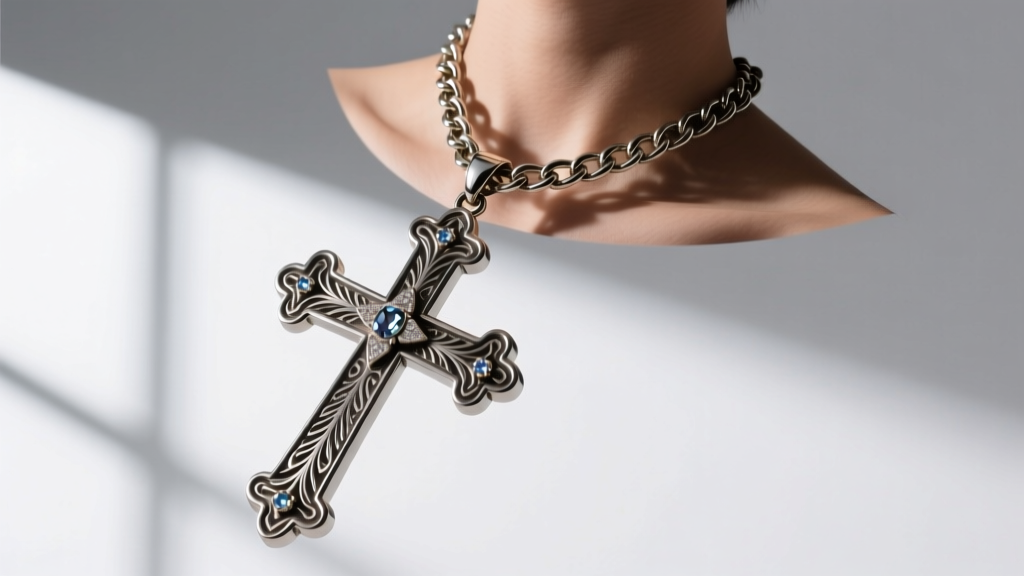

Oversized religious and gothic jewelry has dominated streetwear and high-fashion runways well into 2026, but wearing a giant cross necklace introduces unique mechanical and ergonomic challenges. When a pendant exceeds 50 grams, standard jewelry engineering fails. Chains snap, clasps pop open, bails wear through, and the pendant swings violently against the sternum. This guide bypasses generic styling advice to address the structural physics, metallurgical fatigue, and hardware failures inherent to heavy, oversized pendants, providing actionable troubleshooting steps to secure and stabilize your piece.
The Physics of Heavy Pendants: Why Chains Snap
The most common failure point in a giant cross necklace is not the chain links themselves, but the connection points: the clasp and the jump ring holding the bail. A solid brass or stainless steel cross measuring 3.5 inches by 2.5 inches can easily weigh between 85 and 120 grams. When you walk, the pendant acts as a pendulum, generating kinetic energy that multiplies the static weight by a factor of three to five during sudden movements.
This dynamic load creates a 'guillotine effect' at the weakest link. Standard 10mm lobster clasps are rated for roughly 30-40 grams of tensile stress before the internal spring mechanism deforms or the lever bends. Similarly, standard open jump rings will slowly pull apart under cyclical heavy loading. The Fix: Upgrade your clasp to a 15mm+ heavy-duty lobster clasp or, ideally, a custom box clasp with a figure-8 safety catch. For the jump ring connecting the pendant to the chain, insist on a laser-welded or soldered closed jump ring with a minimum wire thickness of 1.2mm (16-gauge).
Chain Upgrades: Matching Gauge and Link Style
Pairing a massive cross with a delicate or structurally unsound chain is a recipe for disaster. Snake chains and herringbone chains, while beautiful, possess terrible kink resistance and lack the structural integrity to support heavy loads. Once a herringbone chain kinks under the weight of a heavy cross, the work-hardened metal becomes brittle and will inevitably snap.

For pendants over 50g, you must utilize chains with interlocking or welded links that distribute tension laterally. According to metallurgical standards outlined by the Gemological Institute of America (GIA), the tensile strength of sterling silver and gold alloys varies greatly depending on the cold-working process. A 4mm to 6mm gauge is the absolute minimum for a giant cross necklace.
Chain Weight Capacity Matrix
| Chain Style | Min. Gauge for Heavy Pendants | Max Safe Weight Capacity | Kink Resistance |
|---|---|---|---|
| Franco / V-Braid | 4.0mm - 5.0mm | 150g - 250g | Excellent |
| Cuban / Curb | 5.0mm - 6.0mm | 120g - 200g | Very Good |
| Mariner / Anchor | 4.5mm - 5.5mm | 100g - 180g | Good |
| Rope (Solid Core) | 4.0mm - 5.0mm | 130g - 220g | Excellent |
| Herringbone / Snake | N/A (Do Not Use) | < 30g | Poor |
Bail Troubleshooting: Preventing the Pendulum Effect
Does your giant cross necklace constantly flip upside down or swing aggressively to the side? This is known as the pendulum effect, and it is caused by a mismatch between the bail's inner diameter and the chain's width, combined with an off-center center of gravity. If a 5mm chain slides freely inside a 12mm bail, the pendant has too much lateral play, causing it to twist and strike the chest.
Sizing the Bail Correctly
The inner diameter of the bail should be no more than 1.5mm to 2mm wider than the chain's thickness. If your cross already has an oversized bail, you have two troubleshooting options:
- Install a Bail Insert: A jeweler can solder a hardened steel or platinum sleeve inside the existing bail to reduce the inner diameter, preventing excessive sliding and protecting softer metals like 18k gold from friction wear.
- Switch to a Tapered V-Bail: For extremely heavy, top-heavy crosses, replacing a standard tubular bail with a V-shaped or hidden diamond-cut bail forces the chain to sit at a fixed fulcrum point, drastically reducing lateral swing.
Material Fatigue and Skin Contact Issues
A giant cross necklace covers a significant surface area of the sternum, leading to high friction, sweat accumulation, and heat retention. Base metals commonly used in fast-fashion oversized jewelry—such as zinc alloys, brass, and nickel-silver—will rapidly oxidize in this environment, causing severe contact dermatitis and green skin staining.
When dealing with large surface-area pendants, always verify the exact alloy grade. 'Surgical steel' is a marketing term; you must look for 316L stainless steel or Grade 5 Titanium (Ti-6Al-4V) for guaranteed hypoallergenic performance, as noted in GIA's metallurgical guides on skin-safe alloys.
If you are investing in precious metals, 14k or 18k solid gold is superior to gold-plated brass. The plating on a 3-inch cross will wear through on the back edge within six months of daily wear due to sternum friction. If you prefer sterling silver, ensure it is plated with at least 0.5 to 1.0 microns of rhodium to create a hard, tarnish-resistant barrier against sweat and body oils.

Length and Proportion: Stopping the Sternum Strike
The length of the chain dictates how the weight of the cross interacts with your body's geometry. A common mistake is wearing a giant cross on a standard 18-inch or 20-inch chain. At this length, a heavy pendant rests directly on the collarbone or upper sternum, acting as a blunt instrument against the bone when you bend over or walk down stairs.
The Fix: For crosses exceeding 3 inches in height, the chain must be sized between 24 and 28 inches. This drops the pendant to the solar plexus or lower sternum, allowing it to rest flat against the soft tissue of the abdomen or chest. Furthermore, a longer chain creates a shallower parabolic curve, which distributes the weight more evenly across the cervical spine (the back of the neck), reducing neck strain and fatigue during all-day wear.
Quick Troubleshooting Checklist
Before wearing your giant cross necklace out, run through this mechanical safety checklist:
- The Pull Test: Hold the clasp and the bottom of the cross, applying moderate outward pressure. If the jump ring gap widens even slightly, it must be soldered closed.
- The Friction Check: Run your fingernail along the inside of the bail. If you feel deep grooves, the metal is thinning and requires a jeweler's laser weld to prevent a catastrophic drop.
- The Clasp Spring: Push the lever of the lobster clasp. It should snap back with aggressive tension. A sluggish return indicates internal spring fatigue; replace the clasp immediately.
- The Swing Test: Put the necklace on and jog in place for ten seconds. If the cross flips upside down, the bail-to-chain ratio is incorrect and requires a V-bail modification.
By treating your oversized jewelry as a mechanical system rather than just an accessory, you can preserve the structural integrity of the piece and wear it with absolute confidence.