Gold Plumeria Necklace Troubleshooting: Fixes & Care
Is your gold plumeria necklace tarnished or broken? Learn expert troubleshooting steps to fix bent petals, restore plating, and prevent chain tangles.

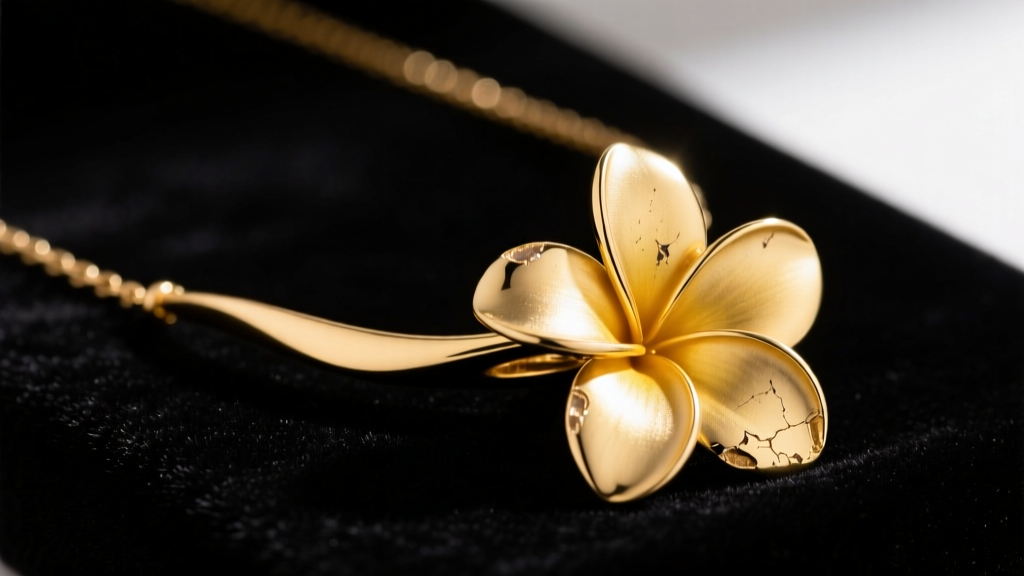
The gold plumeria necklace is a beloved staple in tropical-inspired and botanical jewelry collections. With its five distinct, sweeping petals and delicate center detailing, this floral pendant captures a sense of island elegance. However, the very features that make the plumeria flower pendant beautiful—its intricate edges, protruding petal tips, and mixed-material centers—also make it highly susceptible to specific types of wear and damage. Whether you are dealing with fading gold vermeil, a snagged and bent petal, or a pendant that refuses to lay flat, troubleshooting these issues requires a precise understanding of jewelry metallurgy and structural mechanics.
In this comprehensive 2026 guide, we dive deep into the most common failure modes of gold plumeria necklaces and provide actionable, expert-level solutions to restore your piece to its original glory.
The Anatomy of a Gold Plumeria Pendant: Where Failures Occur
Before attempting any repairs, it is crucial to understand the structural vulnerabilities of a plumeria pendant. Unlike simple geometric pendants, a plumeria design features five asymmetrical or semi-symmetrical petals that overlap. The tips of these petals extend outward, making them prime targets for snagging on clothing, hair, or towels. Furthermore, the center of the plumeria often houses a small cubic zirconia, a pearl, or a drop of vitreous enamel to mimic the flower's natural yellow or pink throat. This multi-material construction means that aggressive cleaning methods can easily destroy the center stone's setting or strip the enamel while trying to polish the gold.
According to the Gemological Institute of America (GIA), mixed-material jewelry requires compartmentalized care. What works for the gold exterior may degrade the adhesive holding the center stone or cloud the enamel finish. Therefore, all troubleshooting must begin with a careful visual inspection under a 10x jeweler's loupe to identify the exact material composition of your specific pendant.
Troubleshooting Tarnish and Gold Plating Wear
The most frequent complaint regarding gold botanical necklaces is the loss of luster or the appearance of dark, tarnished patches. To troubleshoot this, you must first identify whether your necklace is solid gold, gold vermeil, or standard gold-plated brass. The Federal Trade Commission (FTC) strictly regulates these terms, and knowing the difference dictates your restoration strategy.
Vermeil vs. Gold Plated: Identifying Your Finish
Gold vermeil consists of a thick layer of gold (minimum 2.5 microns) bonded over a .925 sterling silver base. Standard gold plating is often a much thinner layer (0.5 to 1.0 microns) applied over a brass or copper alloy. If your necklace is leaving a green or black mark on your skin, the gold layer has worn through to the base metal.
| Material Type | Base Metal | Gold Thickness | Tarnish Behavior | Restoration Method |
|---|---|---|---|---|
| Solid 14k/18k Gold | Gold Alloy | 100% | Does not tarnish; may accumulate oils | Ultrasonic cleaning, professional polishing |
| Gold Vermeil | .925 Sterling Silver | ≥ 2.5 microns | Darkens/blackens as silver oxidizes through pores | Mild soap wash; professional replating if worn |
| Gold Plated | Brass/Copper | < 2.5 microns | Turns skin green; copper bleeds through | Avoid abrasives; requires complete stripping and replating |
The Fix: Never use commercial silver dip solutions or abrasive polishing cloths (like Sunshine cloths) on gold vermeil or plated plumeria pendants. These contain micro-abrasives and harsh chemicals that will strip the thin gold layer instantly. Instead, use a pH-neutral dish soap and a soft-bristled baby toothbrush to gently clean the crevices between the petals. If the gold has completely worn off the high-friction areas (like the petal tips), the only permanent fix is to take the piece to a jeweler for electroplating. They will strip the remaining gold, polish the base metal, and apply a fresh 2.5-micron layer of 14k or 18k gold.
Fixing Physical Damage: Bent Petals and Bail Breakage
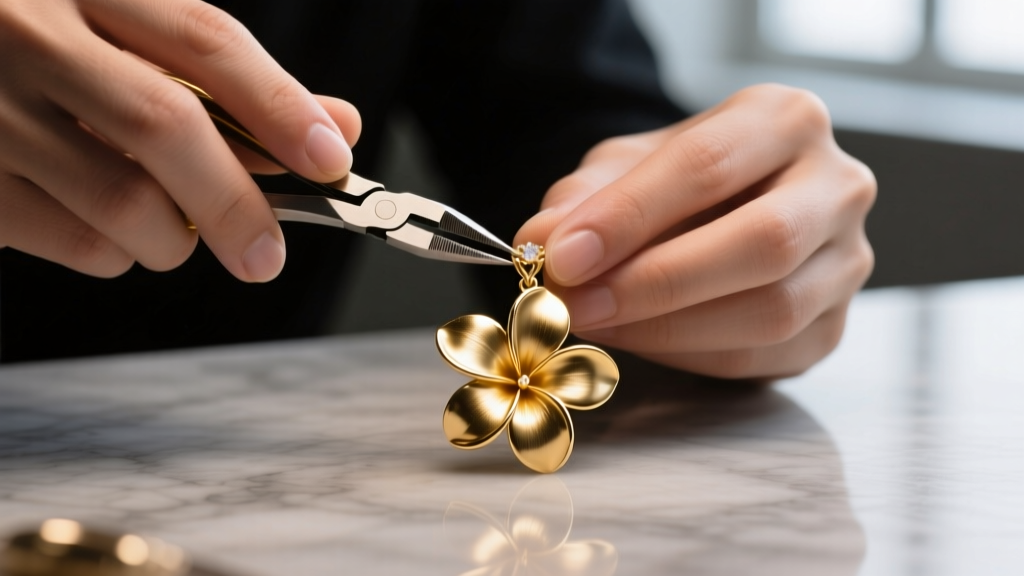
Because the plumeria design relies on the graceful curve of its petals, even a minor bend can ruin the aesthetic of the necklace. Petal tips frequently catch on knit sweaters or towel loops, pulling the metal outward. If your pendant is made of solid gold or thick vermeil, the metal is malleable enough to be reshaped at home, but doing so with standard steel tools will permanently mar the finish.
Step-by-Step Petal Reshaping
- Acquire Nylon-Jaw Pliers: Standard metal pliers will scratch the gold and crush the metal. Nylon-jaw pliers provide a soft, grippy surface that protects the finish.
- Support the Base: Hold the center of the plumeria firmly with your thumb and forefinger to prevent the stress from transferring to the bail or the center stone setting.
- Apply Gradual Pressure: Gently squeeze the bent petal tip back into alignment. Do not bend it past the center line, as gold alloys (especially 14k and 18k) are subject to work hardening. Bending it back and forth will cause the petal tip to snap off entirely.
- Check the Prongs: If the bend occurred near the center stone, inspect the prongs holding the gem. If a prong is lifted, stop immediately and consult a professional.
Solving the "Upside-Down Pendant" Problem
A uniquely frustrating issue specific to asymmetrical or wide floral pendants like the plumeria is the "pendant flip." This occurs when the necklace is worn, and the pendant constantly rotates upside down or sideways, hiding the flower's face. This is not a defect in the jewelry, but rather a physics issue related to the center of gravity.
"The pendant flip happens when the bail (the loop the chain passes through) is positioned too low relative to the pendant's center of mass, or when the chain is too heavy and stiff, preventing the bail from rotating freely." — Master Bench Jeweler
The Fix: First, evaluate your chain. Heavy chains (like thick box chains or 16-gauge rope chains) have large, stiff links that cannot easily pass through the small bail of a delicate plumeria pendant. Switch to a lightweight, highly flexible chain, such as a 1.2mm to 1.5mm cable chain or a fine wheat chain. These chains drape fluidly, allowing the pendant's bail to self-correct and keep the flower facing forward. If the chain is already light and the problem persists, a jeweler can solder a small, hidden counterweight bead to the back bottom edge of the pendant to artificially lower its center of gravity.
Chain Tangles and Clasp Failures
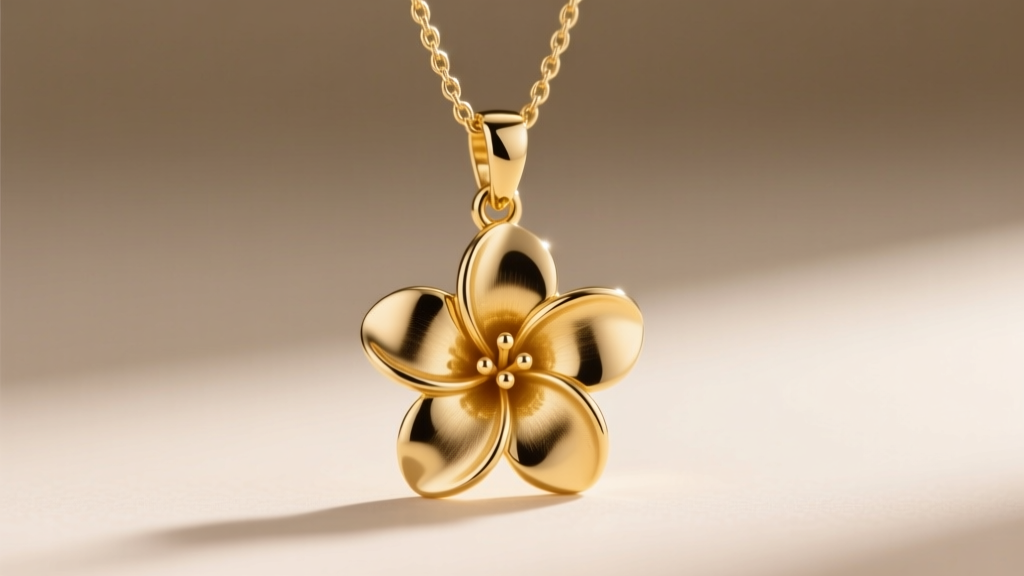
The sweeping tips of the plumeria pendant are notorious for catching on the links of certain chains, particularly box chains and herringbone chains. When a petal tip wedges itself between chain links, it creates a severe tangle that can kink and permanently weaken the chain.
To prevent this, avoid chains with flat, interlocking geometric links. Opt for smooth, rounded chains like snake chains or traditional round cable chains. If your chain has already suffered a kink due to a petal snag, do not pull it tight. Lay the chain flat on a hard surface, apply a single drop of baby oil to the kink to reduce friction, and use two fine sewing needles to gently tease the links apart from the center outward. Once untangled, clean the oil off with a mild degreasing soap to prevent skin irritation.
Regarding clasp failures, the standard spring-ring clasps included with many botanical necklaces are notoriously difficult to operate and prone to internal spring fatigue. Upgrading to a 5mm or 6mm lobster clasp provides a more secure closure and is significantly easier to manipulate, reducing the strain on the chain's end jump rings.
When to Call a Professional Jeweler
While home troubleshooting can resolve surface tarnish, minor bends, and chain mismatches, certain damage requires professional intervention. According to Jewelers Mutual, attempting DIY repairs on structurally compromised jewelry often leads to total loss of the piece. You must take your gold plumeria necklace to a certified bench jeweler if:
- The bail (the loop connecting the pendant to the chain) is cracked or completely detached. Laser welding is required to reattach it without melting the delicate petal tips.
- The center enamel throat is chipped or cracked. Enamel repair requires a kiln and specialized vitreous glass powders that match the original hue.
- The gold plating has worn down to the base metal over more than 30% of the surface area, requiring a full chemical strip and electroplating bath.
By understanding the specific mechanical and chemical vulnerabilities of the gold plumeria necklace, you can transition from frustrated wearer to informed custodian, ensuring your botanical jewelry remains a vibrant, trouble-free staple in your collection for years to come.


