Fixing a Twisting Coller Necklace: Collar Choker Troubleshooting
Is your coller necklace constantly twisting or irritating your skin? Discover expert troubleshooting tips, clasp fixes, and sizing hacks for collar chokers.

The Engineering Flaw: Why Your Collar Choker Keeps Twisting
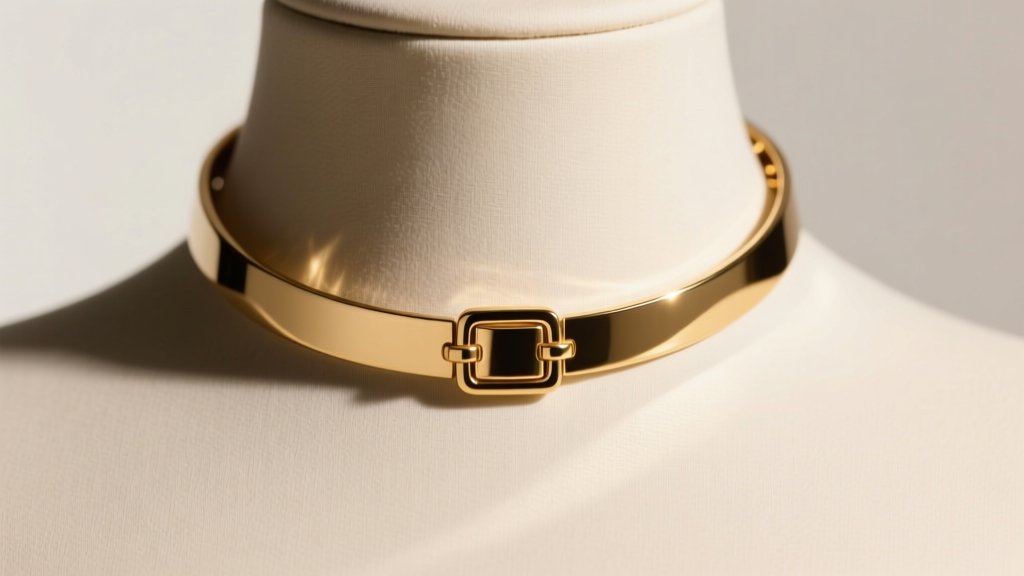
When consumers search for a 'coller necklace'—a common phonetic spelling for the rigid collar choker—they are usually looking for a sleek, architectural piece that sits perfectly flush against the collarbone. However, this specific silhouette is notoriously prone to a frustrating mechanical failure: the perpetual twist. Unlike draping chain necklaces that naturally settle due to gravity and link flexibility, a rigid collar acts as a fixed lever around the cylindrical axis of your neck.
The root cause of the twist is almost always an imbalance in the center of gravity. If the front-facing focal point of the necklace (such as a 15-gram geometric quartz pendant or a dense 14-gauge gold centerpiece) outweighs the rear clasp assembly (which typically weighs less than 3 grams), rotational torque occurs. Every time you turn your head, the heavier front pulls downward, forcing the clasp to migrate from the nape of your neck to your cheekbone.
The Counterweight Solution
To fix this, you must artificially restore the weight distribution. Jewelers solve this by integrating a counterweight into the posterior segment of the collar. If you are retrofitting an existing piece, you can slide a dense tungsten or sterling silver 'balance bead' (weighing roughly 60% of the front pendant's mass) onto the back wire or chain segment just before the clasp. For solid, unyielding metal collars that cannot be threaded, a jeweler can laser-weld a discreet 5-gram platinum or gold counterweight tag directly to the interior of the nape curve.
Clasp Failures: Upgrading the Weakest Link
The hardware on a collar choker endures immense lateral stress. Standard lobster clasps, while fine for lightweight cable chains, routinely fail on rigid collars. The torque applied when taking a stiff 12-gauge wire collar on and off easily bends the tiny spring-loaded lever inside a standard lobster clasp, leading to a compromised seal and eventual loss of the piece.
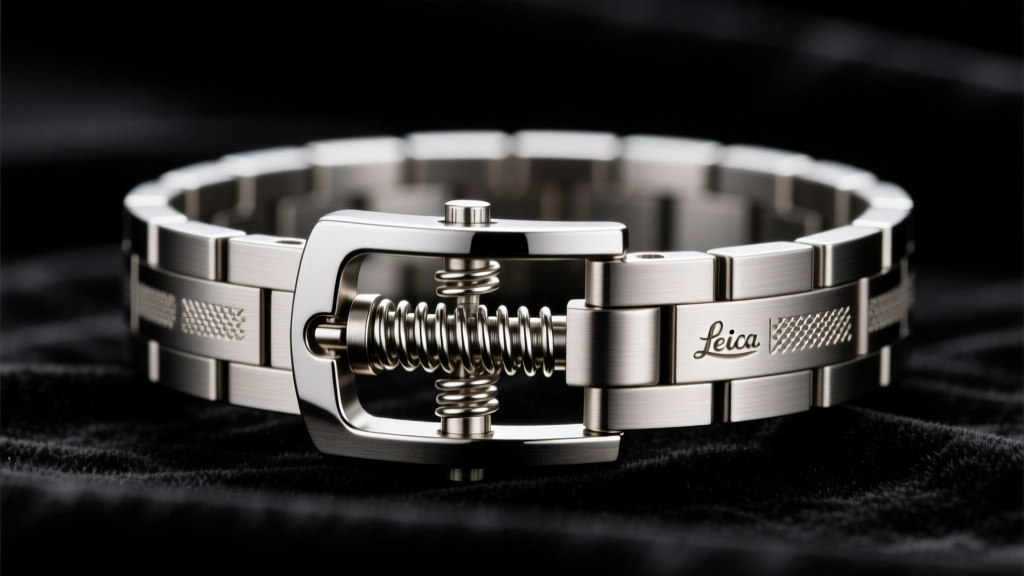
According to manufacturing standards outlined by the Jewelers of America, rigid neckpieces require locking mechanisms that distribute tension across a broader surface area. If your collar necklace keeps popping open, you need to upgrade the findings:
- Box Clasp with Figure-8 Safety: The gold standard for rigid collars. The tongue slides into a V-spring box, and the secondary figure-8 wire latch catches a side pin, providing redundant security against lateral torque.
- N52 Neodymium Magnetic Clasps: Ideal for semi-rigid collars. Ensure the housing is machined from 316L stainless steel and features a snap-lock outer sleeve. Bare magnets will eventually chip and lose polarity if they strike each other repeatedly without a protective metal shell.
- Bayonet Clasps: Common in modern titanium and tungsten carbide collars. These require a push-and-twist motion that is virtually immune to accidental unfastening from neck movement.
Skin Irritation and Tarnish: Material Grade Diagnostics
Because a collar necklace sits tightly against the pulse points and the hollow of the throat, it is exposed to high levels of sebum, sweat, and friction. If your skin is turning green or developing contact dermatitis, the metallurgical composition of your jewelry is to blame.
Many mass-market 'gold' collars are actually brass (an alloy of copper and zinc) with a microscopic 0.5-micron flash plating. Human sweat has a slightly acidic pH (typically between 4.5 and 6.0). When this acid breaks through the thin gold layer and reacts with the copper in the brass base, it creates copper chloride—a green salt that stains the skin and causes itching. For high-friction zones like the neck, the Gemological Institute of America (GIA) strongly advises against porous or reactive base metals.
| Metal Grade | Friction & Sweat Resistance | Allergy Risk | Average Price Range (14' Choker) |
|---|---|---|---|
| Brass with Flash Plating | Poor (Tarnishes in 2-4 months) | High (Nickel/Copper) | $25 - $60 |
| 316L Stainless Steel | Excellent (Contains Molybdenum) | Moderate (Contains trace Nickel) | $40 - $120 |
| ASTM F136 Titanium | Superior (Biocompatible) | Zero (Hypoallergenic) | $80 - $250 |
| Solid 14k / 18k Gold | Excellent (Will not turn skin green) | Low (Depends on alloy mix) | $800 - $2,500+ |
If you are experiencing irritation from a steel collar, verify if it is surgical grade (316L) or commercial grade (304). Commercial 304 steel has higher nickel content and lower corrosion resistance, making it unsuitable for tight-fitting collar chokers worn during physical activity.
Sizing Disasters: The Caliper Method for Rigid Collars
Unlike a chain that drapes and forgives a half-inch miscalculation, a solid metal collar must match the exact topography of your neck. A collar that is too tight will restrict swallowing and cause chafing; one that is too loose will slide off the shoulders and gap awkwardly at the front.
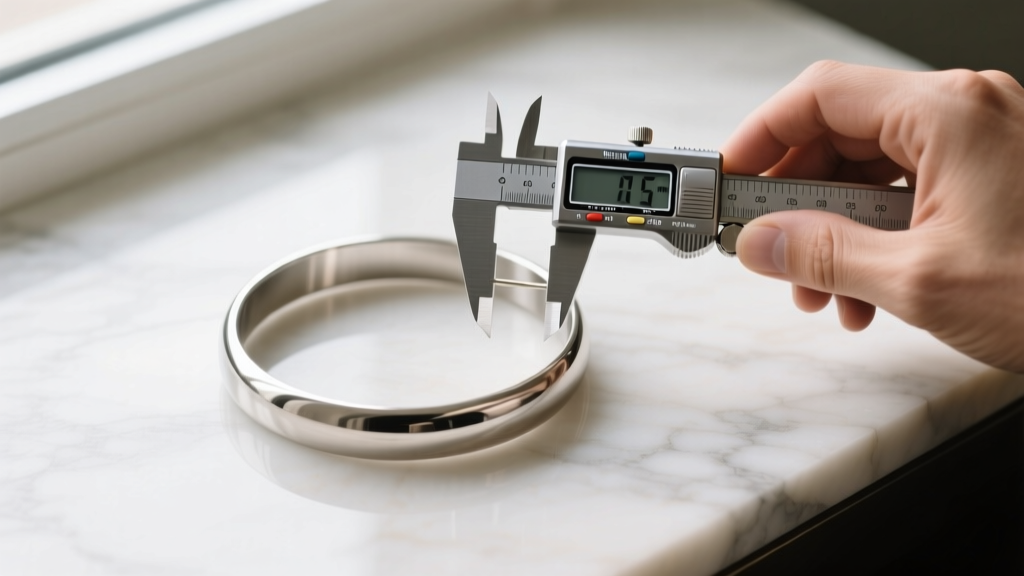
To achieve a flawless fit, abandon the standard string-and-ruler method. Instead, use the digital caliper technique favored by bespoke bench jewelers:
- Measure the Circumference: Use a flexible fiberglass tailor's tape measure around the exact point on your neck where you want the collar to rest (usually the base of the neck, just above the clavicle).
- Calculate the Diameter: Divide your circumference measurement by Pi (3.14159). For example, a 15-inch circumference yields a 4.77-inch inner diameter.
- Add the Breathing Allowance: Add exactly 0.25 to 0.5 inches to your total circumference to account for neck expansion when swallowing or looking down.
- Verify the Oval Shape: Human necks are not perfect circles; they are oval. A high-quality rigid collar should be forged into an elliptical shape (e.g., 5.5 inches wide by 4.2 inches deep) rather than a perfect circle, ensuring it sits flush against the collarbones without jutting out at the sides.
Hinge Tension and Hair Snagging
Many rigid collars feature a hidden hinge on one side and a clasp on the other to allow the piece to open and close around the neck. The hinge is a critical failure point. If the internal steel spring pin is under 0.8mm in diameter, it will eventually shear under the repetitive tension of daily wear. When inspecting a hinged collar, look for a pin diameter of at least 1.0mm, and ensure the hinge barrel is fully soldered to the collar body rather than merely glued or crimped.
Furthermore, exposed hinges and the tiny gaps around box clasps are notorious for catching and tearing fine hair. To troubleshoot this without compromising the aesthetic, apply a microscopic layer of clear, jewelry-safe UV resin over the hinge seam, or use a specialized silicone jewelry guard sleeve that slips over the clasp mechanism. This creates a frictionless bridge that allows hair to glide over the hardware rather than snagging in the mechanical joints.
Final Verdict: Repair vs. Replace
A high-quality collar necklace is an investment in structural jewelry design. If your piece is suffering from rotational twisting, a simple counterweight addition by a local bench jeweler (typically costing between $30 and $75) can completely rehabilitate the wearability of the piece. However, if your collar is exhibiting green tarnish, skin rashes, or microscopic stress fractures near a sub-1mm hinge pin, the metallurgical and structural integrity is compromised. In these cases, no amount of troubleshooting will fix a fundamentally flawed base metal or poorly engineered hinge, and upgrading to an ASTM F136 titanium or solid gold elliptical collar is the only permanent solution.


