French for Necklace: Troubleshooting Antique Collier Clasps & Hallmarks
Discover the French for necklace (collier) and learn expert troubleshooting for antique French clasps, metric chain sizing, and authenticating hallmarks.


The Translation and the Trap: Why 'Collier' Matters
If you have ever typed 'french for necklace' into a search engine, you already know the direct translation is collier. However, in the context of fine jewelry acquisition, restoration, and appraisal, simply knowing the word is not enough. As of 2026, the secondary market for authenticated French Belle Époque and Art Deco jewelry has surged, bringing a wave of new collectors into contact with antique French pieces that operate on entirely different mechanical and metallurgical standards than modern American or British jewelry.
When you are troubleshooting a vintage French collier, you are not just dealing with a language barrier; you are dealing with metric chain sizing, unique historical hallmarking laws, and specialized clasp mechanisms that often baffle modern bench jewelers. This guide moves past basic translation to solve the real-world problems collectors and jewelers face when handling, repairing, and authenticating antique French necklaces.
Decoding French Necklace Terminology
Before troubleshooting a broken chain or assessing a clasp, you must accurately identify the style of the collier from its original French inventory descriptions. Misidentifying these can lead to incorrect restoration practices.
- Sautoir: A long necklace, often ending in a tassel or detachable pendant, designed to be looped or knotted. Troubleshooting tip: Sautoirs from the 1920s frequently suffer from stress-fractures at the loop points due to the weight of the swinging tassel.
- Ras de cou: The French equivalent of a choker, sitting tightly against the base of the neck. Often features a rigid metal collar or a tightly linked chain.
- Rivière: A necklace featuring a continuous line of identically sized gemstones. The French bezel settings on antique rivières are notoriously thin and prone to wearing through at the gallery wire.
- Esclavage: A multi-chain necklace where several chains suspend from a central upper chain, often featuring sliding pendants. The friction sliders on these pieces frequently lose their grip over a century of wear.
Troubleshooting the Infamous French Trombone Clasp
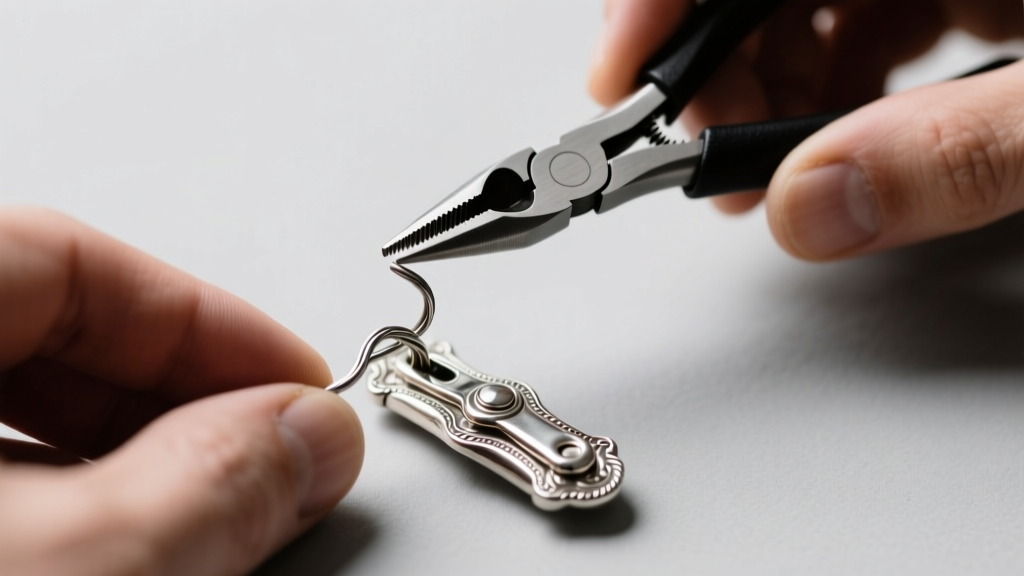
The most common mechanical failure on a late 19th or early 20th-century French collier involves the trombone clasp (also known as a push-pull or barrel clasp with a V-spring). Unlike modern lobster clasps, the trombone clasp relies on a tensioned V-shaped spring that slides into a cylindrical barrel, secured by a secondary figure-8 safety catch.
Problem: The Safety Catch Will Not Stay Closed
The figure-8 safety wire on French antique necklaces is typically made of high-carat gold or silver, which is highly malleable. Over decades of use, the wire bends outward, failing to catch the secondary ring.
The Amateur Mistake: Using standard steel flat-nose pliers to bend the wire back into place. This causes two issues: first, steel pliers will mar the soft 18k gold or 800 silver; second, repeatedly bending the wire causes work hardening, making the metal brittle and leading to an inevitable snap.
The Expert Solution: Use nylon-jaw pliers to gently reshape the safety loop. If the wire has already become work-hardened and stiff, a master bench jeweler must carefully anneal the specific wire loop using a micro-torch and flux before reshaping it, followed by a gentle polish to remove oxidation. Never replace an original French safety catch with a modern lobster clasp; doing so instantly destroys the piece's historical integrity and significantly lowers its resale value at auction.
Problem: The V-Spring Slips Out of the Barrel
If the internal V-spring slides out too easily, the tension has been compromised. Do not pull the spring outward to 'stretch' it, as this alters the geometry of the base joint. Instead, the barrel interior must be cleaned with an ultrasonic bath to remove decades of compacted skin oils and polishing compound, and the V-spring should be carefully squeezed inward by a fraction of a millimeter using smooth-jawed parallel pliers to restore friction.
Authenticating French Gold and Silver Hallmarks
When verifying an antique collier, you cannot rely on stamped karat numbers like '18K' or '750'. France has utilized a strict, government-mandated pictorial hallmark system since the early 19th century. According to the Lang Antiques University, understanding these microscopic stamps is the only way to guarantee the metallurgical authenticity of a French piece.
| French Hallmark Name | Visual Description | Metal & Purity | Era of Primary Use |
|---|---|---|---|
| Tête d'aigle (Eagle Head) | Profile of an eagle's head | 18k Gold (750/1000) | 1838 - Present |
| Minerve 1er titre | Profile of Minerva with helmet | 950 Silver (1st Standard) | 1838 - Present |
| Minerve 2e titre | Profile of Minerva with helmet | 800 Silver (2nd Standard) | 1838 - Present |
| Tête de sanglier | Profile of a boar's head | 800 Silver | 1838 - 1962 |
| Tête de chien | Profile of a dog's head | 18k Gold (Import/Export) | 1864 - 1919 |
To properly view these marks on a delicate French chain, you need a 10x or 20x triplet loupe and a fiber-optic pinpoint light source. The Assay Office London notes that French hallmarks are often struck on the exterior of the jump ring or directly on the clasp barrel. If a piece claims to be French 18k gold but lacks the Tête d'aigle, it is either a later reproduction, an export piece meant for a different market, or a forgery.

Sizing and Metric Chain Link Mismatches
One of the most frustrating troubleshooting scenarios for a jeweler is attempting to repair a broken link on a French collier using standard American jump rings. French chains are manufactured using strict metric wire gauges and outer diameters (OD).
For example, a delicate French cable chain might use a 0.8mm wire with a 2.5mm OD. In the US, a standard 20-gauge jump ring is roughly 0.81mm thick, but US suppliers typically stock them in 3.0mm or 4.0mm ODs. If you force a 3.0mm jump ring into a 2.5mm link pattern, the chain will kink, catch on clothing, and eventually snap due to uneven stress distribution.
Sourcing the Correct Metric Links
To properly troubleshoot and repair a broken French chain, you must source metric-specific jump rings. Look for suppliers that stock 'French wire' or 'metric precise' jump rings, measured strictly in millimeters (e.g., 0.7mm wire x 2.2mm OD). When soldering these links, use a low-temperature, cadmium-free easy solder (flowing around 650°C) to prevent melting the incredibly thin antique links, which often have microscopic seams from historical manufacturing techniques.
Final Thoughts on Preserving the Collier
A French antique necklace is not merely an accessory; it is a mechanical artifact of its era. Respecting its original engineering—from the tension of the trombone clasp to the precise metric gauge of its chain—is the hallmark of true jewelry preservation.
Understanding that the 'french for necklace' is a collier is just the first step. True expertise lies in recognizing the Tête d'aigle under a loupe, knowing how to anneal a work-hardened safety catch, and refusing to compromise a 120-year-old chain with ill-fitting modern parts. As the appreciation for historical jewelry continues to grow in 2026, the ability to troubleshoot and maintain these specific European masterpieces remains an invaluable skill for collectors and jewelers alike. For further reading on historical metallurgy and authentication, the Gemological Institute of America (GIA) offers extensive archives on European jewelry history and hallmark evolution.


