The Gayle King Star Necklace Today: Expert Specs & Guide
Analyze the Gayle King star necklace today: an expert deep dive into exact diamond specs, chain gauges, and pave settings for broadcast-ready pendants.

The Broadcast Jewelry Phenomenon: Beyond the Glamour
When analyzing the Gayle King star necklace today, we must look past the celebrity glamour and examine the bench-level engineering that makes a piece of jewelry survive the rigors of daily national television. As a co-host of CBS Mornings, King’s jewelry is subjected to intense 4K and 8K studio lighting, constant movement, and the friction of high-end broadcast wardrobes. The iconic star pendant she frequently wears is not just a stylistic choice; it is a masterclass in durable, high-impact jewelry design. In 2026, as broadcast resolutions become even more unforgiving, the technical specifications of celebrity jewelry have become a blueprint for serious collectors and bench jewelers alike.
This expert deep dive dissects the exact anatomy, metallurgical choices, and diamond grading requirements necessary to replicate and maintain a broadcast-ready star pendant. We will explore why certain setting styles fail under studio conditions and how to engineer a chain assembly that prevents catastrophic loss.
Anatomy of the Star Pendant: Dimensions and Setting Mechanics
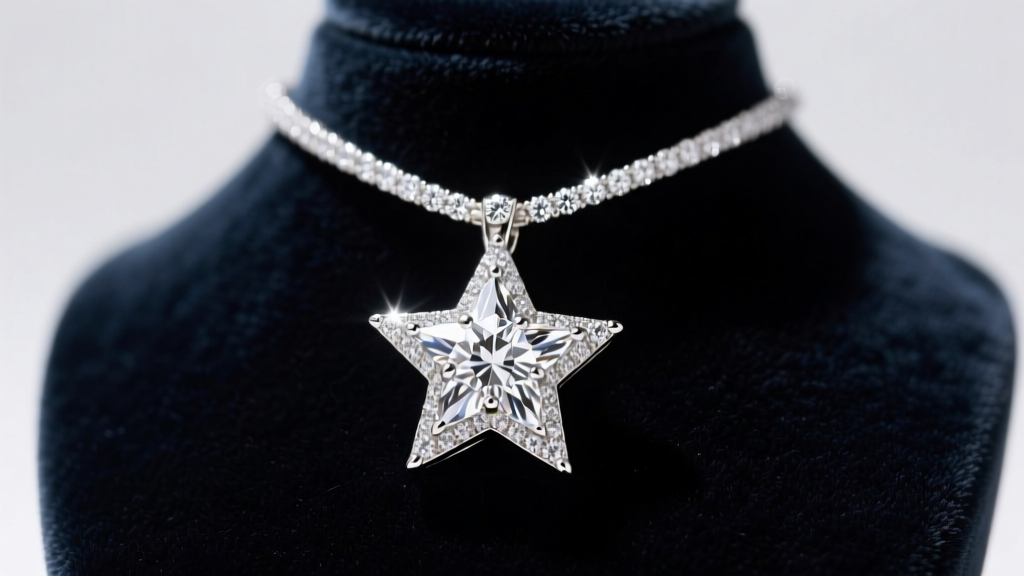
The quintessential star pendant seen on television typically measures between 14mm and 18mm from point to point. This specific dimension is critical: anything smaller loses its silhouette against the intricate patterns of broadcast blouses, while anything larger risks flipping over or catching on lapel microphones.
Bead Setting vs. Micro-Pave: The Wardrobe Snag Test
Many commercial jewelers default to micro-pave settings for star pendants because they offer maximum diamond density. However, micro-pave relies on microscopic prongs (often 0.2mm or thinner) that are highly prone to snagging on silk and chiffon. For a piece worn daily on television, a shared bead setting is the superior technical choice. In a bead setting, the jeweler uses a graver to push the surrounding metal over the diamond's girdle, creating a smooth, low-profile dome. This eliminates the sharp prong tips that destroy delicate broadcast wardrobe fabrics and significantly reduces the risk of a stone being pulled from its seat during a sudden movement.
Casting Thickness and Metal Memory
A high-quality star pendant must be cast with a minimum depth of 2.5mm at the center bezel. If the casting is too thin (under 1.8mm), the metal will suffer from 'memory bend'—a phenomenon where the gold warps slightly over time due to the pressure of the diamond setting process and daily wear. A warped star pendant will not lay flat against the clavicle, causing it to reflect studio lights at awkward, asymmetrical angles.
Chain Mechanics: Engineering for the Pendulum Effect
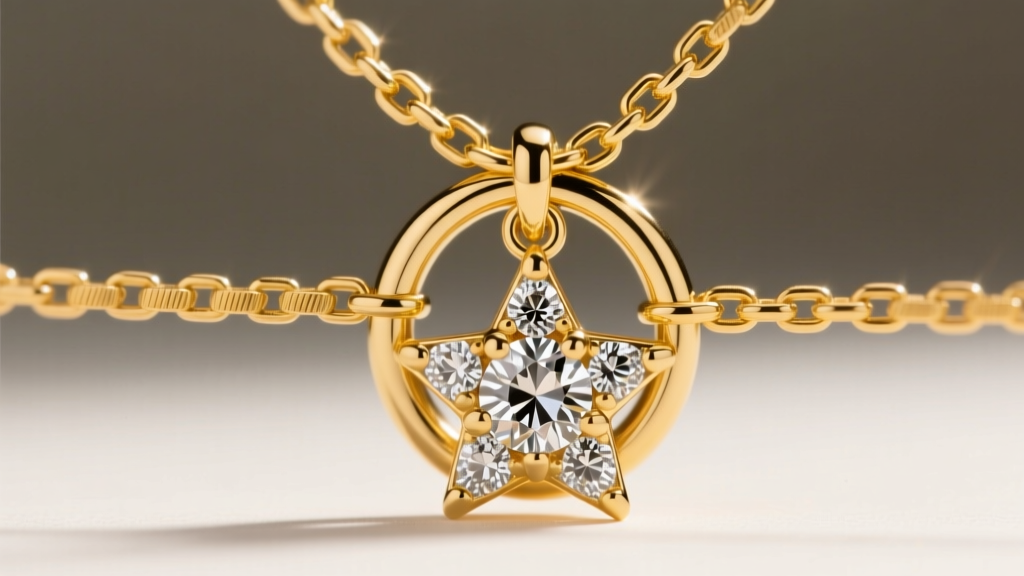
The failure point of most heavy pendants is not the chain itself, but the connection hardware. A solid 18-karat gold star pendant fully set with melee diamonds typically weighs between 4.5 and 7.2 grams. When worn by an active television host, this weight creates a 'pendulum effect,' generating sheer force on the jump ring every time the wearer walks, gestures, or turns.
Gauge and Link Architecture
To support this dynamic load, the chain must be a minimum of 1.2mm to 1.5mm in gauge. Box chains and rounded cable chains are the industry standards for this application. Box chains offer a flat surface area that prevents the pendant bail from sliding too freely, while rounded cable chains provide excellent tensile strength. Avoid hollow-core chains or rope chains; hollow chains will crush under the concentrated weight of a heavy pendant bail, and rope chains are notorious for trapping skin oils and makeup, which degrades the metal over time.
The Soldered Jump Ring Imperative
The most critical component of the assembly is the jump ring connecting the pendant to the chain. It must be a 6mm to 8mm heavy-duty, soldered jump ring. An unsoldered (split) jump ring will inevitably pull apart under the pendulum effect. Bench jewelers must use a laser welder or traditional torch to solder the jump ring shut after threading the chain, ensuring a continuous, unbroken loop of metal. The clasp should be a 12mm or 14mm reinforced lobster clasp, as standard spring-ring clasps lack the internal spring tension to securely hold the weight of the chain and pendant assembly during active wear.
Diamond and Metal Specifications for 4K Broadcast Lighting
Television studio lighting in 2026 utilizes high-CRI (Color Rendering Index) LED panels that expose the true body color of diamonds and the underlying alloy of white gold. Selecting the right materials is a matter of optical physics.
| Component | Technical Specification | Broadcast Advantage |
|---|---|---|
| Metal Base | 18K White Gold (Rhodium Plated) | Maximizes light return and contrast under intense studio LEDs |
| Diamond Melee | 0.01ct - 0.02ct, G-H Color, VS2-SI1 | Prevents yellow tint in 4K color grading; inclusions hidden by facets |
| Setting Style | Shared Bead Set (Not Micro-Pave) | Reduces wardrobe snagging on silk blouses and lapel mics |
| Chain Gauge | 1.2mm - 1.5mm Solid Box or Cable | Supports 4g-8g pendant weight without link stretching |
| Clasp Type | 14mm Reinforced Lobster Clasp | Prevents accidental unclasping during dynamic movement |
According to the Gemological Institute of America (GIA), melee diamonds (those under 0.18 carats) are often graded in batches rather than individually. For a star pendant, insisting on D-F colorless melee is a poor allocation of budget. Under studio lights, G-H near-colorless melee provides identical visual performance to the naked eye, while the VS2-SI1 clarity grade is perfectly acceptable since the brilliant cut of tiny melee diamonds naturally masks minor inclusions. Allocating budget toward ideal cut proportions for the melee is far more important than chasing flawless clarity grades.

Maintenance and Failure Modes in High-Wear Environments
Wearing a diamond star pendant on national television accelerates the standard wear-and-tear timeline. The combination of professional makeup, hairspray, and the heat of studio lights creates a corrosive environment for jewelry finishes.
Rhodium Degradation and Re-Plating Cycles
18K white gold is naturally slightly yellowish; it requires a rhodium plating to achieve the mirror-like white finish seen on camera. However, the friction of clothing and the acidity of skin can wear this plating away in as little as 6 to 9 months of daily broadcast wear. When the rhodium degrades, the pendant will appear dull and yellowish on camera, creating a visual mismatch with the chain. For daily wearers, a complete polish and rhodium re-dip every 12 months is mandatory to maintain optical consistency.
Ultrasonic Cleaning Risks
While ultrasonic cleaners are standard for jewelry maintenance, they pose a severe risk to bead-set and pave star pendants. The high-frequency vibrations can loosen the microscopic metal beads holding the melee diamonds, leading to catastrophic stone loss. The GIA News & Research archives frequently document cases of melee diamonds being shaken loose in ultrasonic tanks. Instead, bench jewelers should clean broadcast star pendants using a mild degreasing solution, a soft-bristled brush, and a low-pressure steam cleaner to safely remove makeup and skin oils without compromising the structural integrity of the setting.
Sourcing and Replicating the Look Today
Replicating the Gayle King star necklace today requires bypassing mass-market mall jewelers and working directly with a custom bench jeweler or a specialized fine jewelry house. Brands like Anita Ko and Messika offer excellent commercial examples of heavy, well-engineered star pendants, often retailing between $4,500 and $12,000 depending on total carat weight. However, a custom commission allows you to dictate the exact 1.5mm chain gauge and soldered jump ring specifications outlined above. Expect to invest between $3,000 and $6,000 for a custom 18K white gold star pendant featuring 0.75 to 1.00 total carat weight of G-H melee diamonds, fully engineered for the demands of daily, high-visibility wear.
Ultimately, the endurance of this iconic look lies not just in its celestial design, but in the uncompromising technical specifications that keep it shining brilliantly under the hottest lights in the industry.