How to Safely Clean and Maintain a Geode Necklace
Learn how to safely clean, store, and maintain your geode necklace. Expert tips on preserving druzy crystals, preventing dye bleed, and protecting settings.

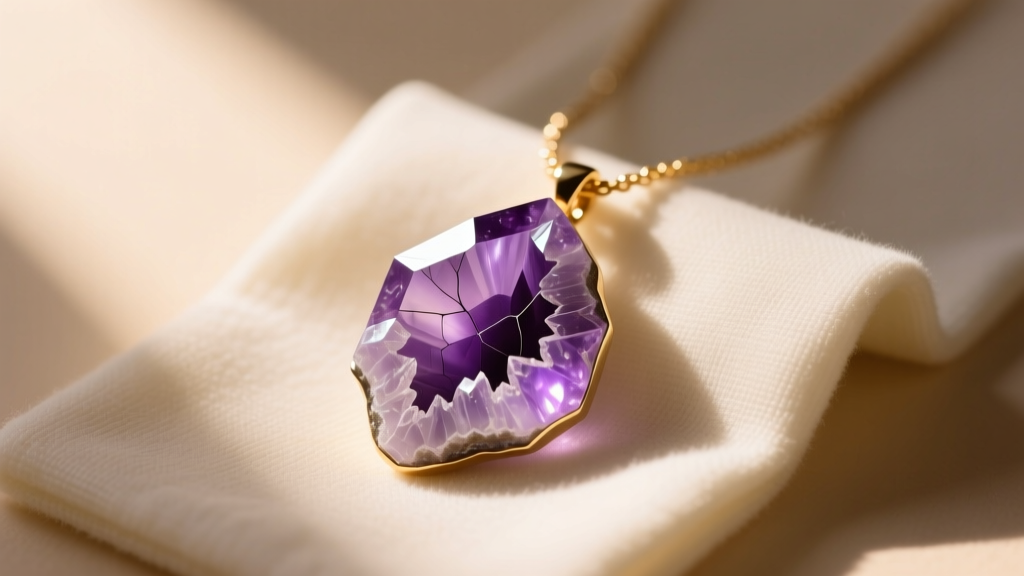
Geode necklaces bridge the gap between raw, natural mineralogy and refined wearable art. Whether your piece features a glittering amethyst druzy, a vibrant blue dyed agate, or a delicate calcite inclusion, these pendants require highly specific maintenance. Unlike faceted gemstones that can withstand rigorous polishing, the porous matrices and delicate crystal formations of a geode necklace demand a gentle, informed approach to care.
In this comprehensive guide, we break down the exact mineralogical properties of geodes, outline the hidden dangers of commercial jewelry cleaners, and provide a professional-grade cleaning protocol to ensure your pendant remains pristine for decades.
Understanding the Mineralogy of Your Geode Necklace
Before applying any cleaning agent, you must understand the geological composition of your pendant. A geode is essentially a hollow cavity lined with crystalline structures. The outer shell is typically composed of chalcedony or agate (a form of microcrystalline quartz), which registers a 6.5 to 7 on the Mohs Hardness Scale. However, the interior druzy crystals can vary wildly.
- Quartz Druzy (Amethyst, Citrine, Clear): Hardness of 7. Relatively durable but prone to trapping dust and skin oils in the microscopic crevices between crystal points.
- Calcite or Selenite Inclusions: Hardness of 2 to 3. Extremely fragile, highly porous, and water-soluble. These must never be exposed to liquids.
- Galena or Pyrite Inclusions: Metallic inclusions that can oxidize, tarnish, or degrade when exposed to moisture and oxygen.
Furthermore, many geode necklaces are set using electroformed copper or delicate prong settings. The intersection of a porous stone matrix and reactive metals dictates your entire cleaning strategy.
The Hidden Dangers of Commercial Jewelry Cleaners
The most common failure mode for ruined geode jewelry is the use of inappropriate cleaning technology. You must strictly avoid the following methods:
1. Ultrasonic Cleaners
Ultrasonic machines use high-frequency sound waves to create cavitation bubbles in a liquid solvent. When these microscopic bubbles collapse against the surface of a druzy geode, they generate localized micro-jets of liquid. This intense, localized pressure can easily dislodge delicate micro-druzy crystals from their natural matrix or weaken the adhesive (often E6000 or two-part epoxy) used to secure the geode slice to its metal bail.
2. Steam Cleaners
Steam cleaning introduces sudden, extreme temperature fluctuations. Quartz crystals, particularly those with natural fluid inclusions or internal fracturing, are highly susceptible to thermal shock. A blast of 212°F (100°C) steam can cause internal micro-fractures to expand, literally splitting the geode slice in half.
3. Harsh Chemical Solvents
Ammonia, bleach, and commercial silver dips are highly corrosive. They will strip the natural patina from electroformed copper settings, degrade rhodium plating on sterling silver, and permanently alter the color of heat-treated or dyed geodes.
Step-by-Step Dry and Damp Cleaning Protocol
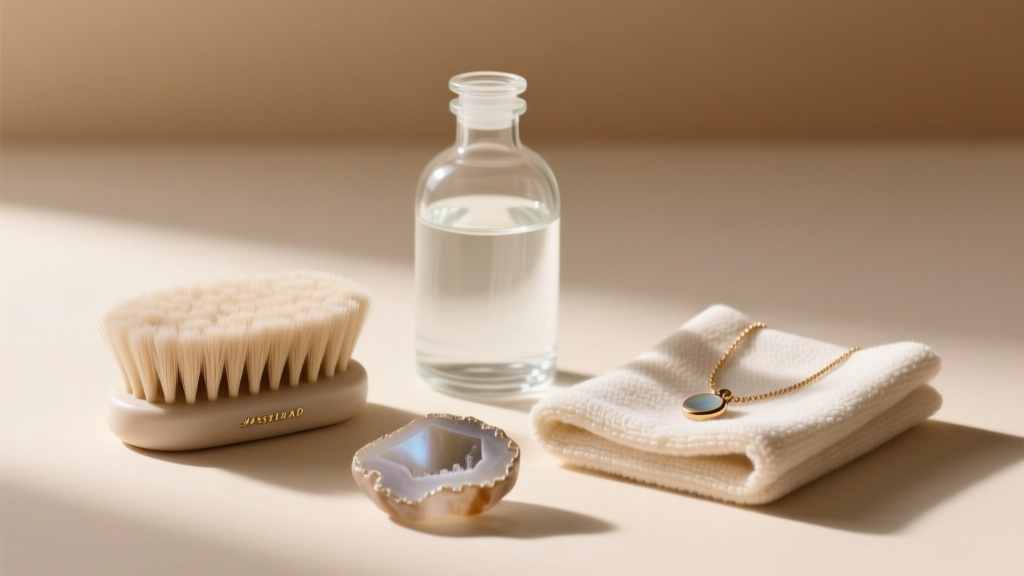
For standard quartz-based geode necklaces set in stable metals (sterling silver, gold-filled, or sealed copper), follow this professional cleaning sequence:
- Dry Dusting (The First Line of Defense): Use a clean, soft-bristled goat hair makeup brush or a specialized jewelry dusting brush. Gently sweep the bristles across the druzy surface in a circular motion to dislodge trapped sebum, dead skin cells, and cosmetic powders. Do not use toothbrushes, as stiff nylon bristles can scratch softer inclusions and leave micro-abrasions on the crystal facets.
- Targeted Damp Wiping: If the geode requires deeper cleaning, lightly mist a lint-free microfiber cloth with distilled water. Never use tap water, as the dissolved calcium and magnesium will leave hard water scale deposits deep within the druzy crevices. Gently dab the surface of the crystals—do not rub aggressively.
- Moisture Extraction: Water trapped in the porous agate matrix can eventually cause the metal setting to oxidize from the inside out. Use a can of compressed air (held at least 6 inches away) to blow moisture out of the crystal clusters, or use a hairdryer on the "cool" setting.
Caring for Electroformed Copper vs. Prong-Set Metals
The metalwork of your geode necklace requires just as much attention as the stone itself. Electroforming is a popular technique for geode pendants, where copper is deposited layer by layer over the raw edge of the stone, creating a thick (usually 0.5mm to 1.5mm), organic-looking bezel.
Electroformed Copper: Unsealed copper will naturally oxidize and develop a dark patina or green verdigris when exposed to the acids in human sweat. If your copper is sealed with a lacquer (like ProtectaClear), simply wipe it with a damp cloth. If it is unsealed and you wish to maintain the bright copper finish, use a mild acid like lemon juice and salt, but mask the geode completely with a dry cloth to prevent the acid from etching the crystals.
Prong-Set Sterling Silver: Use a treated silver polishing cloth (impregnated with anti-tarnish agents) to buff the metal prongs and bail. Never drag the polishing cloth across the druzy surface, as the micro-abrasives in the cloth will dull the crystal's natural luster.
Cleaning Agent Compatibility Matrix
| Cleaning Agent | Quartz Druzy | Calcite / Soft Inclusions | Electroformed Copper |
|---|---|---|---|
| Distilled Water | Safe (Briefly) | Avoid (Dissolves) | Safe (Dry Immediately) |
| Mild Dish Soap | Safe (Diluted) | Avoid | Safe (Rinse Well) |
| Isopropyl Alcohol | Safe | Avoid | Safe (Degreases) |
| Ultrasonic Machine | Avoid (Sheds Druzy) | Avoid (Shatters) | Avoid (Pits Metal) |
| Commercial Silver Dip | Avoid (Dulls Facets) | Avoid (Etches) | Avoid (Strips Patina) |
Preserving Dyed and Heat-Treated Geodes
A significant percentage of geode necklaces on the market, particularly those featuring neon blues, hot pinks, or deep purples, are dyed chalcedony. The porous agate shell is submerged in chemical baths to achieve these vibrant hues. According to the GIA Gem Care guidelines, dyed gemstones require strict environmental controls.
- UV Degradation: Prolonged exposure to direct sunlight will cause organic dyes to fade rapidly. Never leave a dyed geode necklace on a sunny windowsill or wear it during extended outdoor activities like beach days or hiking.
- Solvent Bleed: Acetone, nail polish remover, and high-concentration isopropyl alcohol will dissolve the dye, causing it to bleed onto your clothing or skin. Always remove your necklace before applying perfumes, hairsprays, or cosmetics.
Long-Term Storage and Humidity Control
How you store your geode necklace is just as critical as how you clean it. The primary enemy of stored jewelry is ambient humidity, which accelerates metal oxidation and can cause water-soluble mineral matrices to degrade.
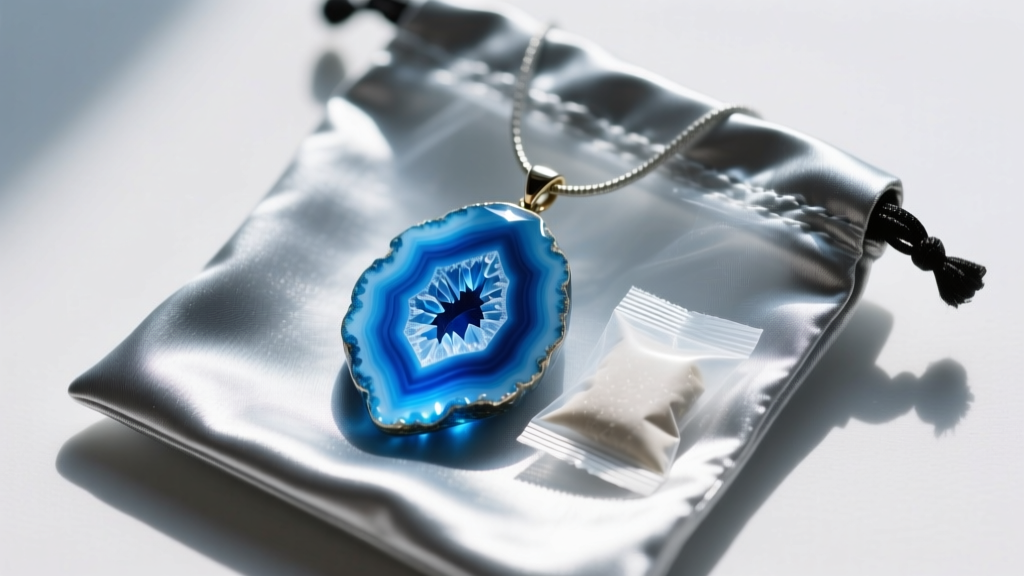
Store your pendant in an individual, airtight anti-tarnish flannel pouch. Toss a small silica gel desiccant packet inside the pouch to absorb excess moisture. This is especially vital if you live in a high-humidity climate or near the ocean, where salt air can rapidly corrode copper and brass settings. Never store multiple geode necklaces together in a single jewelry box compartment; the friction between the raw, unpolished edges of the geode shells will cause severe micro-abrasions and chipping.
Troubleshooting Common Geode Necklace Failures
Even with meticulous care, geode necklaces can experience structural issues over time. Here is how to diagnose and address the most common problems:
Druzy Shedding (Crystal Loss)
If you notice tiny crystals falling out of your pendant, this is usually due to one of two factors. First, natural cleavage: some druzy forms on a loose matrix and naturally sheds over time. Second, adhesive failure: if the geode slice is glued to a backing plate, heat and sweat can degrade the epoxy. Solution: Stop wearing the piece immediately. Use a toothpick to apply a microscopic drop of jeweler's epoxy (not super glue, which dries brittle and clouds the crystals) to the base of the loose cluster.
Cloudy or Chalky Crystals
If your once-sparkling quartz druzy looks cloudy, it is likely coated in hard water scale or a buildup of cosmetic lotions. Solution: For pure quartz only, you can safely use a 50/50 mixture of distilled white vinegar and distilled water. Apply it with a cotton swab directly to the cloudy crystals, let it sit for 30 seconds to dissolve the calcium carbonate, and immediately neutralize it with a baking soda and water paste. Warning: Never use vinegar on calcite, malachite, or any carbonate-based mineral, as the acid will permanently dissolve the stone.
Bail and Jump Ring Wear
The constant friction of the chain rubbing against the pendant's bail will eventually wear through the metal, especially if the chain is a harder metal than the bail (e.g., a stainless steel chain on a soft copper bail). Inspect the jump ring and bail every six months. If the metal has worn down by more than 20%, have a jeweler replace the finding to prevent the loss of your geode pendant.
By respecting the unique mineralogical properties of your stone and avoiding aggressive commercial cleaning methods, your geode necklace will retain its raw, natural brilliance for a lifetime.


