Geode Slice Necklace: Lapidary Techniques & Setting Durability
Explore the technical anatomy of a geode slice necklace. Learn about lapidary stabilization, resin grading, and optimal chain metallurgy for daily wear.

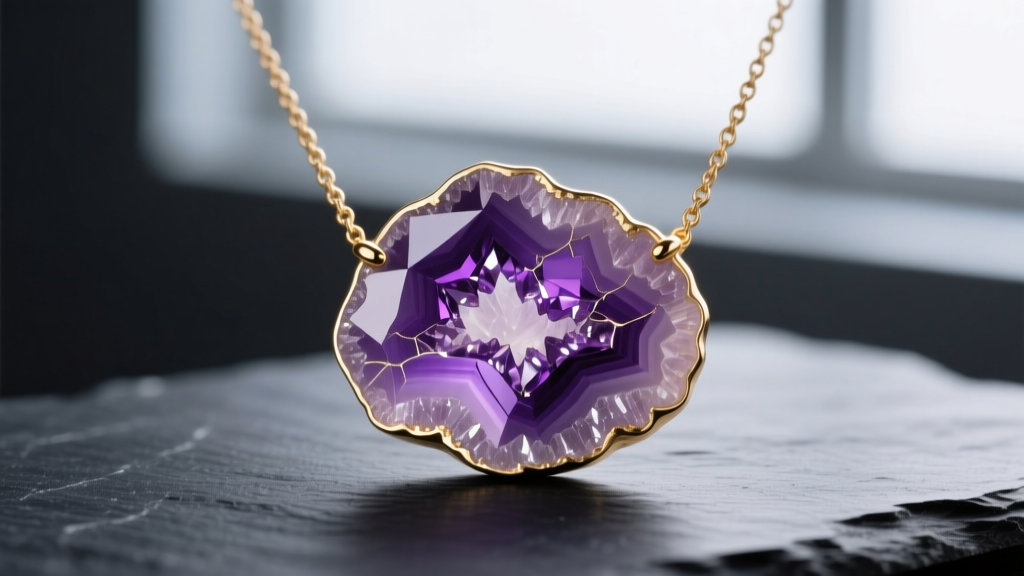
The Intersection of Lapidary Science and Jewelry Engineering
When evaluating a geode slice necklace, most consumers focus exclusively on the vibrancy of the druzy crystals or the color banding of the agate host rock. However, from a master jeweler’s perspective, the true value and longevity of these pieces lie in the unseen lapidary techniques and metallurgical engineering that keep the fragile mineral structure intact. A geode is essentially a geological void lined with crystalline structures; by definition, it is riddled with micro-fractures and inherent structural weaknesses. Transforming this fragile geological specimen into a durable, wearable pendant requires a rigorous understanding of mineral hardness, resin stabilization, and bezel mechanics.
In this technical deep dive, we deconstruct the anatomy of high-end geode slice pendants, examining the specific material grades, failure modes, and engineering tolerances that separate heirloom-quality jewelry from mass-produced tourist trinkets.
Lapidary Preparation: Slicing, Kerf Loss, and Stabilization
The journey of a geode slice begins at the lapidary saw. Cutting a spherical, hollow geode into uniform slices requires specialized slab saws equipped with diamond-impregnated blades. The thickness of the blade, known as the kerf, dictates material loss. High-end lapidaries use ultra-thin kerf blades (often 0.04 inches or 1mm) to preserve the maximum surface area of the druzy lining, but this introduces significant vibration and heat.
Vacuum Resin Impregnation
Agate, the most common host rock for geodes, ranks at 6.5 to 7 on the Mohs hardness scale via Mindat. While the cryptocrystalline quartz is relatively hard, the internal druzy crystals are brittle and prone to cleavage along micro-fractures. Before a slice can be set, it must undergo stabilization.
- Opticon FCR (Fracture Sealer): The industry standard for high-end stabilization. This two-part, heat-curing epoxy is drawn into the stone's micro-fissures using a vacuum chamber. It cures optically clear and matches the refractive index of quartz, rendering fractures invisible while binding the crystal matrix.
- Cyanoacrylate (Super Glue): Frequently used in cheap, mass-produced geode slice necklaces. It cures brittle, yellows under UV exposure, and fails to penetrate deep micro-fractures, leading to eventual crystal shedding.
- UV-Curing Optical Resins: A modern 2026 standard for rapid stabilization of surface-level druzy, offering excellent clarity but lacking the deep-penetrating viscosity of vacuum-impregnated epoxies.

Bezel Engineering: Yield Strength and Burnishing Tolerances
Prong settings are entirely unsuitable for geode slices. The uneven, undulating edges of a natural geode require a custom-fitted bezel. However, the metallurgy of the bezel wire is just as critical as the stone itself.
Master jewelers overwhelmingly prefer .999 Fine Silver for bezel wire over .925 Sterling Silver when setting geodes. Fine silver has a significantly lower yield strength and lacks the copper content found in sterling. This makes it exceptionally malleable, allowing the jeweler to burnish the metal tightly over the irregular, bumpy edges of the agate without applying excessive downward pressure that could shatter the druzy crystals. Sterling silver, being harder and more springy, requires more force to push over the stone, drastically increasing the risk of catastrophic lapidary failure during the setting process.
'The key to setting a geode slice is accommodating its geological imperfections. You do not force the metal to the stone; you coax the fine silver to embrace the stone's natural topography.' — Master Lapidary Bench Note
Component Specifications and Failure Modes
Understanding the technical specifications of a geode slice necklace allows buyers to identify potential structural vulnerabilities before purchase. The following table outlines the critical engineering tolerances required for daily-wear durability.
| Component | Optimal Material / Specification | Engineering Purpose | Failure Mode if Compromised |
|---|---|---|---|
| Bezel Wire | 24-gauge .999 Fine Silver | Low yield strength for safe burnishing over uneven edges | Sterling silver requires excessive force, cracking the agate host |
| Backing Plate | 20-gauge Solid 14k Gold or Sterling | Provides rigid structural floor to prevent flexing | Thin sheet metal flexes upon impact, popping the stone out |
| Bail Connection | Soldered V-Bail or Tube Bail | Distributes pendant weight evenly across the chain | Glued bails degrade from skin oils, causing pendant loss |
| Stabilizer | Vacuum-impregnated Opticon FCR | Binds internal micro-fractures in the druzy matrix | Surface glues peel, resulting in crystal shedding over time |
Load Distribution: Chain Metallurgy and Bail Mechanics
A 35mm agate geode slice can easily weigh between 15 and 30 grams, depending on the thickness of the host rock and the density of the crystalline lining. Suspending this concentrated mass requires careful consideration of chain gauge and bail mechanics.
The Danger of the Glued Bail
In lower-tier manufacturing, the bail (the loop that connects the pendant to the chain) is often affixed to the back of the geode slice using jeweler's epoxy. This is a critical failure point. The thermal expansion coefficient of metal differs vastly from that of quartz. As the wearer moves between extreme temperatures (e.g., stepping out into winter air or entering a heated room), the metal bail and the stone expand and contract at different rates. Over time, this thermal cycling shears the epoxy bond. A properly engineered geode slice necklace features a bail that is mechanically riveted or hard-soldered directly to the metal backing plate of the bezel cup, completely bypassing the stone.
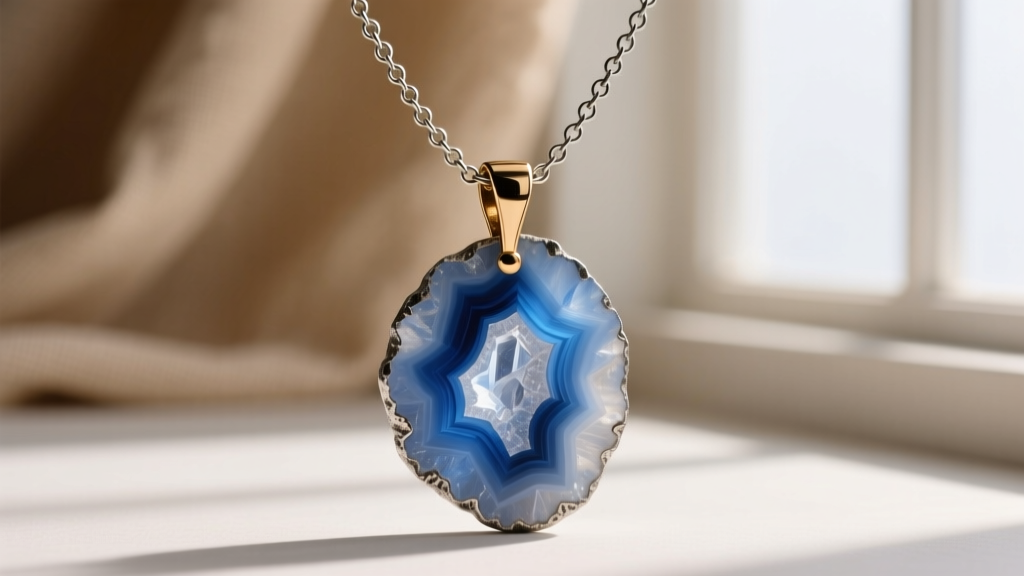
Chain Gauge Requirements
To support a 20+ gram pendant without stretching or snapping, the chain must meet minimum thickness requirements. According to jewelry manufacturing standards outlined by the Gemological Institute of America (GIA), standard fashion chains (0.8mm to 1.0mm) are insufficient for heavy lapidary slices.
- Minimum Gauge: 1.2mm to 1.5mm cable, rolo, or Figaro chains.
- Clasp Integrity: Lobster clasps must feature a solid internal spring mechanism. Hollow-cast clasps will deform under the pendulum-like swinging motion of a heavy geode slice.
- Jump Rings: The jump ring connecting the chain to the clasp must be soldered shut. An open jump ring will inevitably pull apart under the dynamic load of a heavy pendant.
Identifying Synthetic vs. Natural Druzy
As the popularity of the geode slice necklace has surged, so has the market for synthetic alternatives. 'Titanium aura quartz' and electroplated druzy are common. While these treatments are not inherently bad, they must be disclosed. Natural geodes derive their color from mineral inclusions: iron oxides create amethyst purples and citrine yellows, while manganese creates black botryoidal agates. Synthetic coatings are applied via vapor deposition in a vacuum chamber. A jeweler's loupe (10x magnification) will reveal the unnatural, hyper-uniform iridescence of vapor-deposited coatings, which often pool in the microscopic crevices between crystals, unlike the natural, deep-seated color zoning of authentic geological specimens.
Care Protocols: Avoiding Thermal and Acoustic Shock
Maintaining a stabilized geode slice requires strict adherence to specific care protocols. The most common cause of catastrophic failure in these necklaces is improper cleaning.
Never use an ultrasonic cleaner. Ultrasonic cleaners work by generating high-frequency acoustic cavitation bubbles in a liquid solvent. When these microscopic bubbles collapse against the surface of the jewelry, they release intense localized shockwaves. While this is excellent for dislodging dirt from a solid diamond, it will violently shatter the fragile, points-up crystals of a druzy geode lining, turning a vibrant pendant into a cloudy, pitted mess.
Instead, clean your geode slice necklace using a soft, lint-free microfiber cloth and a mild, non-abrasive soap solution applied with a soft-bristled makeup brush. Gently agitate the surface to lift skin oils and cosmetic residues from the crystal matrix, rinse briefly under lukewarm (never hot) water to avoid thermal shock, and pat dry immediately. By respecting the geological fragility and the metallurgical limits of the setting, a well-engineered geode slice pendant will remain a striking, durable staple in your collection for decades.


