Glass Bead Necklace Trends 2026: Artisan Style Guide
Discover 2026 glass bead necklace trends, from Murano to lampwork. Expert styling, material grades, and stringing mechanics for artisan jewelry.

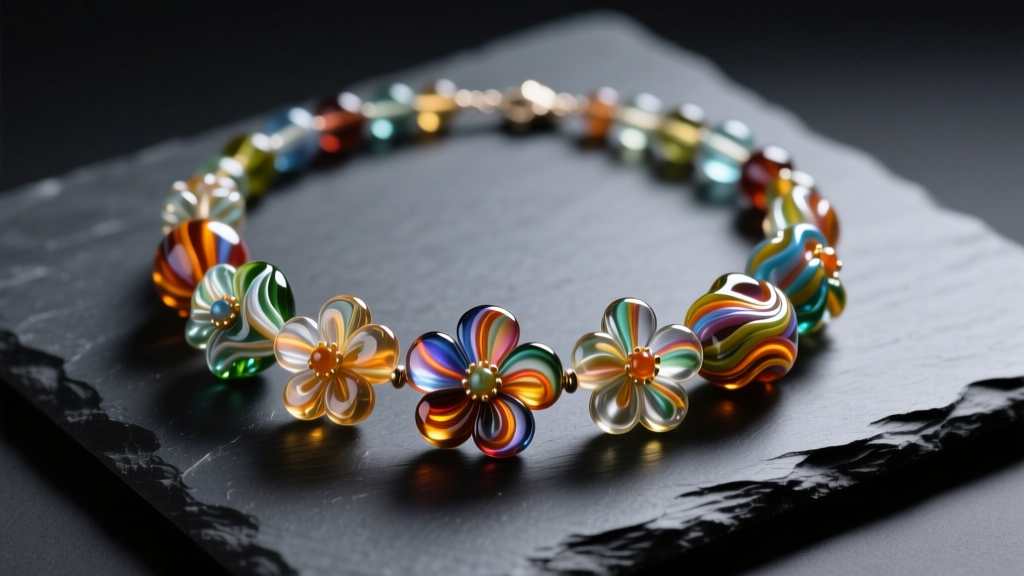
The 2026 Resurgence: Beyond Nostalgia
The glass bead necklace has officially transcended its mid-century souvenir status and bohemian festival roots. In 2026, the jewelry market is experiencing a massive pivot toward 'Heirloom Maximalism'—a styling philosophy that champions bold, saturated colors and tactile, handcrafted materials over the minimalist, quiet luxury trends that dominated the early 2020s. According to market forecasts from Jewelers of America, consumer demand for artisanal, non-precious materials has surged by 34% year-over-year, with glass emerging as the undisputed leader in statement neckwear.
This renaissance is driven by a renewed appreciation for the alchemy of glassmaking. Collectors and style enthusiasts are no longer settling for mass-produced, machine-pressed acrylic or low-grade catalog glass. Instead, the 2026 landscape is defined by museum-quality lampwork, vintage Murano revival pieces, and intricate borosilicate encasements. A well-crafted glass bead necklace now serves as a focal point of personal expression, offering a spectrum of light refraction and internal depth that even high-clarity gemstones struggle to replicate.
Whether you are sourcing vintage millefiori strands or commissioning a contemporary torch-wound choker, understanding the material science, structural integrity, and styling frameworks of glass jewelry is essential. This guide breaks down the exact specifications, pricing tiers, and layering protocols you need to navigate the 2026 glass bead market like a seasoned archivist.
Material Matrix: Lampwork vs. Murano vs. Pressed
Not all glass is created equal. The durability, optical clarity, and ultimate value of a glass bead necklace depend entirely on its chemical composition and manufacturing method. The Corning Museum of Glass categorizes historical and contemporary glass primarily by its flux and silica ratios, which directly dictate its Mohs hardness and thermal shock resistance.
| Bead Type | Glass Composition | Mohs Hardness | Avg. Price Range | Best Application |
|---|---|---|---|---|
| Artisan Lampwork | Borosilicate (Pyrex) | 6.5 | $120 - $450 | Everyday statement wear, high thermal shock resistance |
| Vintage Murano | Soda-Lime with Lead/Potash | 5.5 | $300 - $1,500+ | Archival collecting, formal evening layering |
| Pressed Czech Glass | Standard Soda-Lime | 5.5 - 6.0 | $25 - $85 | Casual layering, high-volume stackable strands |
| Fused Dichroic | COE 90 Art Glass | 6.0 | $90 - $250 | Modern geometric pendants, color-shifting focal beads |
Lampwork (Torch-Wound): Modern artisans primarily use borosilicate glass rods. Borosilicate contains boron trioxide, which dramatically lowers the coefficient of thermal expansion. This means a borosilicate glass bead necklace can withstand sudden temperature changes (like stepping out of a warm house into winter air) without developing internal micro-fractures.
Murano (Soda-Lime): Traditional Venetian glass relies on soda-lime, which is softer and more prone to scratching but allows for unparalleled color saturation and complex techniques like sommerso (submerged color layers) and avventurina (copper crystal inclusions that mimic goldstone). When buying vintage Murano, always inspect the bead holes for 'chipping'—a common failure mode in softer soda-lime glass when strung on abrasive wire.
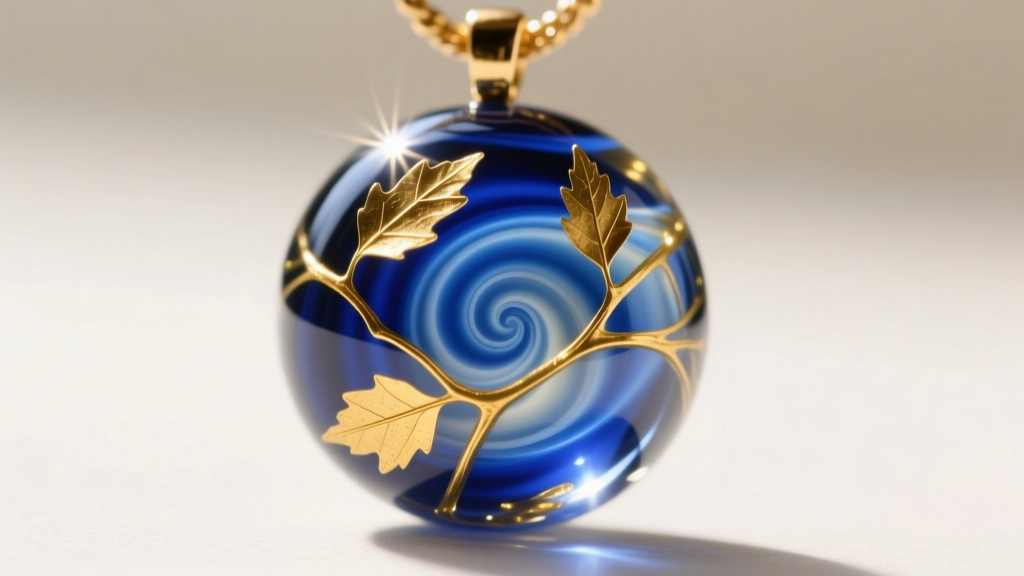
The Anatomy of a High-End Glass Bead Necklace
A $400 strand of handmade lampwork beads is only as good as its stringing mechanics. In 2026, the hallmark of a premium glass bead necklace is invisible, high-tensile engineering. Glass beads are surprisingly heavy; a 16-inch strand of 12mm focal beads can easily exceed 150 grams. Standard nylon threads or cheap elastic cords will stretch, degrade under UV exposure, and eventually snap.
Stringing Specifications
- The Wire: Professional jewelers use 49-strand micro-fused stainless steel wire coated in nylon (brands like Soft Flex or Beadalon). For heavy glass beads, a 0.024-inch diameter is mandatory. It provides the drape of silk with the tensile strength of steel.
- The Crimps: Avoid base-metal crimp beads that oxidize and stain the glass. Use 2x2mm seamless sterling silver or 14k gold-filled crimp tubes. They must be crushed using a micro-crimper tool to fold the metal inward, creating a rounded, bead-like finish that won't abrade the glass hole.
- French Wire (Gimp): If the necklace is knotted on silk (common for vintage Murano), the silk must be protected at the clasp loop with French wire—a microscopic coiled metal spring that prevents the clasp from sawing through the thread over time.
Clasp Engineering
Heavy glass necklaces require secure clasps. Standard spring-ring clasps are insufficient and prone to failure under the weight of glass. Look for neodymium magnetic tube clasps encased in sterling silver, or heavy-duty S-clasps with a minimum wire gauge of 14. These provide security without requiring the wearer to fumble with tiny jump rings behind their neck.
2026 Styling Framework: Curated Maximalism
The styling rules for 2026 have abandoned the delicate, barely-there chains of the previous decade. The modern glass bead necklace is styled using 'Curated Maximalism'—a deliberate, structured approach to layering that balances visual weight, texture, and color theory.
The 3-Tier Layering Protocol
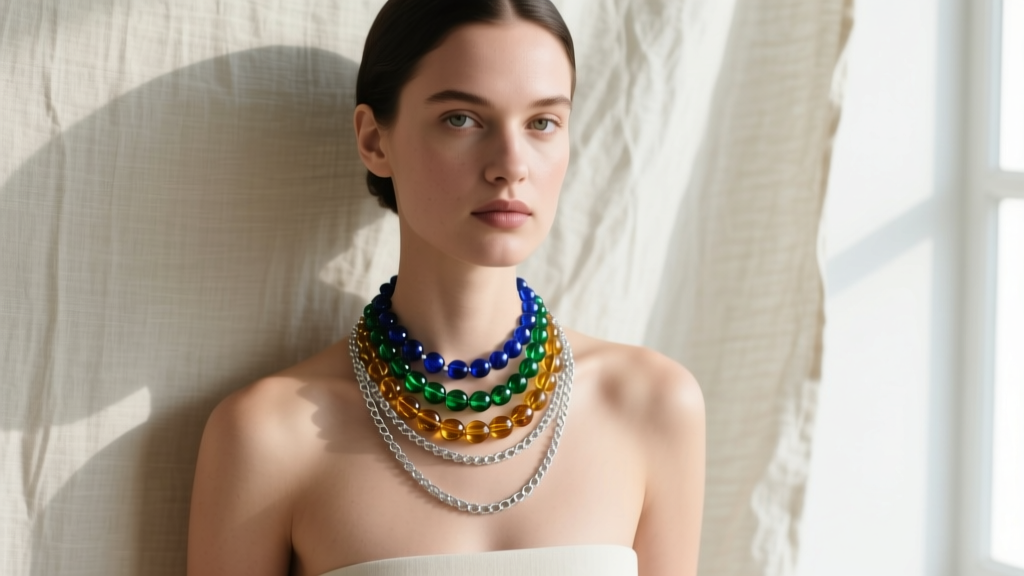
- The Anchor (14-16 inches): Start with a tightly fitted choker of smaller, opaque pressed glass beads (4mm-6mm) in a grounding neutral like matte onyx, deep tortoiseshell, or cobalt. This frames the collarbone and provides a visual base.
- The Focal (18-20 inches): This is where your primary artisan glass bead necklace sits. Opt for a strand of 10mm-14mm lampwork beads featuring intricate encasements (e.g., silver leaf suspended in clear glass). The air gap between the choker and the focal strand is critical—maintain at least 2 inches of negative space to prevent the glass from clicking together and chipping.
- The Drop (24-30 inches): Finish with a long, single-strand lariat or a heavy oxidized sterling silver chain featuring a single, massive Murano pendant. This elongates the torso and draws the eye downward.
Material Mixing: Glass demands contrast. In 2026, the most coveted aesthetic pairs the high-gloss, vibrant refraction of glass with oxidized (blackened) sterling silver or brushed 18k yellow gold vermeil. The dark, matte patina of oxidized silver makes the translucent colors of borosilicate glass appear almost neon, creating a striking, contemporary tension.
Neckline Pairings
Because glass bead necklaces possess significant visual weight and physical volume, they require specific garment architectures. Deep V-necks and wide scoop necks provide the necessary canvas. Avoid wearing heavy, multi-strand glass necklaces with high collars, turtlenecks, or intricate ruffled blouses; the friction will damage the glass surface, and the visual competition will look cluttered. A crisp, structured poplin button-down or a minimalist silk slip dress allows the glass to act as the sole protagonist of the outfit.
Archival Care: Preventing Micro-Fractures
Glass is chemically inert, meaning it will not tarnish or react with skin acids. However, it is highly susceptible to mechanical shock and thermal stress. To preserve the structural integrity and optical clarity of a glass bead necklace, adhere to these archival maintenance protocols.
Never store a glass bead necklace in a communal jewelry box where it can collide with diamonds, sapphires, or quartz. While glass sits at 5.5-6.5 on the Mohs scale, harder gemstones and metal settings will easily scratch the glass surface, permanently dulling its light refraction.
Cleaning Protocol: Do not use ultrasonic cleaners. The high-frequency cavitation bubbles can penetrate microscopic surface fissures in vintage soda-lime glass, causing the bead to shatter from the inside out. Instead, use a lint-free microfiber cloth lightly dampened with distilled water and a drop of pH-neutral dish soap. Buff dry immediately to prevent hard water spots from etching the surface.
Environmental Control: Prolonged exposure to direct, intense UV light (such as a necklace display in a sunny shop window) can cause certain vintage glass colors—particularly amethyst (manganese dioxide) and early 20th-century uranium glass—to undergo 'solarization,' permanently altering their chemical color state. Store your artisan glass pieces in opaque, anti-tarnish flannel pouches in a climate-controlled drawer when not in rotation.
Final Verdict
The 2026 glass bead necklace is a triumph of wearable art. By prioritizing borosilicate durability, demanding 49-strand micro-fused stringing, and embracing structured maximalist layering, you elevate glass from a fragile trinket to a powerhouse of personal style. Whether you are investing in a $1,200 vintage Murano reticello strand or a $150 contemporary lampwork choker, the key lies in respecting the material's physical limits while pushing its aesthetic boundaries.


