2026 Gold Cross Necklace Trends: Proportions & Layering
Discover 2026 gold cross necklace trends. Learn how to choose karats, proportions, and chain styles for modern layering and streetwear aesthetics.


The gold cross necklace has transcended its traditional boundaries, evolving from a purely religious heirloom into a structural cornerstone of contemporary fashion. As we navigate the style landscape of 2026, the ways in which we wear, layer, and proportion this iconic symbol have shifted dramatically. According to Vogue's jewelry trend forecasting, the modern consumer is no longer looking for middle-of-the-road, generic jewelry. Instead, the market is bifurcating into hyper-minimalist micro-pendants and heavy, brutalist statement pieces. This comprehensive style and trend analysis will break down the exact proportions, metallurgical choices, and layering frameworks you need to master the gold cross necklace aesthetic in 2026.
The 2026 Proportion Shift: Micro-Pendants vs. Brutalist Crosses
In previous decades, the standard gold cross necklace hovered around a safe, unremarkable 20mm to 25mm in height. Today, that middle ground has virtually vanished from high-fashion and streetwear circles. The current trend cycle demands intentionality in scale, pushing wearers toward two distinct extremes.

The Micro-Cross Movement
The micro-cross typically measures between 8mm and 12mm in height, with a slender profile of 1.5mm to 2mm. This scale is designed for the "barely there" layering look, often sitting flush against the collarbone on a delicate 16-inch chain. It serves as a subtle textural element rather than a focal point, making it ideal for professional environments or intricate, multi-chain stacks. Because the surface area is so small, jewelers are opting for high-polish finishes to maximize light reflection.
The Brutalist & Neo-Gothic Revival
On the opposite end of the spectrum, the brutalist cross dominates streetwear and avant-garde styling. Ranging from 45mm to over 60mm in height, these pendants feature heavy, distorted, or melted-metal textures. They are often cast using the lost-wax method to retain organic, asymmetric imperfections. Styling a brutalist gold cross necklace requires a heavier chain—typically a 3.0mm to 5.0mm Cuban link or rope chain—and is best worn as a standalone piece over heavy cotton tees or structured outerwear.
Metallurgy & Karat Selection for Daily Wear
Choosing the right gold alloy is critical, especially for a pendant that will experience friction against the skin and clothing. The Gemological Institute of America (GIA) notes that pure 24k gold is far too malleable for daily-wear jewelry. When selecting a gold cross necklace, you must balance color richness with structural integrity, specifically focusing on the Vickers Hardness (HV) scale.
| Karat | Gold Purity | Vickers Hardness (HV) | Best Use Case | Failure Risk |
|---|---|---|---|---|
| 10k Gold | 41.7% | ~160 HV | Heavy streetwear, active lifestyles | Low; highly resistant to bending |
| 14k Gold | 58.5% | ~140 HV | Daily wear, standard layering | Moderate; bail thinning over years |
| 18k Gold | 75.0% | ~120 HV | Heirlooms, luxury micro-pendants | High; prongs and bails wear down faster |
| 22k Gold | 91.6% | ~60 HV | Investment pieces, occasional wear | Extreme; bails will snap under tension |
For a gold cross necklace intended for daily wear, 14k gold remains the undisputed champion. The alloy mix (often incorporating copper and silver) provides enough tensile strength to support the bail—the loop that connects the pendant to the chain—without warping. If you prefer the deeper, richer yellow hue of 18k gold, ensure the bail is reinforced or laser-welded to prevent catastrophic snapping.
Chain Pairings: Beyond the Standard Rope
The chain you select dictates the entire character of the necklace. In 2026, the classic rope chain is being replaced by more architecturally interesting weaves that offer superior tensile strength and visual rhythm.
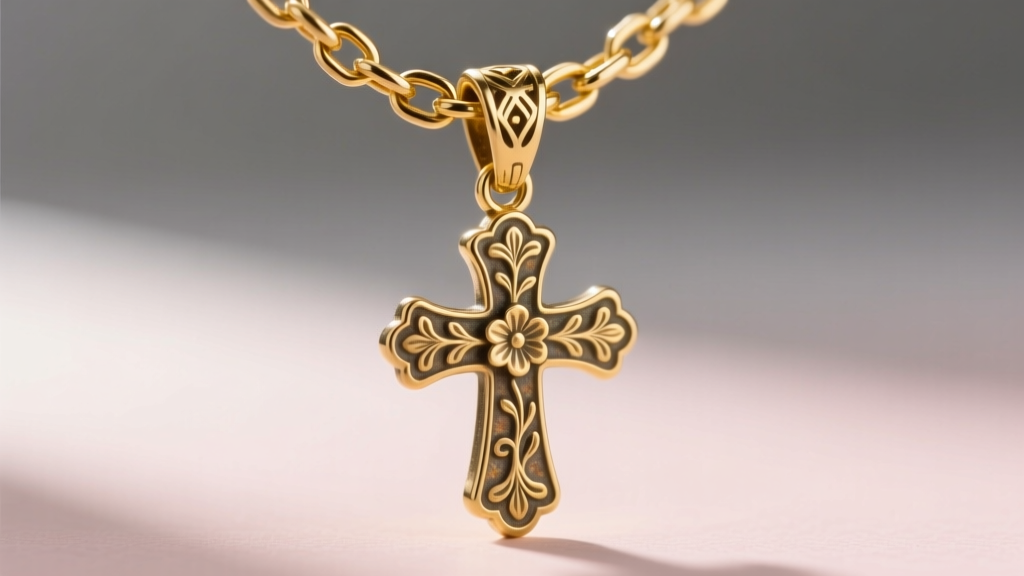
- The Spiga (Wheat) Chain: Woven in a continuous, braided pattern, the Spiga chain is virtually kink-proof. A 1.5mm to 2.0mm Spiga chain in 14k gold provides a luxurious, liquid-like drape that perfectly complements micro and medium-sized crosses. Its tight link structure prevents chest hair from snagging, a common complaint with looser weaves.
- The Figaro Chain: Characterized by a pattern of three short links followed by one elongated link, the Figaro adds a vintage, rhythmic aesthetic. A 2.5mm Figaro chain pairs exceptionally well with brushed or matte-finish crosses, offering a subtle nod to 90s hip-hop heritage without looking costumey.
- The Box Chain: While geometrically striking, box chains under 1.5mm are prone to crushing if the pendant is too heavy. If you prefer the clean lines of a box chain, opt for a minimum gauge of 2.0mm and ensure the pendant's bail is wide enough to glide freely over the square links without causing friction.
Bail Engineering & Failure Modes
The bail is the unsung hero—and most common point of failure—of any gold cross necklace. Trend analysis shows a rise in "hidden bails" (where the chain threads directly through a hollowed-out top arm of the cross) versus traditional soldered loop bails. While hidden bails offer a sleek, uninterrupted silhouette, they concentrate the wear-and-tear on a single, thin slice of gold. Over 3 to 5 years of daily wear, the friction from the chain can saw through the top of the cross. To mitigate this, look for pendants where the hidden bail is lined with a hardened platinum or white gold sleeve, or stick to a traditional, heavy-gauge soldered loop bail that can be easily replaced by a jeweler if it thins.
Advanced Layering Frameworks
Layering a gold cross necklace requires a strategic approach to length and texture to avoid the dreaded "tangled clump" effect. The most effective method utilized by stylists in 2026 is the 3-Point Drop System.
"The secret to modern layering isn't just about adding more chains; it's about managing the negative space between them. A strict two-inch drop between each layer ensures the pendants occupy their own distinct visual zones." — Elara Vance, Senior Jewelry Stylist
The 3-Point Drop System
- Layer 1 (The Anchor - 16 inches): Start with a simple, pendant-less chain. A 1.2mm cable or bead chain sits high on the collarbone, framing the face and establishing the base.
- Layer 2 (The Focal Point - 18 inches): This is where your gold cross necklace lives. An 18-inch drop places the cross perfectly at the hollow of the throat or upper sternum. Use a textured chain, like a 1.8mm wheat chain, to differentiate it from the anchor layer.
- Layer 3 (The Counterweight - 20 to 22 inches): Finish with a heavier, longer chain featuring a contrasting pendant, such as a solid gold signet, a coin medallion, or a raw gemstone drop. The weight of this bottom layer acts as a pendulum, keeping the upper layers taut and preventing them from twisting together.
Sourcing & Price Benchmarks for 2026
Understanding the pricing landscape is essential for making an informed purchase. Due to fluctuations in the spot price of gold and increased labor costs for precision casting, the benchmarks for solid gold cross necklaces have shifted. A high-quality, solid 14k gold micro-cross (weighing roughly 1.5 grams) on a 16-inch 1.2mm chain will typically retail between $350 and $500. For a mid-sized, 4-gram 18k gold cross with diamond-cut beveling on an 18-inch Figaro chain, expect to invest between $800 and $1,200. Beware of "gold vermeil" pieces priced above $250; while vermeil (a thick layer of gold over sterling silver) is a valid entry point, it will eventually wear through on the high-friction edges of the cross, revealing the silver beneath. For a piece meant to last a lifetime, solid karat gold remains the only viable investment.


