2026 Gold Crown Necklace Trends: High-Jewelry Styling Guide
Discover the 2026 gold crown necklace trend. Expert analysis on karat weights, layering techniques, and how to style royal motifs for modern wear.

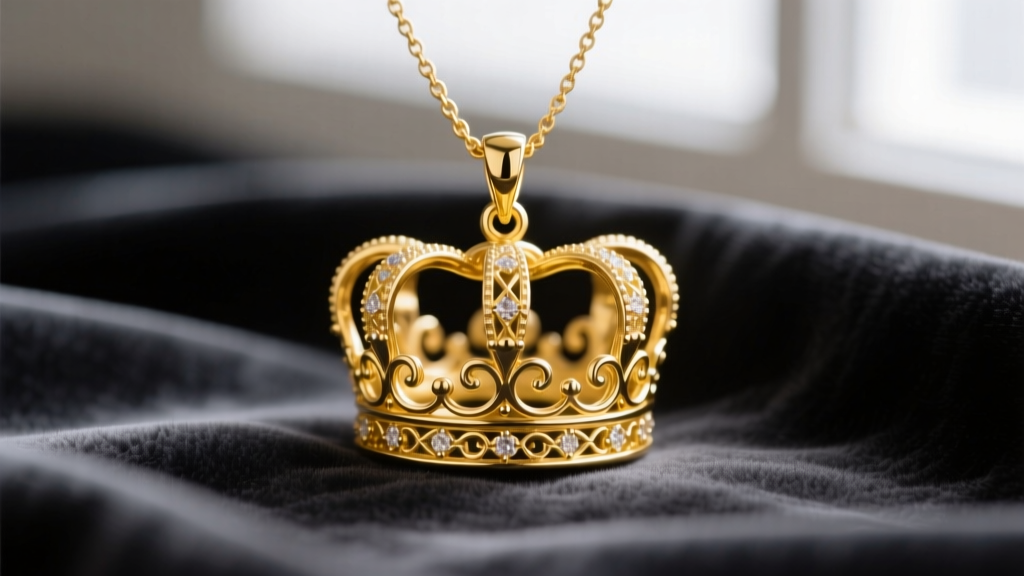
The Royal Revival: From Streetwear Staple to Neo-Romantic High Jewelry
The gold crown necklace has undergone a radical metamorphosis. While its modern cultural footprint was heavily influenced by 1990s hip-hop royalty—most notably echoing the iconic king-and-crown motifs popularized by East Coast rap legends—the 2026 jewelry landscape has completely recontextualized the silhouette. Today, the crown pendant is no longer just a symbol of street-level bravado; it has been elevated into a neo-romantic, high-jewelry statement piece that bridges the gap between historical regalia and contemporary minimalism.
According to recent market analyses by JCK Industry News, heritage motifs like the crown, the fleur-de-lis, and the signet ring are seeing a 34% year-over-year increase in demand among fine jewelry buyers aged 25 to 40. The modern gold crown necklace favors architectural precision over sheer mass. Designers are stripping away the excessive diamond pavé of the early 2010s, opting instead for brushed matte finishes, intricate filigree arches, and oxidized gold accents that highlight the structural geometry of the crown's base band and peaks.
Material Breakdown: Karat Weights and Metallurgical Realities
When investing in a gold crown necklace, understanding the metallurgy is critical. The crown shape, with its protruding peaks and delicate arches, is highly susceptible to bending if the alloy is too soft. The Gemological Institute of America (GIA) emphasizes that the balance between gold purity and structural integrity dictates the longevity of complex pendant shapes.
| Karat Weight | Gold Purity | Alloy Composition | Vickers Hardness (HV) | Best Application for Crown Pendants |
|---|---|---|---|---|
| 14k Gold | 58.5% | Copper, Silver, Zinc | ~130 - 150 HV | Daily wear, thin arches, prong-set gemstones |
| 18k Yellow Gold | 75.0% | Copper, Silver | ~110 - 125 HV | Luxury statement pieces, matte finishes, solid casting |
| 18k Rose Gold | 75.0% | High Copper, Low Silver | ~120 - 135 HV | Vintage-inspired crowns, warm skin tone contrast |
| 22k Gold | 91.6% | Copper, Silver | ~70 - 90 HV | Investment pieces, thick base bands (avoid thin peaks) |
For a gold crown necklace intended for daily wear, 14k gold remains the most pragmatic choice due to its higher tensile strength. However, the 2026 trend heavily favors the rich, buttery hue of 18k yellow gold. To compensate for the softer nature of 18k gold, contemporary jewelers are utilizing CAD/CAM 3D modeling to engineer hidden structural supports within the crown's base band, ensuring the peaks do not warp under lateral pressure.
Sizing, Proportion, and Bail Engineering
A common failure point in mass-market crown pendants is the bail—the loop that connects the pendant to the chain. Because a crown is visually top-heavy, a poorly proportioned bail will cause the pendant to flip upside down or sit awkwardly against the sternum.
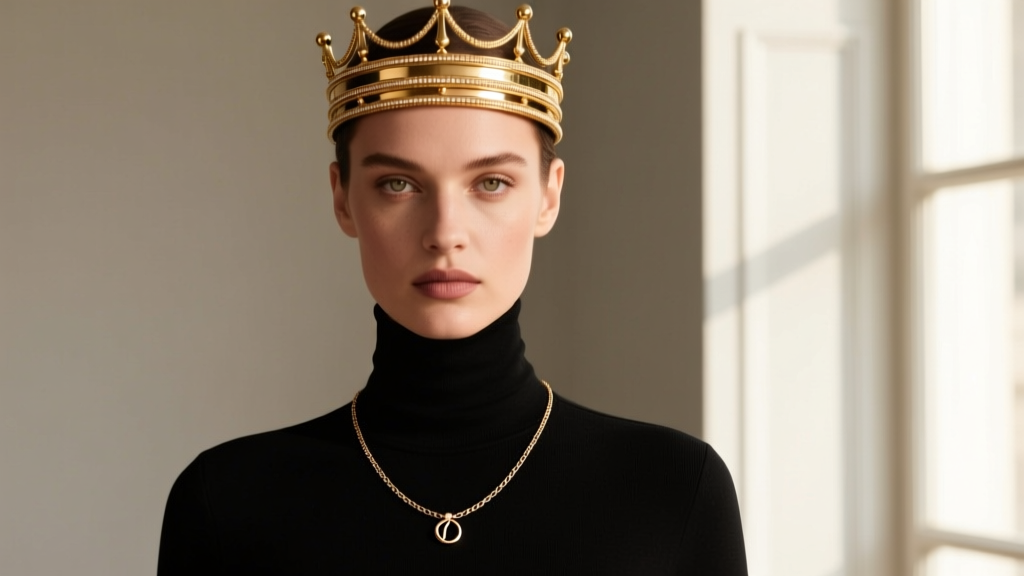
The Hidden Bail Standard
In 2026, high-end gold crown necklaces utilize a "hidden bail" or "euro-bail" design. Instead of a visible loop soldered to the top peak of the crown, a 6mm x 4mm rectangular tube is integrated directly into the back of the crown's central arch. This allows the chain to pass through the pendant itself, keeping the crown flush against the chest and maintaining the illusion of an uninterrupted royal silhouette.
Dimensional Guidelines
- The Subtle Minimalist (12mm - 15mm width): Ideal for layering or wearing over crew-neck t-shirts. Best paired with a 1.5mm to 2.0mm box chain.
- The Statement Standard (20mm - 25mm width): The most versatile size for 2026. Commands attention without looking ostentatious. Requires a 3.0mm to 4.0mm chain to support the weight (typically 8 to 14 grams).
- The Archival Heavyweight (30mm+ width): Reserved for 22k or solid 18k investment pieces. Often features a reinforced 5.0mm Cuban link or thick rope chain.
Advanced Layering Frameworks for Crown Motifs
Styling a gold crown necklace in 2026 requires a departure from the symmetrical, uniform stacks of the past decade. The current aesthetic relies on asymmetrical tension and mixed-metal accents to create a curated, organic look.
The Asymmetrical Royal Stack
Begin with an 18-inch, 2.5mm Franco chain holding a 15mm 14k rose gold crown pendant. For the second layer, drop down to a 22-inch, 3.5mm oxidized silver Cuban link featuring a simple, unadorned signet ring or a geometric tube clasp. The contrast between the warm, intricate gold crown and the dark, industrial silver chain creates a visual anchor that prevents the crown from looking like a costume piece.
The High-Low Minimalist Contrast
Pair a heavy, 25mm solid 18k yellow gold crown necklace on a 20-inch rope chain with a delicate, 18-inch 1.0mm cable chain holding a single, bezel-set 3mm diamond solitaire. The extreme variance in chain gauge and pendant size draws the eye directly to the crown while the diamond solitaire adds a subtle flash of light near the collarbone.
Manufacturing Methods: Lost-Wax vs. CAD/CAM
The manufacturing technique drastically affects the price, weight, and detail of your gold crown necklace. Understanding these methods is essential for evaluating market pricing and long-term durability.
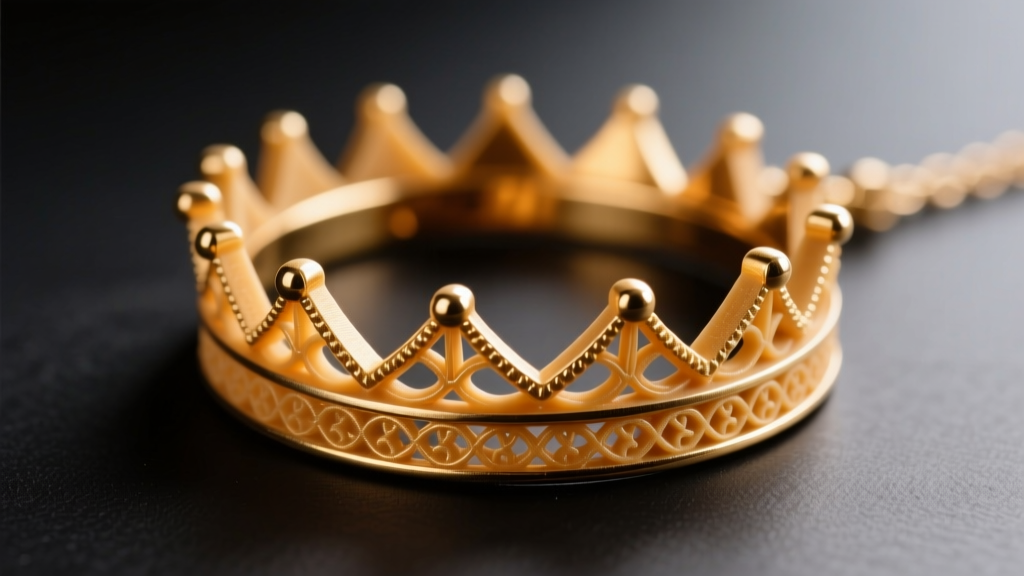
Traditional Lost-Wax Casting
Artisanal jewelers carve the original crown master from jeweler's wax. This method yields organic, slightly imperfect lines that give the crown a hand-forged, antique feel. The wax model is encased in investment plaster, burned out in a kiln at 1,350°F, and molten gold is centrifugally forced into the cavity. This method is preferred for bespoke, neo-romantic crown designs that feature hammered textures and hand-engraved base bands.
CAD/CAM 3D Printing
For crowns requiring absolute geometric symmetry, micro-pavé diamond settings, or complex interlocking arches, Computer-Aided Design (CAD) is the industry standard. A high-resolution resin printer creates the master model with tolerances down to 0.02mm. This ensures that every peak and valley of the crown is mathematically perfect, which is crucial if the piece will be cast in multiples or if the crown features precision-set baguette diamonds along the base band.
Market Pricing and Investment Value
The pricing of a gold crown necklace in 2026 is heavily stratified based on manufacturing origin, karat weight, and gemstone integration. Here is a realistic breakdown of what you should expect to pay in the current market:
- Entry-Level / Die-Struck ($250 - $450): Typically 10k or 14k hollow or semi-solid crowns. Lightweight (2-4 grams), prone to denting, but accessible for fashion-forward styling.
- Mid-Tier Solid Cast ($800 - $1,800): Solid 14k or 18k gold, weighing between 8 and 15 grams. Features cast-in details rather than hand-engraving. The sweet spot for daily-wear luxury.
- High-Jewelry / Gem-Set ($3,500 - $12,000+): 18k gold featuring VVS1/VS2 melee diamonds, hidden structural engineering, and hand-finished filigree. Often produced by boutique heritage brands or custom CAD jewelers.
"When evaluating a gold crown necklace, always check the interior of the base band. A high-quality piece will have a slightly domed or comfort-fit interior that sits flush against the skin, whereas mass-produced versions will feature a flat, hollowed-out back that traps moisture and degrades over time."
Final Verdict: Is the Gold Crown Necklace a Timeless Staple?
The gold crown necklace has successfully shed its novelty status. By embracing architectural minimalism, higher karat weights, and sophisticated layering techniques, the 2026 iteration of the crown pendant stands as a legitimate pillar of modern fine jewelry. Whether you opt for a matte-finished 14k minimalist piece or a heavily structured 18k archival pendant, the crown remains a powerful, versatile motif that commands respect without relying on the overt flash of previous decades. Invest in solid casting, prioritize hidden bail engineering, and let the geometry of the gold speak for itself.


