How to Style a Gold Disk Necklace: 2026 Trend Guide
Discover how to style the gold disk necklace in 2026. Expert tips on layering, karat weights, chain gauges, and pairing with modern necklines.

The Evolution of the Gold Disk Necklace in 2026
The gold disk necklace has long been a cornerstone of minimalist jewelry, but as we navigate the style landscape of 2026, the ultra-thin, high-polish "coin" necklaces of the 2010s have been decisively retired. Today, the trend has shifted toward architectural weight, intentional textures, and mixed-metal layering. According to industry analysts at JCK Magazine, consumers are moving away from fast-fashion delicacy and investing in substantial, heirloom-quality gold pieces that command attention without relying on gemstones. The modern gold disk necklace is less about blending in and more about serving as an anchor piece in a curated, textured neckline stack.
Anatomy of the Perfect Disk: Karat Weights and Hardness
When investing in a solid gold disk pendant, understanding the metallurgy is crucial for both aesthetics and longevity. The Gemological Institute of America (GIA) outlines the distinct properties of gold alloys, which directly impact how a disk wears over time.
- 14k Gold (58.5% Pure Gold): With a Vickers hardness of approximately 125-140 HV, 14k gold is highly resistant to scratching and bending. It is the superior choice for the chain itself, especially in gauges under 1.2mm, but its slightly paler yellow hue may lack the richness desired for the focal disk.
- 18k Gold (75% Pure Gold): Sitting at around 105-115 HV, 18k gold offers the perfect compromise. It provides a deep, luxurious yellow color that catches the light beautifully, while remaining durable enough for daily wear as a pendant.
- 22k Gold (91.6% Pure Gold): At roughly 70 HV, 22k gold is exceptionally soft. While it boasts a breathtaking, almost orange-yellow saturation favored in artisanal and heritage designs, a 22k disk will easily acquire dents and patina. This is ideal for buyers who appreciate a "living" piece of jewelry that records their daily life.
Surface Finishes: Beyond High-Polish
The 2026 styling ethos heavily favors texture over mirror-like reflections. While a high-polish finish offers classic brilliance, it acts as a magnet for fingerprints and micro-scratches. Modern gold disk necklaces are increasingly featuring alternative finishes:
Satin and Brushed Finishes: Created by dragging a fine wire brush across the gold, this technique yields a soft, matte glow that hides daily wear and tear exceptionally well. It pairs beautifully with diamond-cut chains that provide the necessary sparkle.
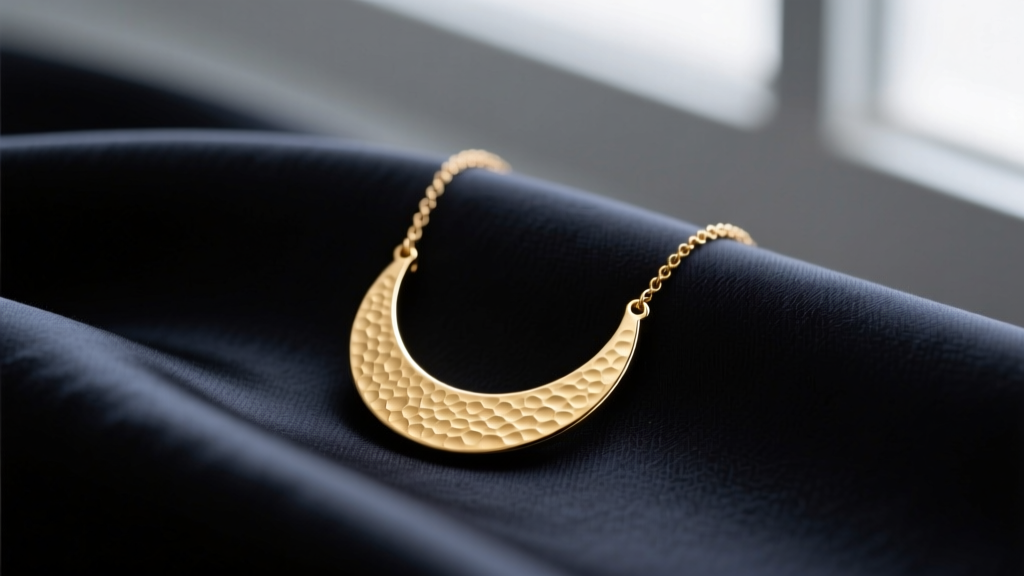
Hammered Textures: Hand-struck with a jeweler's hammer, these disks feature facets that diffuse light in multiple directions. A hammered 18k gold disk offers an organic, artisanal feel that contrasts sharply with tailored, structured clothing.
The Chain-to-Disk Ratio Matrix
A common styling failure is pairing a heavy, substantial disk with a chain too delicate to support it visually and physically. The visual weight of the chain must harmonize with the diameter and thickness of the disk. Use the following matrix to ensure structural and aesthetic balance:
| Disk Diameter | Disk Thickness | Ideal Chain Gauge | Recommended Chain Style | Best Use Case |
|---|---|---|---|---|
| 8mm - 12mm | 0.8mm - 1.0mm | 0.9mm - 1.1mm | Cable, Box, or Bead | Dainty layering base, subtle everyday wear |
| 13mm - 18mm | 1.2mm - 1.5mm | 1.2mm - 1.5mm | Rope, Curb, or Figaro | Standalone statement, medium layering |
| 19mm - 25mm+ | 1.5mm - 2.5mm | 1.6mm - 2.5mm | Paperclip, Cuban, or Wheat | Bold focal point, worn over heavy fabrics |
Advanced Layering Metrics: The 2026 Formulas
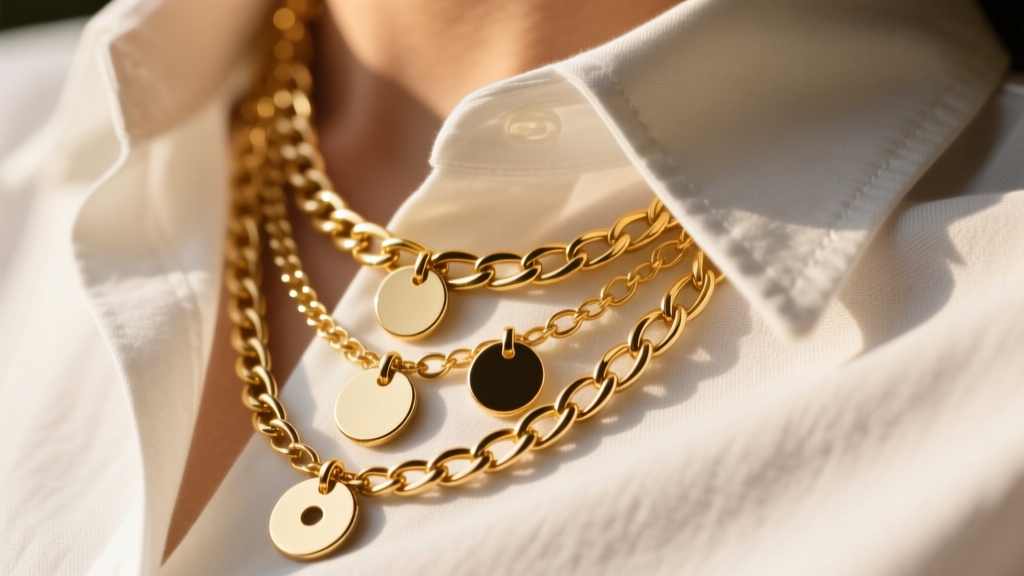
Layering gold disk necklaces requires mathematical precision to avoid a tangled, cluttered appearance. The golden rule of the 2026 stack is the 2-inch drop increment. If your base choker sits at 14 inches, your primary disk necklace should sit at 16 inches, and your secondary, larger disk at 18 inches. This ensures each pendant occupies its own distinct visual zone on the sternum.
The "Rule of Three" for Disk Pendants
When building a stack exclusively of disk necklaces, limit the count to three and vary the diameters drastically to create a visual hierarchy:
- The Anchor (14-15 inches): A 10mm solid disk on a delicate 1.0mm box chain. Sits high on the collarbone.
- The Core (16-18 inches): A 15mm matte-finish disk on a 1.3mm rope chain. Acts as the primary focal point.
- The Counterweight (20-22 inches): A 22mm hammered disk or a hollow-forged geometric medallion on a 2.0mm paperclip chain. Provides depth and swings dynamically with movement.
Neckline Architecture: Pairing Disks with Collars
The geometry of your neckline dictates the optimal size and length of your gold disk necklace. Ignoring this relationship can result in a visually truncated torso or a pendant that gets lost in the fabric.
The V-Neck and Plunging Necklines: These create a natural arrow pointing downward. Complement this geometry with a 16-inch or 18-inch necklace featuring a 15mm to 20mm disk. The circular shape of the disk softens the sharp angles of the V-neck, while the chain mirrors the diagonal lines of the collar.
The Crewneck and High Collars: A standard crewneck sits high and cuts the neck off abruptly. To counter this, bypass the 16-inch lengths entirely. Opt for a 20-inch to 24-inch chain with a substantial 25mm+ disk that rests firmly below the collarbone, elongating the torso and breaking up the block of fabric.
The Boatneck and Square Necklines: These horizontal lines require a pendant that disrupts the width. A shorter 14-inch or 15-inch choker-style chain with a small, 10mm high-polish disk resting exactly in the center of the clavicle draws the eye inward and upward.

Investment Tiers and Pricing Realities
Understanding how gold disk necklaces are manufactured will protect you from overpaying for mass-produced items disguised as artisanal jewelry. In 2026, pricing is strictly tiered by production method and material integrity.
Tier 1: Stamped and Plated ($30 - $90)
These are thin sheets of brass or copper stamped by a machine and plated with a microscopic layer of gold vermeil. They are lightweight, prone to warping, and the plating will inevitably wear off at the friction points where the bail meets the chain.
Tier 2: Cast Solid 14k ($150 - $400)
Created using the lost-wax casting method, these solid gold disks have excellent weight and durability. They represent the best value for daily-wear jewelry, offering genuine precious metal content at an accessible price point.
Tier 3: Hand-Forged and Artisanal 18k/22k ($600 - $1,500+)
These pieces are cut from solid gold sheet metal and hand-hammered or textured by a jeweler. The bail is often soldered seamlessly rather than attached via a jump ring. You are paying for the labor, the higher gold purity, and the unique, unrepeatable texture of the metal.
Maintenance and Patina Management
Caring for a gold disk necklace depends entirely on its finish. High-polish disks can be maintained with a standard jewelry polishing cloth, but you must be careful not to rub the edges too aggressively, which can soften the crisp geometry of the circle.
For matte, brushed, or hammered finishes, never use a polishing cloth or ultrasonic cleaner. Polishing compounds will gradually smooth out the intentional textures, turning a beautiful hammered surface into a dull, scratched polish over time. Instead, clean textured disks by soaking them in warm water with a few drops of mild dish soap, gently agitating with a soft-bristled baby toothbrush, and drying with a microfiber cloth. Embrace the natural accumulation of oils and minor surface marks; in 2026, a pristine, flawless piece of gold is considered sterile, while a slightly worn, textured disk tells a compelling style story.
"The gold disk is no longer just a blank canvas; it's a sculptural element. In 2026, we are treating the metal itself as the gemstone, relying on weight, texture, and light diffusion rather than traditional sparkle."
— Contemporary Jewelry Design Forecast, 2026


