Gold Men's Necklace Pendants: The Ultimate Karat & Alloy Guide
Compare 10k, 14k, and 18k gold men's necklace pendants. Expert insights on alloy metals, structural integrity, pricing, and skin sensitivities.
The Metallurgy of Men's Gold Pendants: Why Pure Gold Fails
When shopping for gold men's necklace pendants, the assumption that 'purer is better' is a common trap that leads to premature jewelry failure. Pure 24-karat gold (99.9% gold) possesses a Vickers hardness of roughly 25 HV, making it exceptionally malleable. While this softness is ideal for intricate investment-grade goldsmithing, it is catastrophic for daily-wear men's pendants. A solid 24k gold pendant will easily dent against a steering wheel, bend at the bail (the loop connecting the pendant to the chain), and lose its structural integrity over time.
To create durable gold men's necklace pendants, metallurgists alloy pure gold with harder metals like copper, zinc, silver, and nickel. This process not only increases the tensile strength and scratch resistance of the metal but also dictates the final color, weight, and biocompatibility of the piece. Understanding these material properties is the difference between buying a generational heirloom and a disposable accessory.
Karat Breakdown: 10K, 14K, 18K, and 22K Compared
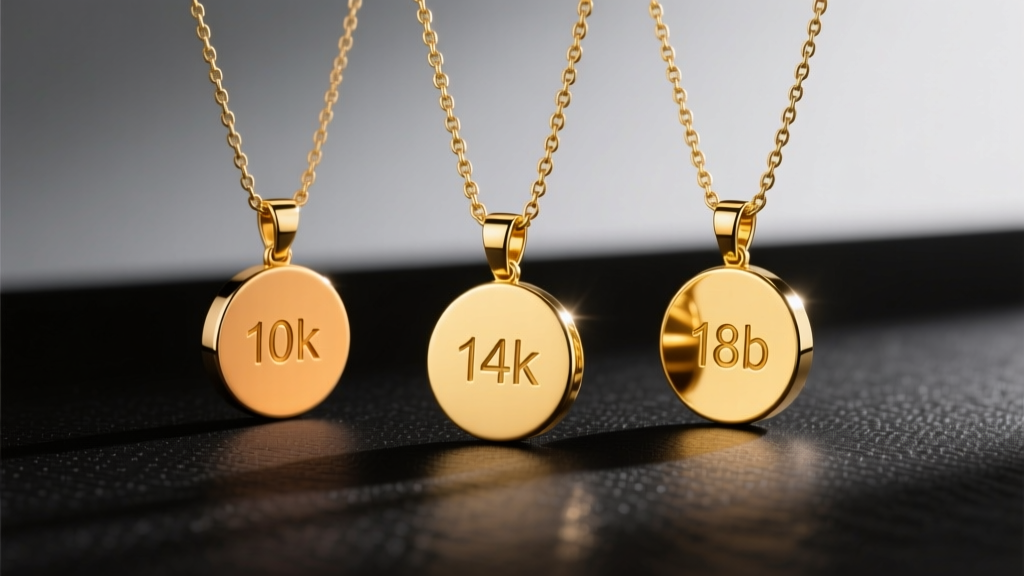
The karat (k) system measures the proportion of pure gold in an alloy out of 24 parts. For men's pendants, which often feature heavier, more geometric, or signet-style designs, the karat weight directly impacts both the price and the pendant's ability to withstand impact.
| Karat | Gold Content | Vickers Hardness (Approx.) | Best Use Case | Avg. Price Range (1in Solid Pendant) |
|---|---|---|---|---|
| 10K | 41.7% | 135 - 150 HV | Heavy, rugged daily wear; budget-conscious buyers | $250 - $450 |
| 14K | 58.3% | 140 - 160 HV | The industry standard; optimal balance of color and durability | $450 - $850 |
| 18K | 75.0% | 120 - 135 HV | Luxury pieces, rich color, gemstone settings | $900 - $1,800+ |
| 22K | 91.6% | 80 - 90 HV | Cultural/heritage pieces; low-impact wear | $1,500 - $3,000+ |
According to the Gemological Institute of America (GIA), 14k and 18k gold remain the most popular choices for fine jewelry in the United States and Europe. 14k gold offers a slightly paler yellow hue but provides superior resistance to the micro-abrasions that occur when a pendant rests against the chest or swings during physical activity.
Solid Gold vs. Hollow Gold vs. Gold Plated: Structural Integrity
Beyond the karat stamp, the internal architecture of gold men's necklace pendants dictates their lifespan. Manufacturers use three primary construction methods, each with distinct failure modes.
1. Solid Cast Gold
Solid gold pendants are cast from a single alloy mixture or machined from a solid billet. They are heavy, dense, and can be polished repeatedly to remove scratches. If a solid gold bail bends, a jeweler can easily solder it back into place. This is the only recommended structure for gemstone-set pendants, as the prongs require the density of solid metal to grip stones securely over decades.
2. Hollow and Electroformed Gold
To create large, oversized men's pendants (like thick medallions or large crosses) without the exorbitant cost of solid gold, manufacturers use electroforming. This creates a microscopic shell of gold over a wax or resin core, which is later melted or dissolved. The failure mode: Hollow gold cannot be resized, repaired, or easily soldered. If you sleep on a hollow gold pendant or drop it on a hard surface, the shell will crush inward, permanently ruining the piece.
3. Gold Vermeil and Gold Plated
The Federal Trade Commission (FTC) strictly regulates gold plating terminology. 'Gold plated' refers to a microscopic layer of gold (often less than 0.5 microns) over a base metal like brass. 'Gold vermeil' (pronounced ver-may) requires a base of sterling silver with a gold layer of at least 2.5 microns. While vermeil is an excellent entry point for fashion-forward men's pendants, the gold layer will eventually wear through at the high-friction bail area, exposing the silver underneath.
Alloy Metals and Skin Sensitivities: Nickel, Copper, and Zinc
The metals mixed with gold to create different colors can trigger contact dermatitis in sensitive individuals. When evaluating gold men's necklace pendants, you must consider the alloy recipe.
- Yellow Gold: Typically alloyed with equal parts copper and zinc. The zinc acts as a deoxidizer and lightens the copper's redness. It is generally hypoallergenic and highly stable against skin acids.
- Rose Gold: Contains a high percentage of copper (up to 20% in 14k rose gold) and little to no zinc. The copper provides the warm, pinkish hue but can cause a harmless greenish tint on the skin of individuals with highly acidic sweat pH.
- White Gold: Alloyed with nickel, palladium, or manganese to strip the yellow color. Nickel-white gold is the most common and durable, but nickel is a leading cause of metal allergies. Furthermore, white gold is almost always plated with rhodium to achieve a bright, chrome-like finish. This plating wears off every 12 to 24 months, requiring professional re-dipping.
'If a client wants a white gold pendant but has sensitive skin, I always steer them toward palladium-white gold or simply recommend platinum. The nickel in standard 14k white gold will cause a rash on the chest where the pendant rests and traps sweat.' — Master Bench Jeweler
Maintenance, Patina, and Real-World Wear
Gold itself does not tarnish, but the alloy metals within gold men's necklace pendants absolutely do. Pendants with lower karat weights (10k and 14k) contain higher amounts of copper and silver. When exposed to sulfur in the air, chlorine in swimming pools, or the natural oils and lotions on your skin, these alloy metals can oxidize, leading to a dull, darkened patina.
Pro-Tip for Longevity: Never wear solid gold pendants in hot tubs or chlorinated pools. Chlorine reacts violently with the copper and zinc alloys in 14k and 18k gold, causing a phenomenon known as 'stress corrosion cracking.' This can cause the microscopic joints at the bail or gemstone prongs to become brittle and snap without warning.
To maintain the luster of your pendant, clean it monthly using a few drops of mild dish soap, warm distilled water, and a soft-bristled baby toothbrush. Avoid ultrasonic cleaners if your pendant features porous gemstones like turquoise, opal, or lapis lazuli, as the high-frequency vibrations can shatter the stones.
Expert Verdict: Matching the Alloy to Your Lifestyle
Selecting the right material for gold men's necklace pendants requires an honest assessment of your daily routine. If you work a manual labor job, hit the gym daily, and want a piece you never have to take off, 10K or 14K solid yellow gold is your best investment. The higher alloy content provides the necessary armor against dents and scratches, and the lower gold content keeps the price accessible for heavier, larger pendant designs.
If you are purchasing a luxury piece for formal occasions, or a pendant featuring high-value diamonds, 18K solid gold is the superior choice. The richer, deeper yellow color provides a stunning contrast to gemstones, and the softer metal allows jewelers to create highly detailed, secure prong settings. By understanding the metallurgy and structural realities of gold alloys, you can invest in a pendant that not only elevates your style but stands the test of time.