Gold Rosary Necklace Mens Guide: Karats, Links & Weight
Discover the technical details of a gold rosary necklace mens styles demand. Expert analysis of karat purity, link soldering, gauge thickness, and weight.

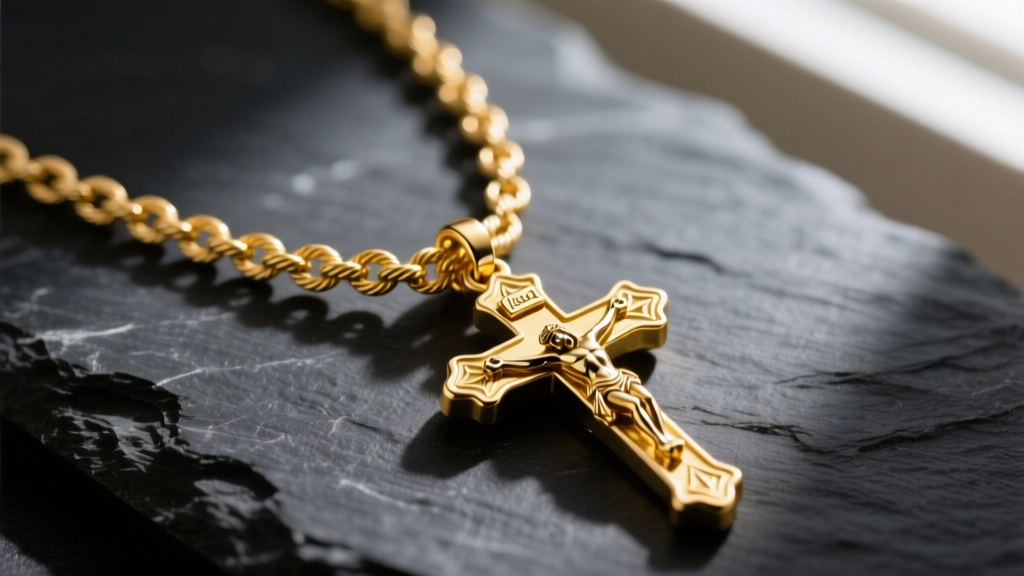
The Metallurgy and Anatomy of Men's Chain Rosaries
The intersection of devotional tradition and modern menswear has elevated the chain rosary from a purely religious artifact to a staple of contemporary style. However, when sourcing a gold rosary necklace mens buyers frequently prioritize aesthetics over structural metallurgy. A rosary chain is uniquely vulnerable: unlike a standard necklace, it features multiple junction points, a suspended centerpiece, and a terminal crucifix that acts as a pendulum, generating kinetic stress on the upper links. Understanding the technical specifications of wire gauge, alloy composition, and soldering methods is critical for acquiring a piece that survives daily wear.
According to the Gemological Institute of America (GIA), the alloying metals used in karat gold drastically alter not just the color, but the tensile strength and work-hardening properties of the final piece. For a garment that is meant to be handled, pulled, and worn against the skin daily, these metallurgical realities dictate the lifespan of the jewelry.
Wire Gauge and Link Architecture
The foundation of any chain rosary is the wire gauge. In men's jewelry, structural integrity is paramount. A standard women's rosary might utilize a delicate 0.8mm to 1.0mm wire, but a gold rosary necklace mens wearers rely on for daily use requires a minimum wire thickness of 1.5mm, with 1.8mm to 2.2mm being the optimal range for durability without excessive weight.
The link architecture also plays a role in tensile strength. Traditional cable links (uniform oval or round loops) are the most common for rosaries because they mimic the uniformity of prayer beads. However, cable chains are prone to stretching if the wire is not properly work-hardened during the drawing process. Figaro chains, which alternate between two or three shorter links and one elongated link, offer a superior drape and distribute kinetic tension more evenly across the chain's length, reducing the likelihood of localized link distortion.

Karat Purity: Balancing Color and Durability
Selecting the correct karat purity is a compromise between the rich, buttery color of high-purity gold and the mechanical hardness required for a chain. Pure 24k gold is far too malleable for a chain rosary; the links would deform under the weight of the crucifix alone. Therefore, alloying with copper, silver, and zinc is mandatory.
The Federal Trade Commission (FTC) Jewelry Guides strictly regulate karat markings, ensuring that a 14k stamp guarantees at least 58.3% pure gold content. But how do these alloys perform under stress?
| Karat | Gold Content | Vickers Hardness (HV) | Tensile Strength | Best Use Case |
|---|---|---|---|---|
| 10k Gold | 41.7% | ~140 HV | High | Heavy daily wear, high-tension links |
| 14k Gold | 58.3% | ~120 HV | Medium-High | The industry standard for men's chains |
| 18k Gold | 75.0% | ~95 HV | Medium | Luxury pieces, requires thicker gauge wire |
For a men's gold rosary, 14k gold remains the undisputed champion. It provides the necessary yield strength to resist stretching while maintaining a warm, premium color profile. If you opt for 18k gold, you must compensate for the lower Vickers hardness by increasing the wire gauge to at least 2.5mm to prevent the links from pulling open.
Crucifix and Centerpiece Mechanics
The centerpiece (the intersection where the loop meets the drop) and the crucifix are the heaviest components of the assembly. The method used to manufacture these components dictates their longevity.
Die-Struck vs. Cast Components
Most mass-market rosaries feature cast crucifixes. Casting involves pouring molten gold into a plaster mold created from a wax prototype. While cost-effective, casting can introduce microscopic porosity—tiny air bubbles trapped within the metal. Over time, the repetitive stress of the crucifix swinging can cause a crack to propagate from these porous voids, leading to a sudden snap at the bail or jump ring.
Conversely, die-struck components are formed by applying immense pressure to a sheet of gold alloy, compressing the molecular structure and eliminating porosity. A die-struck 14k gold crucifix is significantly denser, harder, and more resistant to impact damage. When evaluating high-end mens rosaries, always inquire whether the terminal pieces are die-struck or cast.
Soldering Techniques and Failure Points
Every link in a chain rosary must be closed and soldered to prevent the chain from unraveling. The traditional method is torch soldering, which involves applying a lower-melting-point gold solder to the seam. However, torch soldering requires heating the entire link, which can anneal (soften) the work-hardened wire, creating a weak point.
Modern master jewelers utilize laser welding to close jump rings and attach the crucifix bail. Laser soldering focuses a highly concentrated beam of light to melt a microscopic point of solder without transferring heat to the surrounding wire. This preserves the temper and tensile strength of the link, a crucial advantage for the heavy drop section of a men's rosary.

Sizing and Proportions for the Male Silhouette
Proportion is what separates a purposeful piece of men's jewelry from an ill-fitting accessory. The standard loop length for a men's chain rosary ranges from 22 to 26 inches. A 24-inch loop will typically rest just below the sternum on an average-built man, allowing the 3.5-inch drop to hang comfortably without interfering with the waistband.
Weight distribution is equally critical. A complete 24-inch, 2.0mm 14k gold chain rosary with a solid crucifix should weigh between 28 and 38 grams. Anything lighter suggests hollow links or a plated base metal core, both of which are unacceptable for a lifelong devotional piece. Solid links provide a satisfying, heavy drape that anchors the necklace against the chest.
Environmental Degradation and Stress Corrosion
Gold is famously inert, but karat gold alloys are susceptible to specific environmental hazards. The most destructive of these is stress corrosion cracking (SCC). When alloyed gold is exposed to halogens—specifically chlorine found in tap water, swimming pools, and household cleaners—the copper and silver in the alloy can undergo a chemical reaction that literally dissolves the molecular bonds at points of high mechanical stress.
The jump ring holding the crucifix is under constant tension. If exposed to chlorinated water while under this tension, the link can suffer catastrophic SCC failure, resulting in the loss of the crucifix. To prevent this, never wear your gold rosary in a pool or hot tub, and remove it when using harsh cleaning chemicals. For routine maintenance, ultrasonic cleaners are generally safe for solid gold chains, provided there are no soft gemstones inlaid in the crucifix corpus. A simple soak in warm water with a few drops of mild dish soap, followed by a gentle brushing with a soft-bristled toothbrush, remains the safest and most effective method for removing sebum and skin cells from the intricate link seams.
By prioritizing wire gauge, demanding die-struck components, and respecting the metallurgical limits of gold alloys, you can secure a gold rosary necklace that serves as both a resilient testament to faith and a masterclass in horological-grade jewelry engineering.


