Anatomy of a Gold T Necklace: Clasps, Karats, and Engineering
Explore the engineering of a gold T necklace. We analyze T-bar toggle mechanics, karat hardness, and T-pendant weight distribution for lasting wear.


When master jewelers and structural engineers discuss the longevity of fine jewelry, the gold T necklace frequently emerges as a masterclass in mechanical design and metallurgical planning. Whether you are referring to the iconic T-bar toggle clasp that secures heavy link chains or the architectural T-letter pendant that rests against the clavicle, both variations demand rigorous engineering tolerances. A failure in either design results in lost gold, damaged heirlooms, and compromised structural integrity. In this technical deep dive, we bypass superficial aesthetic commentary to examine the precise metallurgy, tensile requirements, geometric tolerances, and failure modes that dictate the lifespan of these essential jewelry components. Understanding these mechanics is crucial for collectors, bench jewelers, and informed buyers navigating the luxury market.
The Engineering of the T-Bar Toggle Clasp
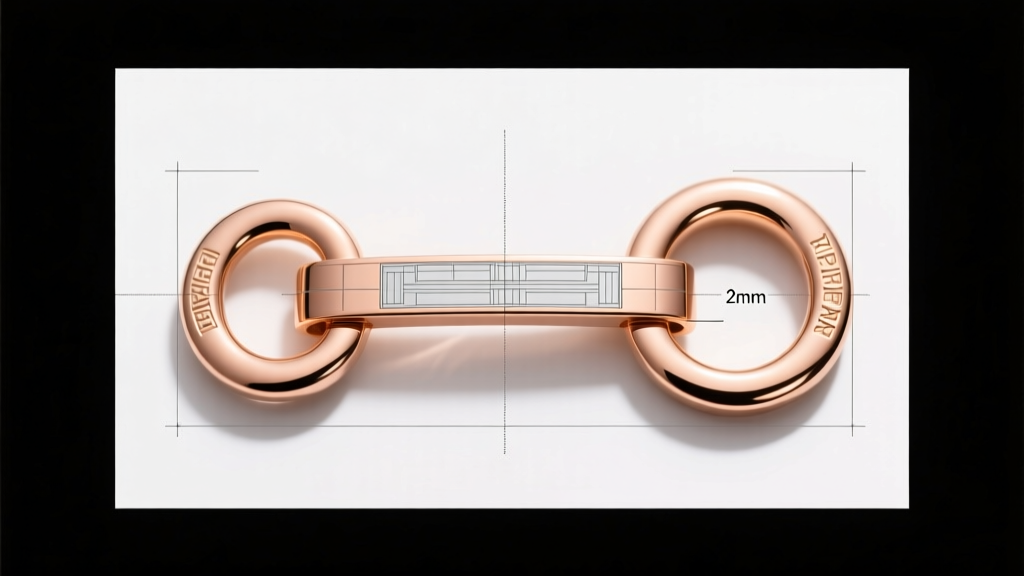
The T-bar toggle is deceptively simple in appearance but relies on strict geometric ratios to function securely under dynamic lateral tension. The mechanism consists of a rigid T-shaped bar that passes through a circular O-ring. The primary failure mode in poorly manufactured gold T necklaces is O-ring deformation or T-bar slippage. To prevent slippage, the length of the T-bar must exceed the inner diameter of the O-ring by a minimum of 15% to 20%. For example, if the O-ring has an inner diameter of 12.0mm, the T-bar must measure at least 14.4mm in total length.
Furthermore, the T-bar must be work-hardened during the manufacturing process. Annealed gold is far too soft to withstand the lever action applied when the necklace is caught on clothing. Master bench jewelers typically use a rawhide mallet to work-harden the T-bar, increasing its yield strength without compromising the karat purity of the alloy. The O-ring itself must be soldered using hard solder (melting point approximately 750°C to 780°C) rather than easy solder, ensuring the joint does not fail when subjected to the repetitive stress of daily clasping and unclasping.
Metallurgical Breakdown: Karat Selection and Hardness
The structural viability of a gold T necklace is inextricably linked to its alloy composition. Pure 24k gold possesses a Vickers hardness (HV) of roughly 25, making it entirely unsuitable for mechanical clasps or heavy pendants. Jewelers must rely on alloyed gold to achieve the necessary tensile strength. Below is a technical comparison of standard karat options for T-necklace components.
| Alloy Composition | Vickers Hardness (HV) | Tensile Strength (MPa) | Optimal Application |
|---|---|---|---|
| 14k Yellow Gold | 135 - 150 | 550 - 650 | Heavy T-Bar Toggles, Thick Chains |
| 18k Yellow Gold | 115 - 130 | 400 - 500 | T-Pendants, Medium Link Chains |
| 22k Yellow Gold | 70 - 90 | 250 - 300 | Decorative Elements Only (Avoid for Clasps) |
As noted by the Gemological Institute of America (GIA), the addition of copper and silver in 14k gold not only alters the color but significantly increases the dislocation density within the crystal lattice, directly resulting in higher hardness. For a heavy gold T necklace featuring a substantial toggle clasp, 14k gold is the superior engineering choice for the clasp components, even if the chain itself is crafted from 18k gold.
Architectural T-Pendants: Center of Mass and Bail Mechanics
When the term gold T necklace refers to a pendant featuring the letter 'T', the engineering challenges shift from clasp mechanics to weight distribution and pendulum physics. A horizontal T-pendant presents a high moment of inertia. If the pendant is struck or caught, the elongated top bar acts as a lever, placing immense shear stress on the bail (the loop connecting the pendant to the chain). Standard jump-ring bails soldered to the top center of the 'T' are prone to snapping under lateral torque.
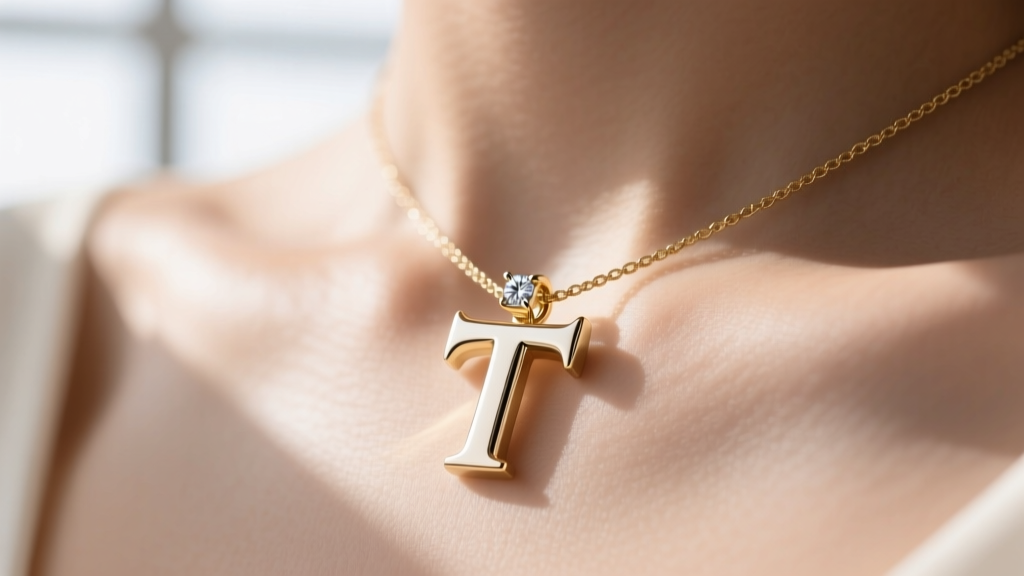
To mitigate this, advanced CAD (Computer-Aided Design) modeling is employed to create hidden bails that are integrated directly into the posterior geometry of the pendant. By positioning the hidden bail precisely at the pendant's center of mass, the necklace hangs perfectly flat against the sternum, eliminating the pendulum swing that causes chain abrasion. Furthermore, to reduce the overall weight without sacrificing the visual footprint, manufacturers utilize precision CNC milling to hollow out the back of the 'T', creating a shell structure that maintains rigidity while reducing gold weight by up to 30%. According to technical guidelines from Rio Grande, integrating a hardened steel or platinum sleeve inside the gold bail hole prevents the chain from wearing through the softer gold over years of friction.
Chain Gauge and Tensile Requirements
A gold T necklace is only as strong as its weakest link. Pairing a heavy T-bar toggle or a solid gold T-pendant with an inadequate chain is a common point of catastrophic failure. For necklaces weighing over 25 grams, the chain must possess a minimum wire gauge of 1.5mm and a verified breaking strength exceeding 15 pounds. Curb chains and Figaro chains are structurally superior to standard cable chains for T-necklaces because their interlocking, flattened links distribute lateral tension across multiple contact points rather than concentrating it on a single vertical wire.
Rope chains, while visually striking, contain numerous tiny solder joints that can unravel if a single link fails, making them a risky choice for heavy T-bar toggles. When evaluating a chain, inspect the jump rings connecting the chain to the clasp; these must be flush-soldered closed. An unsoldered jump ring will inevitably gap open under the dynamic load of a heavy gold T necklace, leading to immediate separation.
Troubleshooting and Wear Patterns
Even meticulously engineered jewelry requires proactive maintenance. The most common wear pattern in T-bar toggle necklaces is the gradual thinning of the O-ring due to friction against the T-bar. Over a period of five to seven years of daily wear, the interior diameter of the O-ring can expand by 0.5mm to 1.0mm, compromising the 15% safety margin and leading to accidental unclasping. Bench jewelers can remedy this by laser-welding additional gold wire to the interior of the O-ring and re-sizing it to original tolerances.
For T-pendants, inspect the bail hole for oval deformation. If the hole has become elliptical, the structural integrity is compromised, and the pendant requires immediate re-bushing. The Jewelers of America recommends bi-annual professional inspections for all toggle-clasp necklaces to measure joint integrity and clasp tolerances using digital calipers. By respecting the metallurgical and mechanical realities of these designs, collectors can ensure their gold T necklaces endure as both functional mechanisms and lasting works of art.


