Graduated Necklace Engineering: Proportions, Weight & Craft
Master the technical art of the graduated necklace. Explore bead proportion ratios, wire gauge selection, and weight distribution for flawless drape.


Constructing a true graduated necklace is one of the most demanding exercises in jewelry fabrication. Unlike a uniform strand where every bead shares identical dimensions and mass, a graduated piece requires a meticulous orchestration of geometry, physics, and material science. The transition from the center apex to the clasp is not merely an aesthetic choice; it is a calculated progression designed to manipulate the center of gravity, ensuring the piece drapes perfectly against the clavicle without riding up or twisting. In this expert deep dive, we deconstruct the technical architecture of the graduated necklace, exploring the exact sizing ratios, threading tensile strengths, and clasp mechanics required to engineer a flawless, heirloom-quality strand.
The Mathematics of Drape: Bead Sizing Ratios
The visual harmony of a graduated necklace relies on a strict geometric progression. A haphazard reduction in bead size results in a piece that looks unbalanced or top-heavy. Master jewelers utilize a specific differential ratio to dictate the 'run' of the strand. For a classic 18-inch graduated pearl necklace, the center bead (the apex) typically measures between 9.0mm and 10.0mm. From this center point, the bead diameter decreases incrementally—often by 0.25mm to 0.5mm every three to four beads—until it reaches a terminal size of 5.5mm to 6.5mm near the clasp.
This specific tapering serves a dual purpose. Aesthetically, it draws the eye to the center of the chest while creating a slimming illusion along the sides of the neck. Structurally, it concentrates the majority of the necklace's mass at the sternum. According to the Gemological Institute of America (GIA), the precision of this graduation is a critical factor in evaluating the craftsmanship and overall value of fine pearl and gemstone strands. If the transition is too abrupt, the necklace will kink; if it is too gradual, the piece loses its defining graduated silhouette and appears merely inconsistent.
Structural Integrity: Wire Gauges and Threading Materials
The internal armature of a graduated necklace must withstand asymmetric tension. Because the center beads are significantly heavier than the terminal beads, the threading material experiences variable stress loads. Selecting the wrong gauge or material is the primary cause of premature strand failure.
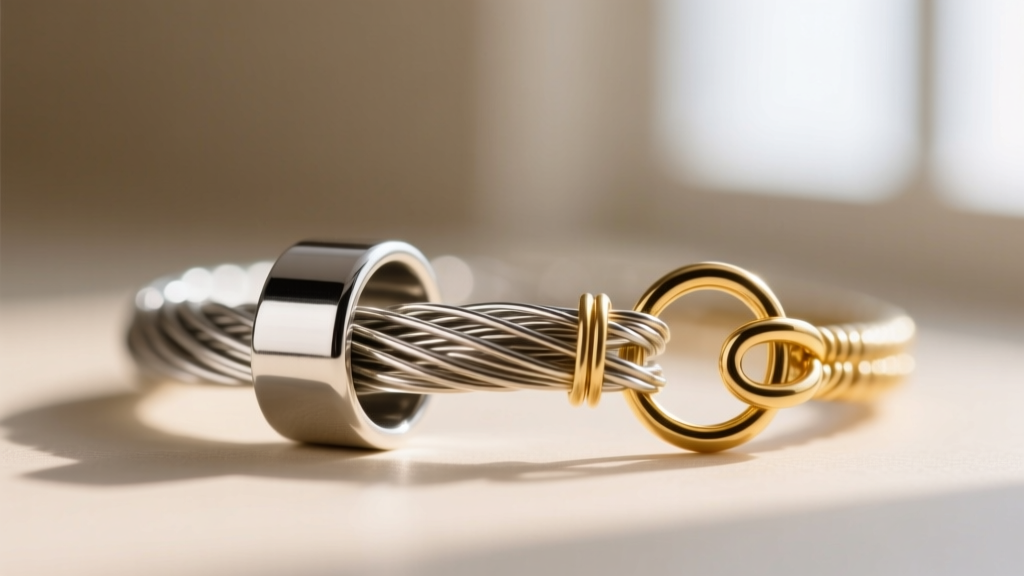
For heavy graduated gemstone strands (such as quartz, agate, or jade), synthetic nylon-coated stainless steel wire is mandatory. A 49-strand micro-wire with a diameter of 0.024 inches provides the necessary tensile strength (often exceeding 30 lbs) while maintaining the flexibility required to drape softly. Using a stiffer 7-strand or 19-strand wire in a heavy graduated piece will result in permanent kinking at the neck's flex points. As documented in Rio Grande's technical fabrication guides, 49-strand wire mimics the drape of silk while offering the sheer strength of steel.
For graduated pearls or delicate coral, traditional silk thread remains the gold standard due to its ability to knot securely between each bead. Griffin silk card sizes must be matched precisely to the drill hole diameter. A size #6 silk thread (0.30mm) is typically used for 7.0mm to 8.0mm pearls, ensuring a snug fit that prevents the beads from sliding and exposing the thread. Crucially, the final two inches of the silk thread must be protected by French wire (gimp)—a microscopic coiled metal spring—where the thread loops through the clasp ring. Without French wire, the friction of the metal clasp will sever the silk within months of wear.
| Threading Material | Diameter / Size | Tensile Strength | Best Application |
|---|---|---|---|
| 49-Strand Steel Wire | 0.024 inches | ~35 lbs | Heavy graduated gemstones (Jade, Onyx) |
| 49-Strand Steel Wire | 0.018 inches | ~20 lbs | Medium graduated crystals and glass |
| Griffin Natural Silk | Size #6 (0.30mm) | ~8 lbs | Graduated Akoya or Freshwater Pearls |
| PowerPro Braided | 0.008 inches | ~15 lbs | Sharp-edged graduated beads (requires reaming) |
Weight Distribution and the Center of Gravity
The physics of how a graduated necklace rests on the body is dictated by its center of gravity. A uniform strand distributes weight evenly in a parabolic arc. A graduated strand, however, is heavily bottom-weighted. If the heavy apex beads are positioned even half an inch too high on the shoulder, the necklace will act as a pendulum, constantly swinging and twisting to find equilibrium, ultimately choking the wearer.
To counteract this, expert stringers calculate the exact millimeter placement of the heaviest beads to ensure the apex rests precisely in the sternal notch (the dip at the base of the throat). This requires careful counting and dry-laying of the beads on a flocked board before any threading begins. Furthermore, the terminal beads near the clasp must be light enough to act as a counterbalance, but heavy enough to prevent the clasp from migrating to the front of the neck—a common annoyance known as 'clasp creep'.
Clasp Mechanics for Asymmetric Tension
Standard spring-ring or lobster clasps are entirely insufficient for a graduated necklace weighing over 60 grams. The asymmetric pull of the heavy center beads will warp the thin metal of a standard clasp, leading to catastrophic failure and lost gems. Instead, heavy graduated strands require a rigid box clasp (also known as a tongue-and-groove clasp) forged from 14k or 18k gold, or platinum.

The structural integrity of a box clasp relies on the thickness of its outer walls and the tension of its internal 'tongue'. For a heavy graduated necklace, the tongue must be stamped from metal no thinner than 0.8mm to resist bending under lateral torque. Additionally, the clasp must feature a double figure-8 safety catch—two secondary wire loops that snap over exterior beads on the clasp. This ensures that even if the primary tongue mechanism is compressed or accidentally dislodged, the secondary safeties will bear the full dead-weight load of the strand, preventing the necklace from dropping to the floor.
Expert Troubleshooting: Common Construction Failures
Even experienced jewelers encounter structural hurdles when assembling graduated pieces. Recognizing and mitigating these specific failure modes is what separates amateur stringing from master craftsmanship.
- Failure Mode 1: Drill Hole Abrasion. Graduated gemstone beads, particularly those sourced from mass-market lapidaries, often feature poorly drilled holes with razor-sharp internal edges. When strung on silk or synthetic thread, these edges act as microscopic saws, severing the strand at the neck's flex points. Solution: Use a diamond-coated bead reamer to smooth the interior of every drill hole before stringing, or utilize flexible wire with a high abrasion-resistant nylon coating.
- Failure Mode 2: The 'Gaping' Effect. In knotted graduated pearl necklaces, failing to pull the silk thread taut against the bead before tying the overhand knot results in visible gaps of thread between the pearls. This not only looks sloppy but allows the pearls to slide and grind against one another. Solution: Use an awl or a specialized pearl-knotting tool to push the knot flush against the bead's surface while the adhesive cures.
- Failure Mode 3: Wire Memory and Kinking. If nylon-coated wire is stored in tight coils before stringing, it retains 'memory'. When used in a graduated necklace, this memory fights the natural drape of the piece, causing it to stick out awkwardly at the collarbone. Solution: Always unspool and hang wire weights vertically for 24 hours prior to fabrication to release the manufacturing tension.
Engineering a graduated necklace is a masterclass in balancing aesthetic grace with unforgiving physics. By adhering to strict geometric ratios, selecting threading materials based on precise tensile data, and employing heavy-duty clasp mechanics, jewelers can create pieces that not only captivate the eye but endure the mechanical stresses of daily wear for generations.


