The Anatomy of a Green Butterfly Necklace: Materials & Craft
Explore the technical anatomy of a green butterfly necklace, from tsavorite pavé and plique-à-jour enamel to articulated wing mechanics.

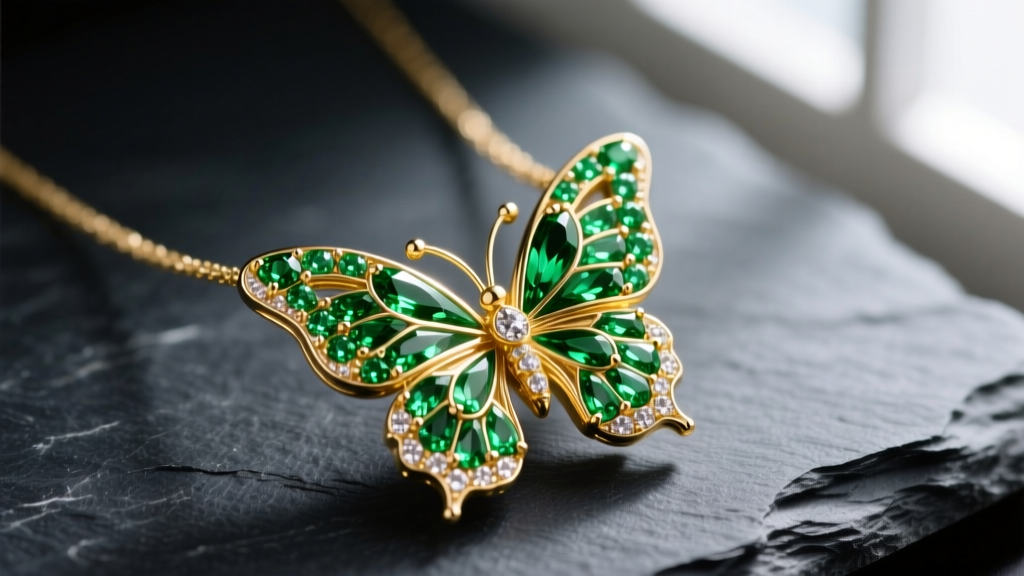
The green butterfly necklace is a masterclass in combining organic motifs with precise metallurgical and gemological engineering. While mass-market versions rely on stamped base metals and synthetic resins, fine jewelry interpretations demand a rigorous understanding of material science. From selecting the correct gemstone refractive index to engineering micro-hinges for articulated wings, creating or purchasing a high-caliber green butterfly pendant requires technical scrutiny. This guide deconstructs the anatomy of these pieces, offering actionable metrics for collectors, bench jewelers, and informed buyers.
The Gemological Spectrum: Sourcing the Perfect Green
The "green" in a luxury butterfly necklace is rarely a single material. Master jewelers leverage specific gemstones to capture the iridescence and depth of lepidopteran wings, each presenting unique structural challenges.
- Tsavorite Garnet: With a refractive index of 1.74 and a Mohs hardness of 7.0-7.5, tsavorite offers high brilliance without the brittleness of emerald. According to the Gemological Institute of America (GIA), tsavorite's lack of required clarity treatments makes it ideal for micro-pavé settings on butterfly wings, where numerous 1.0mm to 1.5mm stones must withstand the intense lateral pressure of bead setting without fracturing.
- Emerald: While iconic, emerald (Mohs 7.5-8) is heavily included (the jardin). Carving an emerald into a three-dimensional butterfly cabochon risks structural failure along natural fissures. If used, emeralds must be bezel-set or reserved for the central thorax of the butterfly, protected from direct impact.
- Chrysoprase: A cryptocrystalline variety of chalcedony colored by nickel silicates. Its Mohs hardness of 6.5-7 and uniform translucency make it the premier material for carved, solid-wing butterfly pendants, as it lacks the cleavage planes that cause other stones to split during lapidary work.
Advanced Enameling: Guilloché vs. Plique-à-Jour
When gemstones are bypassed in favor of vitreous enamel, the technical execution dictates the pendant's longevity and value. The Victoria and Albert Museum notes that historical enameling techniques remain the benchmark for modern fine jewelry, requiring exact thermal control.
Guilloché Enameling: This technique involves engine-turning a precise geometric pattern into the 18k gold or sterling silver base metal. Translucent green enamel is then applied and fired in a kiln at approximately 800°C. The light refracts off the engraved metal ridges beneath the glass, creating a shimmering, optical illusion of wing scales that shifts with movement.
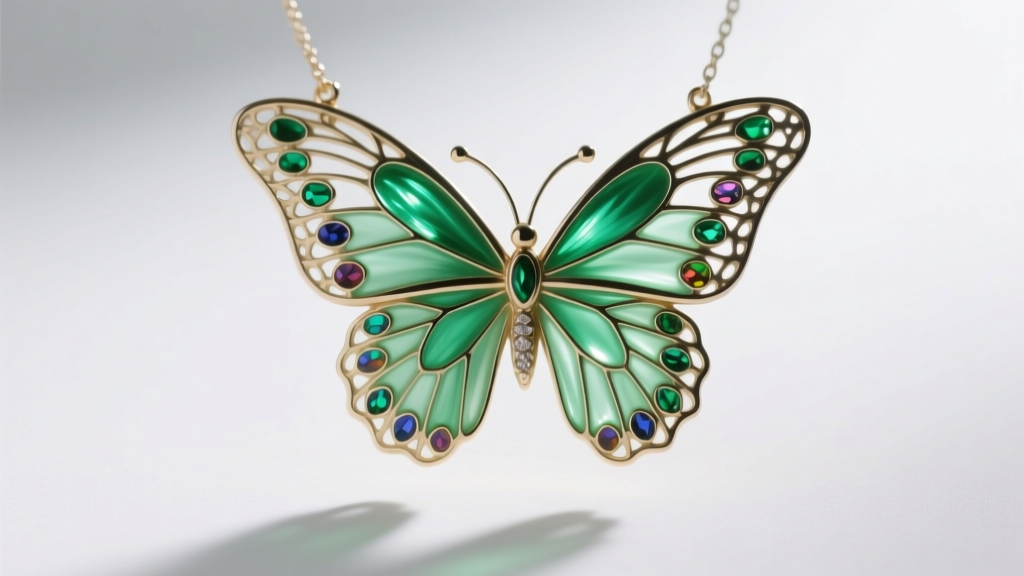
Plique-à-Jour: Translating to "letting in daylight," this technique creates a stained-glass effect. The butterfly wing cells are filled with transparent green enamel without a metal backing. Because the structural integrity relies entirely on the surface tension of the glass and the 0.5mm gold cloisonné wires, plique-à-jour is highly fragile. A dropped pendant will shatter the enamel wings, making it strictly a collector's piece rather than daily wear.
Structural Engineering: Articulated Wings and Bail Mechanics
A static butterfly is a missed opportunity in kinetic jewelry design. High-end green butterfly necklaces often feature articulated wings that flutter with the wearer's movement, requiring microscopic precision.
Micro-Hinge Mechanics: Articulation requires lost-wax casting of individual wing segments, followed by the insertion of 0.4mm to 0.6mm stainless steel or titanium hinge pins. To prevent the wings from flopping unnaturally, master jewelers integrate microscopic torsion springs or use precise friction-fitting (tolerance of less than 0.05mm) so the wings hold their angle until physically moved.
Bail Clearance: The bail (the loop connecting the pendant to the chain) must be engineered to accommodate kinetic movement. A standard 3mm x 5mm hidden bail is often soldered directly to the butterfly's thorax. However, if the wings span wider than 30mm, an integrated, articulated bail is required to prevent the chain from kinking when the pendant shifts on the chest.
Chain Gauge and Metallurgy Pairings
The chain supporting a green butterfly necklace must balance tensile strength with visual delicacy. A heavy chain overwhelms the organic motif, while a weak chain risks catastrophic failure. Below is a technical pairing guide based on pendant weight and structure.
| Chain Type | Gauge (mm) | Tensile Strength | Best Pairing |
|---|---|---|---|
| Box Chain | 0.9mm - 1.1mm | High (up to 15 lbs) | Heavy gemstone pavé butterflies (5g - 12g) |
| Cable Chain | 0.8mm - 1.0mm | Medium (up to 8 lbs) | Enamel or carved chrysoprase pendants (3g - 6g) |
| Snake Chain | 1.2mm - 1.5mm | Low (prone to kinking) | Not recommended for kinetic/articulated pieces |
| Wheat Chain | 1.0mm - 1.2mm | Very High (up to 20 lbs) | Heirloom emerald and diamond statement pieces |
Clasp Mechanics: Securing the Kinetic Piece
The termination point of the necklace is often an afterthought, yet it is the most common failure point in fine jewelry. For a green butterfly necklace featuring heavy gemstone pavé or fragile enamel, the clasp must distribute tension evenly.
Fold-Over vs. Lobster: A standard spring-ring or lobster clasp concentrates stress on a single 0.8mm jump ring. For pendants exceeding 8 grams, a fold-over clasp with a secondary figure-8 safety catch is mandatory to distribute the kinetic load.
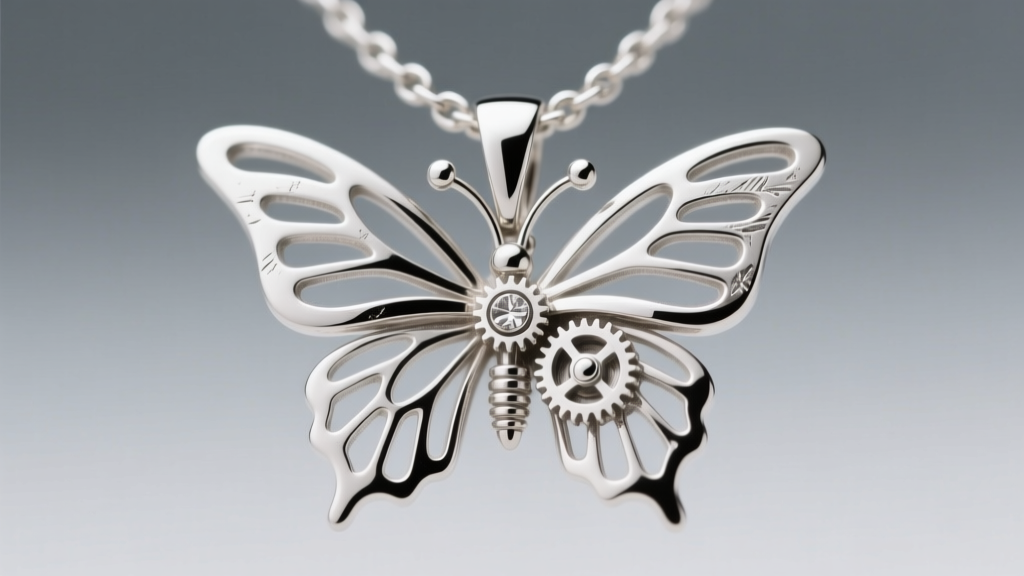
Soldered Jump Rings: Inspect the jump ring connecting the chain to the clasp. In mass-produced pieces, these are split rings that can easily pry open if the necklace snags on fabric. High-caliber necklaces utilize laser-welded or soldered jump rings, ensuring the ring will deform before it opens, protecting the intricate butterfly pendant from catastrophic loss.
Pricing Tiers and Authenticity Verification
Understanding the market stratification of green butterfly necklaces prevents overpaying for inferior metallurgy and misidentified stones.
Tier 1: Commercial Fashion ($40 - $150)
Materials: Brass or zinc alloy base, cold enamel (epoxy resin), and dyed quartz. The "green" degrades under UV exposure, and the clasps are typically hollow-cast lobster claws that fail under 3 lbs of tension.
Tier 2: Bridge Fine Jewelry ($400 - $1,500)
Materials: Solid 14k gold or sterling silver, genuine chrysoprase or malachite cabochons, and vitreous enamel. Prong settings are cast, not hand-cut, but the structural integrity is suitable for daily wear.
Tier 3: High Jewelry & Master Craft ($3,500 - $25,000+)
Materials: 18k gold, untreated tsavorite or emerald pavé, plique-à-jour enameling, and fully articulated micro-hinged wings. Authenticity at this tier requires a gemological certificate detailing the exact carat weight, color grade (e.g., Vivid Green for emeralds), and clarity enhancements.
Conclusion
A green butterfly necklace is far more than a whimsical accessory; it is a convergence of gemology, kinetic engineering, and historical enameling. By scrutinizing the refractive indices of the stones, the firing techniques of the enamel, and the tensile limits of the chain gauge, collectors can acquire pieces that are not only visually arresting but structurally enduring for generations.


