Green Turquoise Necklace Guide: Geology, Grading & Authenticity
Master the technical grading of a green turquoise necklace. Explore iron-rich geology, stabilization methods, matrix types, and authentication tests.

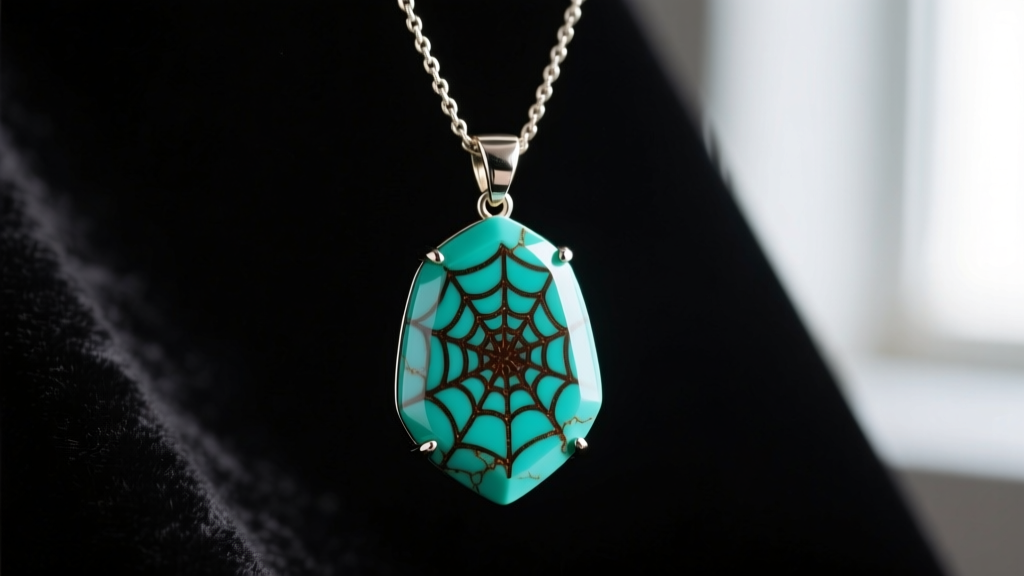
When collectors and jewelers discuss turquoise, the conversation often defaults to the classic robin’s-egg blue. However, the green turquoise necklace represents a distinct, highly sought-after category in fine jewelry, driven by complex mineralogy and specific geographic origins. For the serious collector or the discerning buyer, understanding the technical nuances of green turquoise—from its chemical composition and stabilization requirements to matrix identification and non-destructive authentication—is essential. This expert deep dive explores the gemological realities of green turquoise and how they dictate the design, durability, and value of necklace pieces.
The Mineralogy of Green Turquoise: Why Color Shifts Occur
Turquoise is a hydrous phosphate of copper and aluminum, with the chemical formula CuAl6(PO4)4(OH)8·4H2O. The color of the gemstone is entirely dependent on trace elemental substitutions within its triclinic crystal structure. While copper is responsible for the highly prized blue hues, the shift toward green occurs when iron or zinc substitutes for aluminum in the crystal lattice.
According to the Mindat.org mineral database, when iron dominates the substitution, the mineral transitions toward chalcosiderite, resulting in deep, earthy greens. Conversely, when zinc is the primary substituting element, the stone shifts toward faustite, yielding striking yellowish-green or apple-green hues. This geological distinction is critical for appraisers: a naturally occurring, zinc-rich apple-green turquoise from Nevada commands a vastly different premium than a pale, iron-rich green stone from a commercial Chinese mine.
"The presence of iron or zinc not only alters the visual spectrum of the turquoise but can also slightly affect its porosity and specific gravity, which must be accounted for during the lapidary process."
Stabilization vs. Enhancement: What You Must Know Before Buying
Because natural, untreated turquoise is relatively soft (ranking 5 to 6 on the Mohs scale) and highly porous, it is inherently vulnerable to the oils, acids, and friction present when worn against the skin. This is especially true for necklaces, where the stone rests directly on the décolletage. The Gemological Institute of America (GIA) notes that only 10% to 15% of mined turquoise is hard enough to be cut and polished without treatment.
For necklace applications, stabilization is not a flaw; it is often a structural necessity. However, buyers must distinguish between acceptable stabilization and deceptive enhancement.
| Method | Process Description | Market Acceptance | Impact on Value |
|---|---|---|---|
| Zachery Process | Infuses stone with potassium silicate (similar to natural minerals) without polymers or dyes. | Highly accepted by purists. | Retains 70-85% of natural value. |
| Epoxy/Resin Stabilization | Vacuum-impregnates porous stone with clear, hardening epoxy resin. | Industry standard for bead necklaces. | Standard commercial value ($1-$4/ct). |
| Dye Enhancement | Adds artificial color to pale or chalky material during resin infusion. | Considered deceptive if undisclosed. | Severely diminishes collector value. |
| Reconstitution (Block) | Turquoise dust mixed with resin and molded into blocks before cutting. | Low-end fashion jewelry only. | Negligible gemological value. |
Decoding the Matrix: Spiderweb, Pyrite, and Golden Web
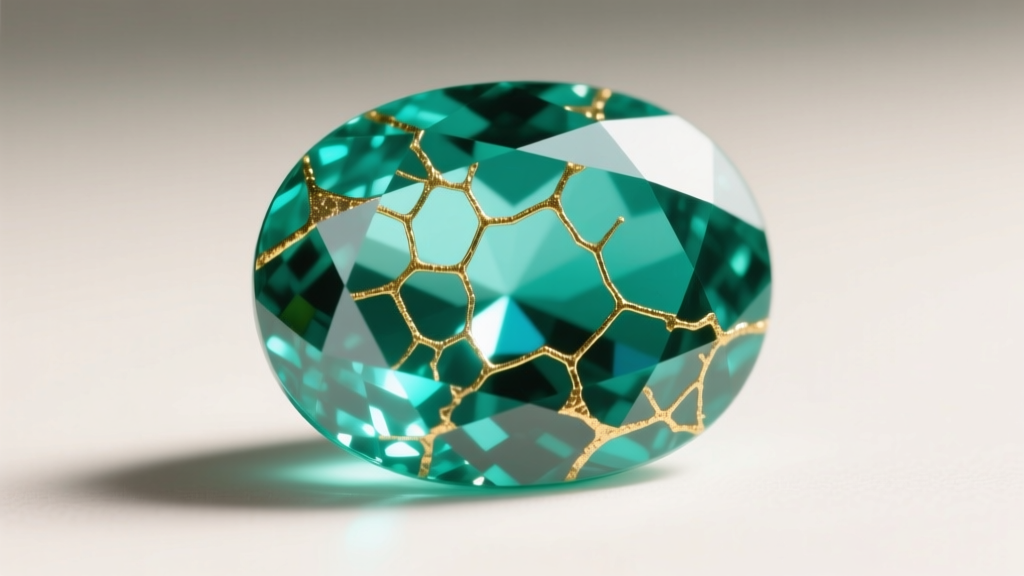
The matrix is the host rock that remains embedded in the turquoise. In green turquoise necklaces, the matrix is not just a visual feature; it is a geographic fingerprint.
- Golden Web (Limonite): Often found in Nevada and Arizona mines, limonite creates a warm, golden-brown webbing that contrasts beautifully with yellow-green turquoise. It is highly stable and takes an excellent polish.
- Pyrite Inclusions: The presence of metallic, silver-gold pyrite flecks is a hallmark of the Kingman mine in Arizona. In green turquoise, pyrite adds a striking metallic flash that elevates the stone's lapidary appeal.
- Sandstone & Quartzite: Common in Chinese and some Southwestern sources, a heavy sandstone matrix can make the stone more brittle, requiring a heavier bezel setting in pendant designs to prevent chipping.
Sourcing and Pricing: Origin Impacts on Carat Value
The provenance of a green turquoise necklace heavily dictates its market price. While blue Sleeping Beauty often dominates headlines, high-grade green turquoise from specific American mines has seen aggressive appreciation in the 2020s.
- Carico Lake (Nevada): Famous for its zinc-rich, electric apple-green and lime-green turquoise with black or brown webbing. High-grade, untreated cabochons for pendants can command $25 to $75+ per carat.
- Tonopah & Blue Ridge (Nevada): Known for deep, forest-green stones with heavy, dramatic spiderweb matrices. Stabilized necklace beads of top-tier quality range from $8 to $15 per carat.
- Hubei Province (China): Produces massive quantities of green and teal turquoise. While high-grade Chinese material exists, the market is flooded with heavily dyed and reconstituted block turquoise. Commercial beads typically price at $0.50 to $2.00 per carat.
Non-Destructive Authentication Tests for the Collector
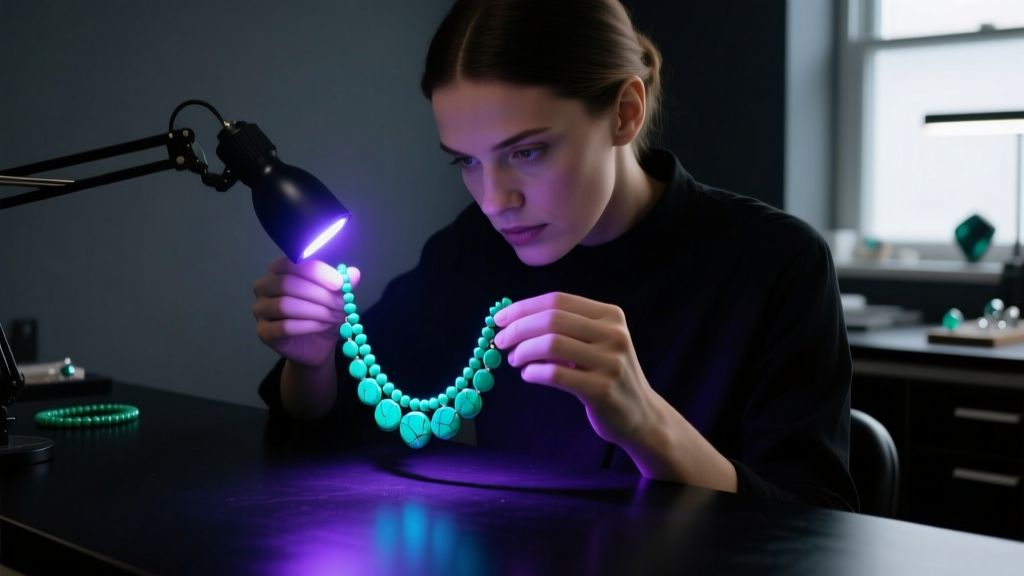
Before purchasing a high-value natural green turquoise necklace, collectors should employ non-destructive testing to verify authenticity and treatment status. Avoid the outdated "hot pin" test, which damages the stone and is useless against modern, heat-resistant polymers.
1. UV Fluorescence Testing
Using a standard 365nm UV flashlight in a dark room, examine the surface of the beads or cabochon. Natural, untreated turquoise is generally inert to UV light. If the stone exhibits a bright, milky, or bluish-white glow, it indicates the presence of epoxy resins or plastics used in stabilization. While stabilization is acceptable, this test confirms the stone is not 100% natural.
2. Magnification and Dye Pooling
Using a 10x or 20x jeweler's loupe, inspect the surface cracks, pits, and matrix boundaries. If the green color appears concentrated or "pooled" in the microscopic crevices, the stone has likely been dyed. Natural green turquoise will display a uniform distribution of color, even within microscopic fractures.
3. The Acetone Swab Test
For a discreet test on a single bead near the clasp, apply a tiny drop of pure acetone on a cotton swab and rub an inconspicuous area. If the swab picks up green pigment, the stone is artificially dyed. (Note: Acetone will not dissolve fully cured, high-quality epoxy, but it will lift surface dyes).
Necklace Engineering: Beads vs. Pendants
The structural engineering of a green turquoise necklace must adapt to the physical limitations of the gemstone. Bead necklaces require the turquoise to be drilled. Drilling creates micro-fractures and exposes the porous interior of the stone to sweat and skin acids. Therefore, expert lapidaries almost universally recommend stabilized turquoise for bead necklaces to prevent the beads from absorbing oils, which can cause them to turn a muddy, dark green and eventually crack along the drill hole.
Conversely, a pendant necklace allows for the use of rare, untreated, natural green turquoise. By cutting the stone into a cabochon, backing it with a stabilizing epoxy or metal plate, and enclosing it in a tight silver or gold bezel, the jeweler protects the stone's edges and limits skin contact. This preserves the gemological integrity and investment value of high-grade, natural Carico Lake or Tonopah material.
Ultimately, a green turquoise necklace is more than a splash of color; it is a wearable piece of complex geology. By understanding the elemental shifts that create its hue, the stabilization methods that ensure its longevity, and the authentication techniques that protect your investment, you can confidently navigate the market and acquire a piece that is both structurally sound and gemologically significant.


