Heart With Cross Inside Necklace: Casting, Metals & Chain Guide
Master the anatomy of a heart with cross inside necklace. Explore casting techniques, metal grades, bail stress points, and ideal chain pairings.

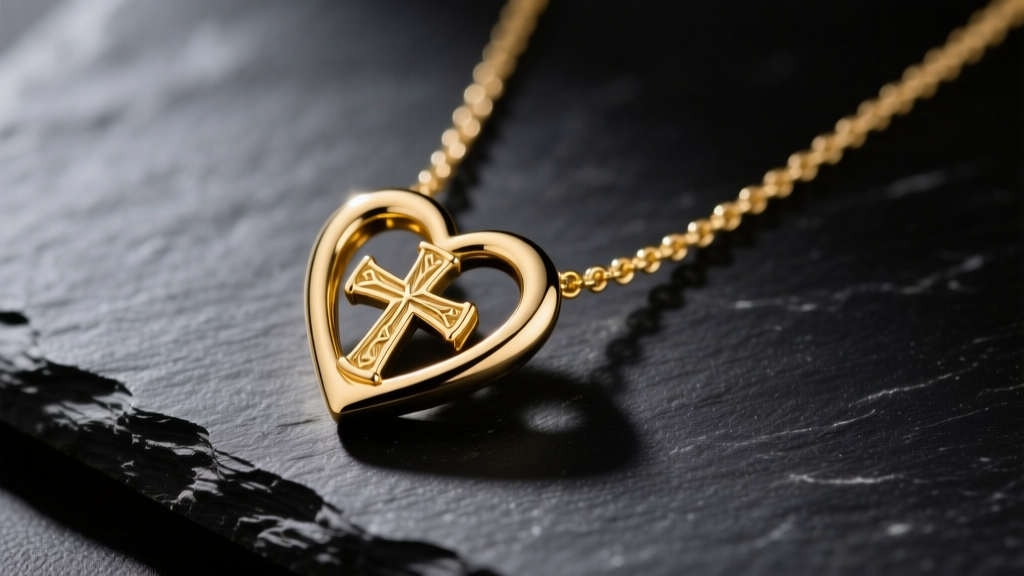
When evaluating fine jewelry, sentimental motifs often mask complex structural engineering challenges. The heart with cross inside necklace is a prime example. While visually striking and rich in symbolic meaning, the integration of a cross within the negative space of a heart creates unique metallurgical vulnerabilities. The inner arms of the cross act as stress concentrators, and the overall pendant head requires precise weight distribution to prevent premature bail wear. In this expert deep dive, we dissect the CAD design parameters, casting methodologies, alloy selections, and chain pairings necessary to ensure a heart with cross inside necklace survives decades of daily wear.
The Structural Anatomy of the Inner Cross Motif
Designing a heart with cross inside necklace begins in CAD (Computer-Aided Design) software. The primary engineering hurdle is the 'fillet radius'—the curved junction where the arms of the inner cross meet the interior wall of the heart. If a jeweler designs this junction with a sharp, 90-degree internal corner, the pendant becomes highly susceptible to torsional snapping.
Industry best practices dictate a minimum fillet radius of 0.35mm for cast gold alloys to disperse kinetic stress evenly. Furthermore, the cross arms must maintain a minimum thickness of 1.2mm to 1.5mm. Anything thinner risks deformation when the wearer accidentally snags the pendant on clothing. Some high-end manufacturers utilize a 'floating cross' design, where the cross is connected to the heart via four micro-struts. While visually lighter, this requires laser welding rather than traditional casting, significantly increasing the manufacturing cost and structural integrity.
Lost-Wax Casting vs. Die-Striking
The manufacturing method fundamentally dictates the durability of the negative space within the pendant. The vast majority of heart with cross inside necklaces are produced via lost-wax investment casting.
The Spruing Challenge
In lost-wax casting, molten metal must flow through channels called 'sprues' to fill the mold. The intricate negative space around the inner cross creates a thermal bottleneck. If the sprues are placed poorly, the gold or silver cools too rapidly at the tips of the cross arms, resulting in micro-porosity (tiny air bubbles trapped inside the metal). Porosity weakens the structural integrity of the cross arms, making them brittle. Expert casters use CAD simulation software to predict thermal shrinkage and place multiple micro-sprues directly at the cross terminals to ensure a dense, void-free cast.
Conversely, die-striking involves pressing metal between two hardened steel dies under immense pressure. While die-struck pendants boast superior tensile strength and a denser grain structure, creating the complex negative space of a heart with an inner cross requires expensive, multi-stage progressive dies. Consequently, die-struck versions of this specific motif are rare and typically reserved for high-volume, standardized designs.
Metallurgical Breakdown: Choosing the Right Alloy
The choice of metal is not merely an aesthetic decision; it directly impacts the yield strength of the inner cross. According to the Gemological Institute of America (GIA), the alloying metals mixed with pure gold dictate the hardness and durability of the final piece. Below is a technical comparison of common alloys used for this specific pendant style.
| Alloy | Purity | Vickers Hardness (HV) | Structural Verdict for Inner Cross |
|---|---|---|---|
| 10k Gold | 41.7% | ~135 HV | Excellent durability, highly resistant to bending, but lacks the rich color premium buyers expect. |
| 14k Gold | 58.5% | ~125 HV | The optimal balance. Provides sufficient tensile strength for thin cross arms while maintaining high corrosion resistance. |
| 18k Gold | 75.0% | ~115 HV | Softer and more malleable. Requires the cross arms to be cast 20% thicker to prevent bending under stress. |
| 925 Sterling Silver | 92.5% | ~65 HV | Highly prone to work-hardening and sulfide tarnishing in the deep crevices of the negative space. |
For a heart with cross inside necklace, 14k gold (alloyed with copper and silver for a yellow hue, or nickel/palladium for white gold) remains the industry standard. It offers the necessary rigidity to protect the delicate inner geometry without compromising the intrinsic value of the piece.
Bail Engineering and Chain Gauge Pairing
The bail—the loop that connects the pendant to the chain—is the most critical failure point on any necklace. A heart pendant with an integrated cross is often heavier than a standard solid heart due to the extra dimensional depth required to make the cross visible from oblique angles. This added weight acts as a pendulum, generating kinetic friction against the interior of the bail.

Preventing Bail Shear and Chain Snap
Never pair a heavy, complex pendant with a delicate 0.8mm cable chain. The mismatch in wear rates will cause the chain to act like a micro-saw, eventually cutting through the bail. For a heart with cross inside necklace weighing between 3.5 and 6.0 grams, adhere to these chain pairing specifications:
- 1.2mm to 1.5mm Box Chains: Offer excellent structural rigidity and distribute the pendant's weight evenly across the flat interior links.
- 1.5mm Wheat (Spiga) Chains: The woven, directional links provide immense tensile strength and resist kinking, which is vital for heavier pendants.
- Avoid Rope Chains under 2.0mm: Thin rope chains have a high surface-area friction profile that will rapidly degrade the interior of a gold bail.
Additionally, ensure the bail is a 'soldered loop' rather than a glued or pressure-set hidden bail. Soldered loops distribute the sheer force across the entire top arch of the heart, rather than concentrating it on a single micro-weld point.
Authenticity, Hallmarks, and Pricing Tiers
When investing in fine jewelry, verifying the metallurgical claims is paramount. The London Assay Office and equivalent global bodies mandate that precious metals bear specific hallmarks. For a 14k gold heart with cross inside necklace, look for the '585' stamp, usually located on the interior of the bail or on a small soldered tag near the clasp.
"A genuine hallmark is your only legal guarantee of the precious metal content. In intricate pendants where space is limited, laser-hallmarking on the back plate of the heart is an acceptable and increasingly common industry practice."
Market Pricing Framework (2026 Estimates):
- Mass-Market Sterling Silver (Cast): $45 – $120. High risk of porosity and tarnish in the negative space.
- Mid-Tier 10k/14k Gold (Commercial Cast): $250 – $600. Standard spruing, adequate durability for occasional wear.
- Boutique 14k/18k Gold (CAD Optimized): $800 – $1,800+. Features optimized fillet radii, laser-welded bails, and hand-polished interior walls of the cross.
Maintenance and Ultrasonic Cleaning Risks
The deep negative space surrounding the inner cross traps skin oils, cosmetic residues, and environmental dust. While ultrasonic cleaners are standard for diamond jewelry, they pose a specific risk to heart with cross inside necklaces if the cross features micro-pavé diamonds. The high-frequency cavitation bubbles can easily vibrate loose the tiny beads holding the micro-stones in place, especially if the casting has minor porosity.
Instead, utilize a thermal shock method: soak the pendant in a warm bath of distilled water and a few drops of pH-neutral dish surfactant for ten minutes. Use a soft-bristled, tapered interdental brush to gently sweep the crevices around the cross arms. Rinse with distilled water to prevent hard water spotting, and dry with a low-pressure air duster to ensure no moisture remains trapped in the intricate geometry. By respecting the structural nuances of this design, you ensure the piece remains a lasting heirloom rather than a fragile novelty.


