Heart Necklace with Initial: An Expert Metallurgy & Engraving Guide
Discover the technical details behind a heart necklace with initial. Compare metal grades, engraving methods, and chain gauges for lasting wear.

The Anatomy of Sentimental Jewelry: Beyond the Surface
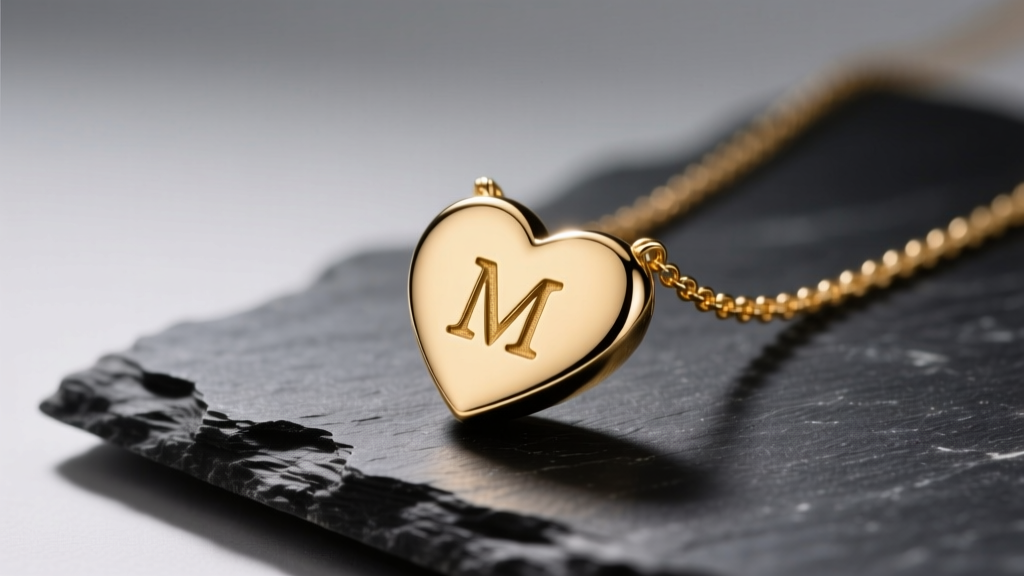
A custom heart necklace with initial is often viewed purely through a sentimental lens, but from a master jeweler's perspective, it is a complex intersection of metallurgy, mechanical engineering, and surface physics. When you personalize a pendant, you are permanently altering the crystalline structure of the metal. In 2026, with advancements in laser technology and alloy compositions, the gap between mass-produced trinkets and heirloom-quality personalized jewelry has widened significantly. This deep dive explores the exact material grades, engraving techniques, and structural mechanics required to ensure your personalized piece survives decades of daily wear without snapping, fading, or warping.
Metallurgical Foundations: Choosing the Right Alloy Blank
The longevity of an initial pendant begins with the base metal. The Gemological Institute of America (GIA) outlines how alloying elements dictate not just the color of gold, but its Vickers hardness (HV) and resistance to deformation. A 15mm solid heart pendant blank typically weighs between 2.5 and 4.0 grams, meaning the metal must possess enough tensile strength to resist bending when caught on clothing.
| Metal Grade | Composition | Vickers Hardness (HV) | Tarnish Resistance | Engraving Suitability |
|---|---|---|---|---|
| 925 Sterling Silver | 92.5% Ag, 7.5% Cu | 60 - 75 | Low (Prone to sulfur oxidation) | Excellent (Soft, deep cuts) |
| 14k Yellow Gold | 58.5% Au, Cu/Ag/Zn | 130 - 150 | High | Very Good (Crisp laser contrast) |
| 18k Yellow Gold | 75.0% Au, Cu/Ag | 110 - 125 | High | Good (Softer, requires care) |
| Platinum 950 | 95.0% Pt, Ru/Ir | 110 - 130 | Exceptional | Difficult (High density, work-hardens) |
While 925 sterling silver is the most accessible option, its copper content makes it highly susceptible to sulfur-induced tarnishing, which can obscure fine engraving lines over time. For a balance of durability, rich color, and optimal engraving contrast, 14k gold remains the industry standard for personalized pendants.
Engraving Techniques: Laser vs. Diamond Drag vs. Hand Cut
The method used to etch the initial into your heart necklace with initial fundamentally alters the surface integrity of the pendant. In modern jewelry manufacturing, three primary techniques dominate the market, each with distinct wear profiles.
1. Fiber Laser Engraving (1064 nm Wavelength)
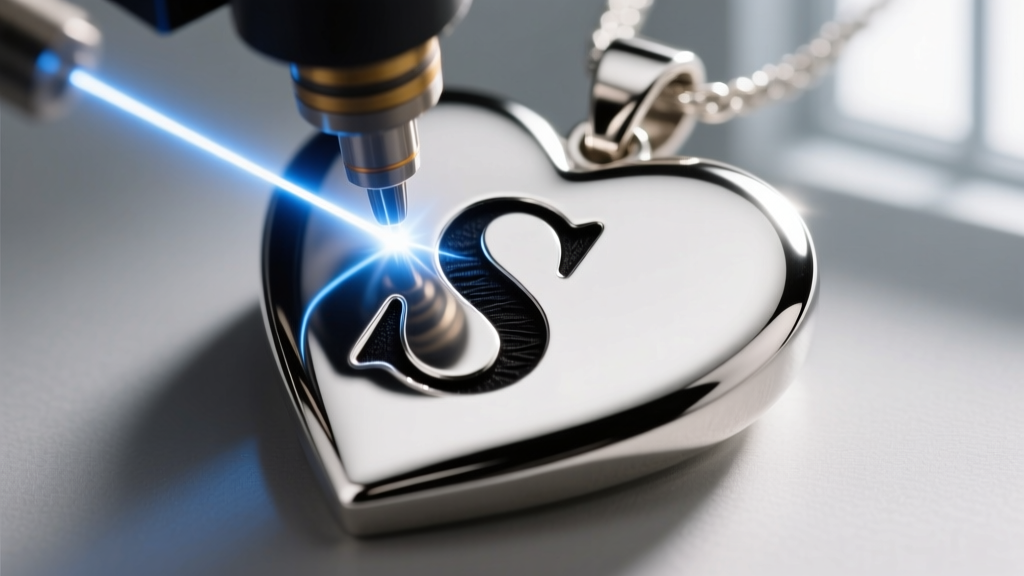
Fiber lasers have revolutionized metal marking. By focusing a 1064 nm infrared beam onto the metal surface, the laser vaporizes a microscopic layer of the alloy, typically achieving a depth of 0.01mm to 0.05mm. In 2026, advanced MOPA (Master Oscillator Power Amplifier) fiber lasers allow jewelers to manipulate pulse frequencies to create deep, black oxidized contrasts on gold and silver without applying chemical patinas. This method is permanent; the initial will never 'rub off' because the metal itself has been removed and oxidized.
2. Diamond Drag Engraving
This mechanical process uses a hardened diamond-tipped stylus dragged across the metal surface by a CNC pantograph. It displaces rather than removes metal, creating a shallow scratch (typically 0.005mm deep). While it produces a bright, reflective cut on softer metals like silver and 18k gold, diamond drag engravings are highly susceptible to wear. Years of friction against clothing and polishing cloths will eventually erode the displaced metal ridges, causing the initial to fade.
3. Hand Engraving (Push Graving)
Reserved for bespoke, high-end commissions, a master engraver uses hardened steel gravers to physically carve ribbons of metal away from the surface. This creates deep, V-shaped channels (up to 0.2mm deep) with bright, mirror-like walls. According to master engravers, hand-cut initials actually become more legible over time as the surrounding metal develops a patina while the bright-cut walls remain reflective.
'A laser marks the surface, a diamond scratches it, but a hand graver sculpts it. When engineering a piece meant to outlive the wearer, depth of cut is the ultimate metric of permanence.' — Master Jeweler's Guild Technical Bulletin, 2025
Why Your Heart Necklace with Initial Requires Specific Chain Gauges
The most common failure point in personalized jewelry is not the pendant itself, but the chain snapping under the dynamic load of the pendant. A solid 15mm heart pendant weighs approximately 3.2 grams. While this seems light, the kinetic force generated when the wearer moves, bends, or accidentally snags the pendant can multiply this static weight by a factor of five or more.
Data from Rio Grande, a premier jewelry supply manufacturer, indicates that chain breaking strength is directly correlated to wire gauge and link geometry. Here is the technical breakdown for pairing chains with a 3-gram heart pendant:
- 0.8mm Cable Chain: Breaking strength of ~6 lbs. Verdict: Too weak. High risk of snapping at the soldered jump ring.
- 1.0mm Box Chain: Breaking strength of ~22 lbs. Verdict: Ideal. The interlocking square links distribute kinetic stress evenly, preventing single-point failure.
- 1.2mm Rolo Chain: Breaking strength of ~35 lbs. Verdict: Excellent for heavy wearers, though the thicker links may visually overpower a delicate 15mm heart.
- 0.9mm Snake Chain: Breaking strength of ~12 lbs. Verdict: Avoid. The smooth, tubular surface structure is prone to kinking, which creates microscopic stress fractures that eventually snap.
Clasp Engineering and Jump Ring Mechanics
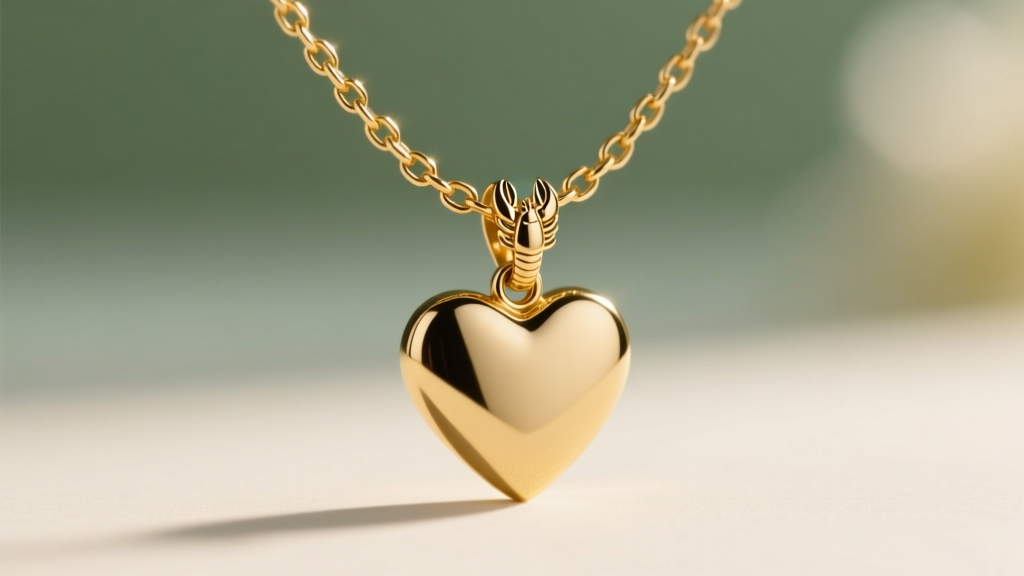
The clasp and the jump ring connecting the chain to the heart pendant are critical structural vulnerabilities. A standard 4mm spring-ring clasp relies on a tiny internal steel spring that frequently fails due to moisture ingress and corrosion. For a personalized piece meant for daily wear, upgrade to a 5mm or 6mm solid cast lobster claw clasp. Lobster claws feature a wider internal spring cavity and a thicker closure lip, reducing the chance of accidental unhooking.
Furthermore, the jump ring attaching the pendant to the chain must be soldered closed. An unsoldered jump ring, no matter how tightly closed with pliers, will eventually gap open under the lateral torque of a swinging heart pendant, resulting in the loss of the piece. Always verify with the jeweler that the pendant's bail or jump ring has been laser-welded or torch-soldered shut.
Maintenance: Preserving the Initial's Contrast
Cleaning a heart necklace with initial requires specific protocols to avoid destroying the engraving. If your pendant features a laser-engraved initial with an oxidized (blackened) contrast, never use an ultrasonic cleaner. The high-frequency cavitation bubbles can strip the oxidized patina from the microscopic crevices of the lettering, leaving you with a faint, illegible mark.
Instead, use a mild solution of warm water and phosphate-free dish soap, agitating gently with a soft-bristled baby toothbrush. Avoid silver polishing cloths on diamond-drag or hand-engraved silver, as the mild abrasives embedded in the cloth will polish away the bright-cut ridges over time. For laser-engraved gold, a microfiber cloth is perfectly safe, as the contrast is achieved through metal removal and heat oxidation, not surface coatings.
Final Verdict: Specifying Your Custom Piece
When commissioning or purchasing a heart necklace with initial, treat it as an engineering project. Specify a 14k gold or platinum blank for optimal hardness, demand fiber laser or hand engraving for permanence, and pair it with a 1.0mm box chain secured by a soldered jump ring and a 5mm lobster clasp. By focusing on these technical specifications, you ensure that the sentimental value of the initial is protected by uncompromising structural integrity.


