How to Clean & Care for Your Rose Gold Paper Clip Necklace
Learn expert tips to clean, maintain, and protect your rose gold paper clip necklace from tarnish, scratches, and copper oxidation.

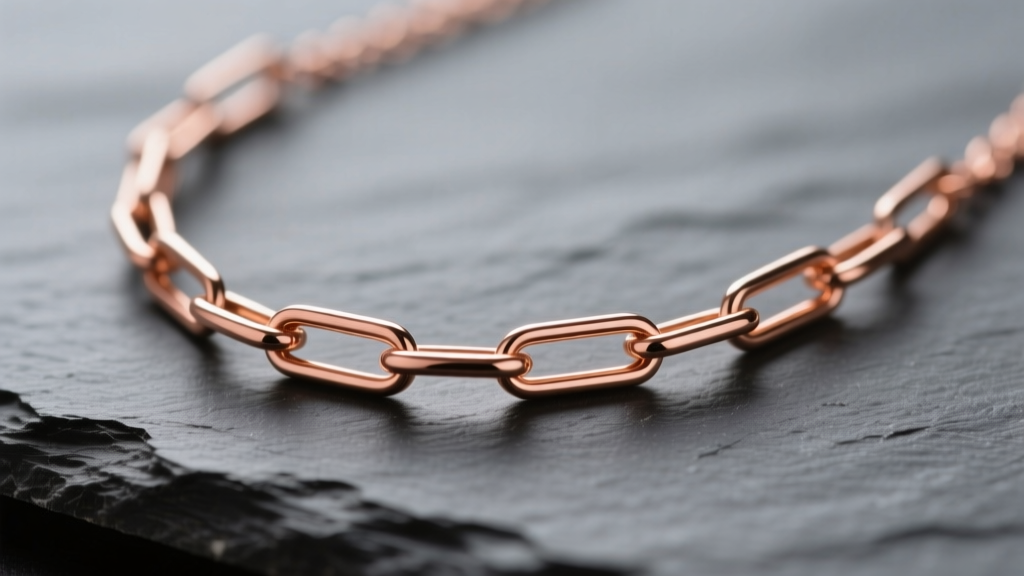
The rose gold paper clip necklace has cemented its place as a modern jewelry staple, blending vintage charm with contemporary minimalism. However, the unique metallurgy of rose gold combined with the specific geometry of paper clip chains requires a specialized approach to maintenance. Unlike traditional yellow gold or platinum, the copper alloys that give rose gold its signature blush are highly reactive to environmental factors. Furthermore, the elongated, interlocking rectangular links of a paper clip chain create microscopic crevices where sebum, cosmetics, and environmental pollutants accumulate. This comprehensive guide provides actionable, expert-level protocols to clean, protect, and restore your rose gold paper clip necklace, ensuring it retains its structural integrity and warm luster for decades.
The Metallurgy of Rose Gold: Understanding Copper Oxidation
To properly care for your jewelry, you must first understand its atomic composition. Pure 24k gold is entirely yellow and too soft for daily wear. Rose gold is an alloy created by mixing pure gold with copper, and occasionally a small percentage of silver. According to the Gemological Institute of America (GIA), the most common formulations are 14k (58.3% gold, 41.7% copper/silver) and 18k (75% gold, 25% copper).
The copper content is responsible for the pinkish-red hue, but it is also the primary vulnerability. When copper is exposed to sulfur compounds in the air, chlorides in tap water, or the natural acidity of human sweat, it undergoes surface oxidation. This is often misidentified as "tarnish" (a term more accurately applied to sterling silver). On a rose gold paper clip necklace, this oxidation manifests as a gradual darkening or dulling of the flat surfaces of the links. While 14k rose gold is more durable against physical scratching due to its higher copper content, it is slightly more prone to this surface oxidation than 18k rose gold. Understanding this distinction is critical when selecting cleaning agents, as harsh chemicals designed to strip silver sulfide tarnish can permanently damage the copper alloy matrix of your rose gold.
The Geometry of Paper Clip Chains: Where Dirt Hides
The paper clip chain is defined by its elongated, uniform oval or rectangular links. While visually striking, this geometry presents unique maintenance challenges. The flat, often slightly hammered or diamond-cut surfaces of the links act as magnets for fingerprint oils and lotion residue. More problematically, the interlocking junctions where two links meet create high-friction pivot points.
Over time, a paste-like mixture of dead skin cells, cosmetic foundation, and sebum builds up inside these pivot points. This buildup not only dulls the necklace's overall brilliance but also increases friction between the links, accelerating micro-abrasions and metal fatigue. If your paper clip chain is crafted from a lighter gauge wire (such as 18-gauge or 20-gauge), this accumulated grime can actually cause the links to stiffen, increasing the risk of a link snapping under tension.
Solid vs. Plated: Identifying Your Necklace's Core
Before applying any cleaning protocol, you must definitively identify whether your necklace is solid rose gold, rose gold vermeil, or rose gold plated. The Federal Trade Commission Jewelry Guides strictly regulate these terms, and the differences dictate your cleaning limits:
- Solid Rose Gold (10k, 14k, 18k): The color and alloy are consistent throughout the entire link. You can safely use mild mechanical agitation and specialized gold polishing cloths without fear of stripping the finish.
- Rose Gold Vermeil: A thick layer of rose gold (minimum 2.5 microns) plated over a sterling silver base. Aggressive polishing or ultrasonic cleaning can wear through the gold layer, exposing the yellowish-white silver beneath.
- Rose Gold Plated/Filled: A microscopic layer of rose gold over a brass or copper base. These require the gentlest touch; any abrasive action will strip the plating, and if the base metal is exposed to moisture, it will oxidize rapidly, potentially turning your skin green.
The Ultrasonic vs. Hand-Wash Debate
Many jewelry owners default to ultrasonic cleaners for chain necklaces. While ultrasonic waves are excellent for dislodging dirt from intricate settings, they pose a severe risk to certain paper clip chains. If your necklace features hollow paper clip links—a common manufacturing technique used to create chunky, oversized chains without the prohibitive weight and cost of solid gold—the high-frequency vibrations can cause micro-fractures or completely collapse the hollow links. Unless you are 100% certain your chain is solid cast or solid wire-drawn, avoid ultrasonic cleaners entirely. Hand-washing remains the gold standard for safe, effective maintenance.
The Ultimate Hand-Wash Cleaning Protocol
This protocol is safe for solid, vermeil, and plated rose gold paper clip necklaces. It relies on chemical breakdown rather than abrasive force.
| Ingredient | Ratio | Purpose & Metallurgical Impact |
|---|---|---|
| Distilled Water | 1 Cup (240ml) | Provides a mineral-free base. Tap water contains chlorine and calcium that can leave permanent water spots on copper alloys. |
| Phosphate-Free Dish Soap | 3 Drops | Acts as a gentle surfactant to break down sebum and cosmetic oils without reacting with the copper. |
| Ammonia-Free Glass Cleaner | 0 (Strictly Avoid) | Ammonia is highly corrosive to copper alloys and will strip the rose hue, leaving a porous, yellowish surface. |
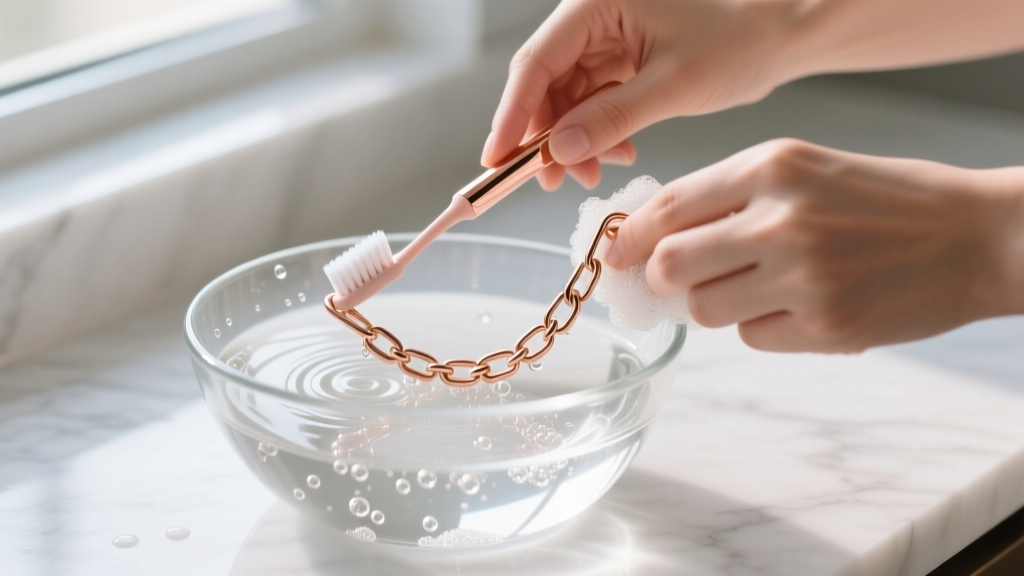
Step 1: Mix the distilled water and phosphate-free dish soap in a glass bowl. Allow the solution to sit for five minutes to reach room temperature; extreme temperature changes can shock certain alloy structures.
Step 2: Submerge the rose gold paper clip necklace fully. Let it soak for exactly 10 to 15 minutes. This allows the surfactant to penetrate the interlocking pivot points and soften the sebum buildup.
Step 3: Using an extra-soft baby toothbrush (bristle diameter under 0.1mm), gently brush the chain. Focus specifically on the interlocking junctions and the clasp mechanism. Brush in the direction of the links to avoid snagging.
Step 4: Rinse thoroughly under a gentle stream of lukewarm distilled water to remove all soap residue.
Drying and Polishing Without Stripping the Finish
Never air-dry your paper clip necklace, as water droplets will leave mineral rings on the flat surfaces of the links. Instead, lay the chain flat on a lint-free microfiber cloth and gently pat it dry.
If your solid 14k or 18k rose gold necklace has lost its luster due to surface oxidation, use a specialized, untreated microfiber jewelry cloth. Avoid traditional rouge polishing cloths or abrasive pastes. According to Jewelers of America, abrasive polishes remove a microscopic layer of metal. On rose gold, this can alter the surface ratio of copper to gold, inadvertently changing the color of the necklace or removing the rhodium flashing sometimes applied to enhance shine. Gently glide the cloth over the flat surfaces of the paper clip links; do not pull the chain tightly through the cloth, as this can stretch the links over time.
Strategic Storage to Prevent Tangling and Oxidation
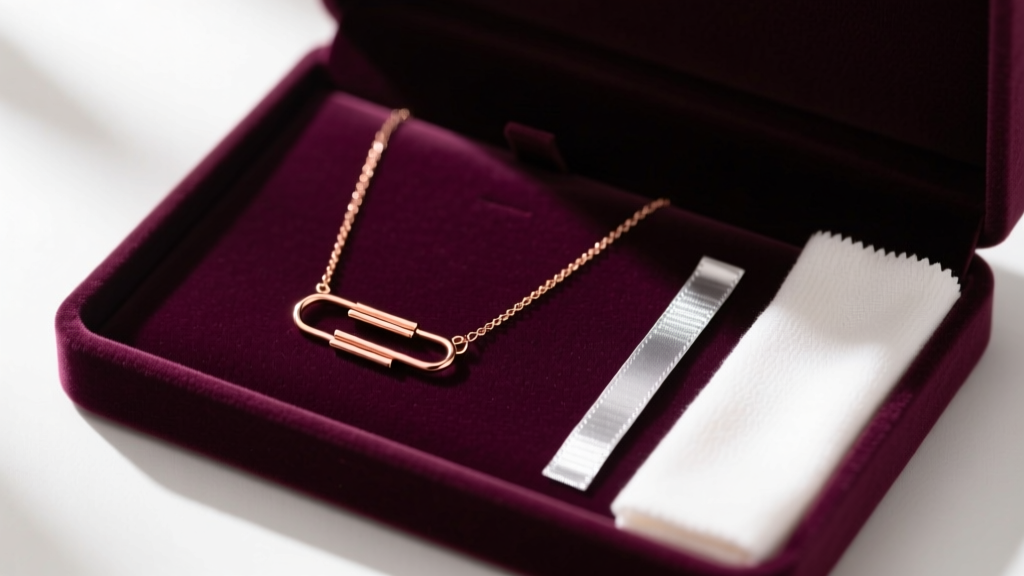
The elongated links of a paper clip chain are notoriously prone to tangling, which can lead to kinks and structural weak points. To prevent this, always store the necklace laid completely flat or hanging vertically from a padded hook. Never toss it into a communal jewelry box where it can become entangled with harder gemstones or diamond tennis bracelets, which will easily scratch the relatively soft surface of 14k or 18k rose gold.
To combat copper oxidation during storage, place the necklace in an airtight polyethylene bag along with a 3M anti-tarnish strip. These strips absorb atmospheric sulfur and chlorides before they can react with the copper alloy. Replace the strips every three to six months to maintain an inert storage environment.
Troubleshooting: Stuck Clasps and Kinked Links
The Frozen Lobster Clasp: The tiny internal spring of a lobster clasp is highly susceptible to soap scum and lotion buildup. If the trigger becomes stiff, do not force it with metal tools. Apply a single drop of mineral oil to the clasp hinge using a toothpick, work the trigger back and forth gently, and then wash the clasp with the soapy distilled water protocol outlined above.
Kinked Links: If a paper clip link becomes bent or kinked, do not attempt to bend it back into shape with your fingers or standard pliers. Standard steel pliers will mar the rose gold surface instantly. Take the piece to a professional jeweler who can use nylon-jawed pliers and a specialized mandrel to reshape the link without compromising the metal's structural integrity or its polished finish.


