How to Ship a Necklace Safely: Cost, Insurance & Packaging Guide
Learn how to ship a necklace safely without overspending. Compare carrier insurance costs, packaging materials, and value-protection strategies.

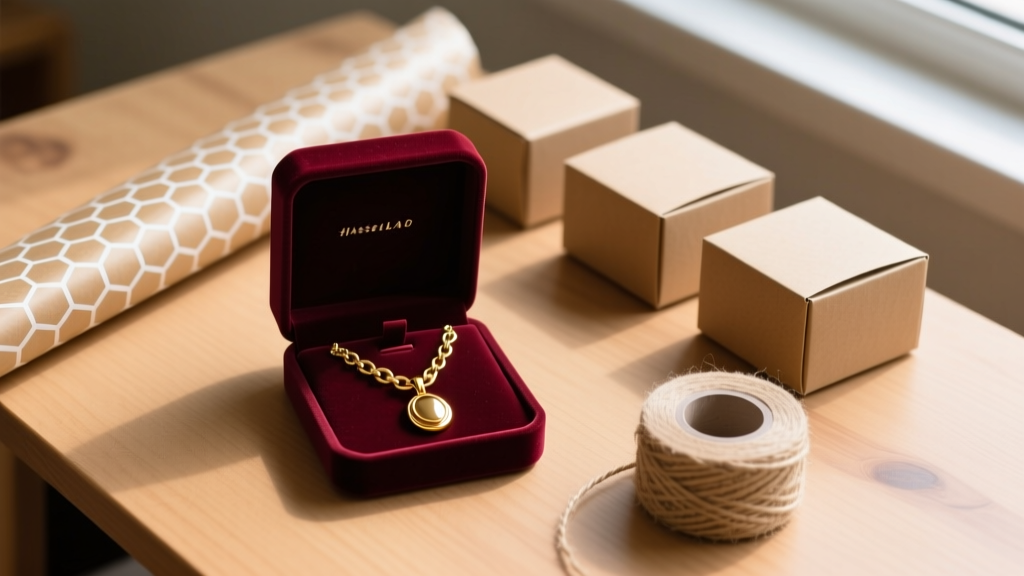
Shipping a necklace—whether it is a $50 fashion chain or a $5,000 heirloom diamond pendant—requires a strategic balance between cost and security. Many sellers, independent jewelers, and givers overpay for expedited shipping while under-investing in proper insurance and structural packaging. This mismatch leads to devastating financial losses, tangled chains, and crushed presentation boxes. Understanding how to ship a necklace from a budget and value assessment perspective means looking beyond the base postage rate and evaluating the total cost of risk mitigation.
In 2026, carrier liability limits and packaging material costs have shifted, making it more important than ever to optimize your jewelry logistics. This guide breaks down the exact economics of shipping fine and fashion necklaces, providing actionable frameworks to protect your assets without destroying your profit margins.
The True Cost of Shipping Fine Jewelry
When calculating how to ship a necklace, amateur shippers often focus solely on the base transit rate. However, the base rate is only a fraction of the total logistics cost. The real budget drain comes from declared value insurance and dimensional weight packaging. If you are shipping a $2,500 gold pendant, paying $12 for Priority Mail is irrelevant if you fail to pay the $28 insurance premium, leaving you entirely exposed to carrier loss.
To assess value properly, you must match the carrier's security infrastructure to the necklace's replacement cost. According to the USPS Registered Mail guidelines, high-value items require a specific chain of custody that standard express services simply do not provide.
Carrier Insurance Tiers & Value Thresholds
Below is a comparative breakdown of shipping a $2,500 necklace across major carriers, factoring in base rates, insurance premiums, and security protocols.
| Carrier & Service | Max Insurable Value | Est. Total Cost ($2.5k Item) | Transit Time | Security & Handling |
|---|---|---|---|---|
| USPS Registered Mail | $50,000 | ~$42.00 | 3-10 Days | Maximum (Caged, locked, signature-tracked) |
| USPS Priority Express | $5,000 | ~$75.00 | 1-2 Days | Moderate (Standard sorting facilities) |
| UPS Declared Value | $50,000 | ~$38.50 | 1-3 Days | High (Secure cage routing for high value) |
| FedEx Declared Value | $1,000 (Standard) | N/A (Requires Custom) | 1-3 Days | High (But standard limits are restrictive) |
Budget Takeaway: For necklaces valued under $500, USPS Priority Mail with included $100 insurance (plus a small add-on fee) offers the best ROI. For necklaces valued between $500 and $5,000, UPS or USPS Registered Mail provides the most cost-effective security. Never use standard FedEx Ground for high-value jewelry, as their standard declared value caps at $1,000 without specialized account setups.
Packaging ROI: Where to Spend and Where to Save
Packaging is your first line of defense against physical damage and theft. However, over-packaging can trigger dimensional weight pricing penalties, while under-packaging risks crushed gemstones and tangled chains. The goal is to achieve maximum structural integrity with minimal volumetric footprint.
Material Grade Specifications
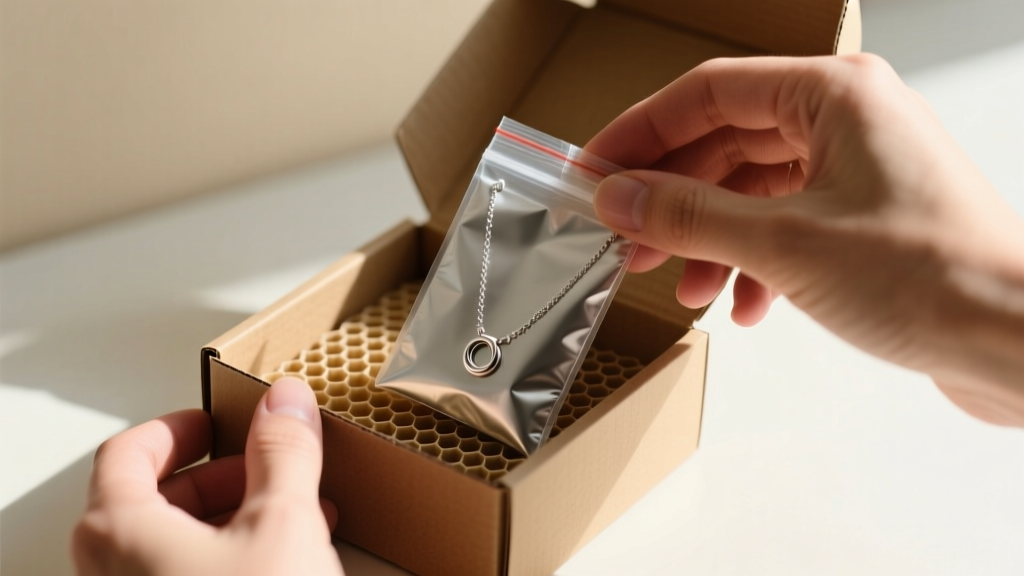
Do not use standard bubble wrap for fine necklaces. The plastic can trap moisture, accelerating silver tarnish, and the edges can snag on delicate pavé prongs. Instead, invest in materials that offer both physical cushioning and chemical protection:
- Anti-Tarnish Strips: 3M Silverguard or equivalent activated carbon strips cost roughly $0.15 each and prevent sulfur-induced tarnishing for up to 12 months inside a sealed environment.
- Poly Bags: Use 2-mil to 4-mil thickness polyethylene zip bags. They provide a moisture barrier and prevent the necklace chain from snagging on the corrugated cardboard fibers.
- Corrugated Boxes: Always use ECT-32 (Edge Crush Test) rated corrugated boxes for the outer layer. ECT-32 can withstand 32 pounds of pressure per linear inch, preventing the box from collapsing if heavy parcels are stacked on top during transit.
- Void Fill: Skip the styrofoam peanuts. Use die-cut honeycomb kraft paper. It expands to lock the inner jewelry box in place, eliminating movement without adding excessive weight.
The 'Russian Doll' Method for High-Value Pendants
To minimize theft risk, the outer packaging should never indicate that jewelry is inside. The 'Russian Doll' method involves layering the packaging to disguise the contents while maintaining a compact size to avoid dimensional weight surcharges.
- Layer 1 (The Core): Secure the necklace in its velvet or leather presentation box.
- Layer 2 (The Barrier): Place the presentation box inside a 2-mil poly bag with an anti-tarnish strip and heat-seal or zip it shut.
- Layer 3 (The Decoy): Place the poly bag inside a plain, unmarked white cardboard mailer box (e.g., 4x4x2 inches).
- Layer 4 (The Shell): Place the white mailer inside a slightly larger kraft corrugated shipping box (e.g., 6x6x4 inches), surrounded by tightly packed honeycomb paper.
Assessing Risk: Third-Party Insurance vs. Carrier Liability
When determining how to ship a necklace valued over $2,500, you must evaluate third-party shipping insurance. Carrier insurance is notoriously difficult to claim; carriers often deny payouts by arguing the item was 'improperly packaged' or that the loss was due to 'inherent vice' (like a weak clasp breaking).
Third-party insurers like ParcelPro or Shipsurance often offer lower premiums for high-value jewelry and have more lenient claims processes, provided you can supply proof of value (like a GIA certificate or a professional appraisal). For a $10,000 diamond tennis necklace, a carrier might charge $85+ in declared value fees, whereas a specialized third-party jeweler's block policy or per-shipment marine cargo insurance might cover it for a fraction of the cost, provided you maintain a minimum annual shipping volume.
Troubleshooting Common Shipping Failures
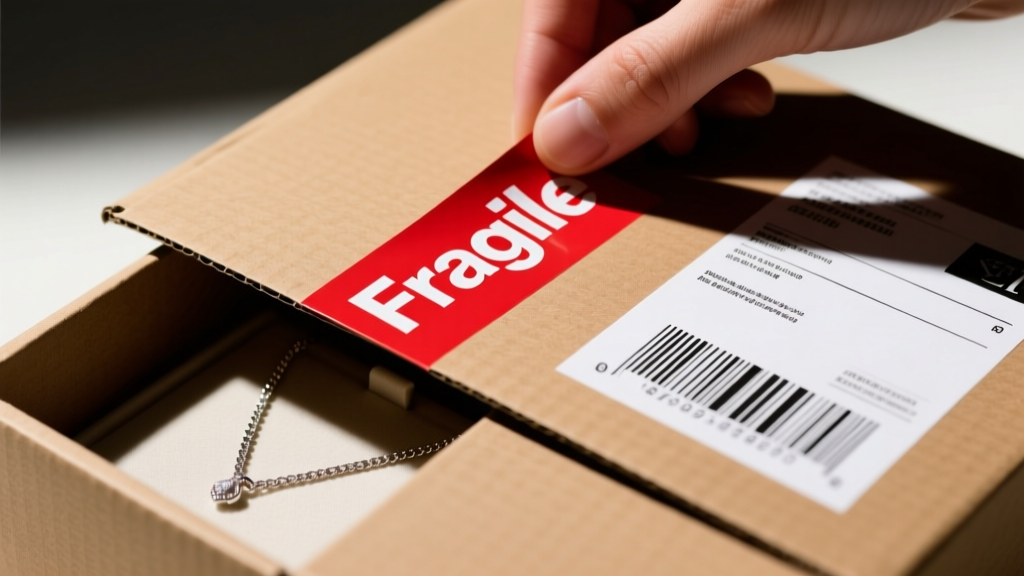
Even with the right budget allocated to insurance and boxes, physical failure modes can ruin the recipient's experience or damage the asset. Here is how to troubleshoot the most common necklace shipping disasters:
1. The Tangled Chain Nightmare
The Problem: Transit vibrations cause delicate chains (especially serpentine and box chains) to knot tightly, sometimes requiring professional jeweler intervention to untangle without breaking the links.
The Fix: The 'Straw Trick'. Thread one end of the necklace chain through a standard plastic or paper drinking straw, then clasp it shut. The rigid straw prevents the chain from looping back on itself. Alternatively, lay the necklace flat on a sheet of plastic wrap, fold the wrap over the chain, and roll it tightly before placing it in the box.
2. Snagged Prongs and Crushed Settings
The Problem: If a pendant with raised prongs shifts inside the presentation box, it can catch on the velvet lining or the box hinge, bending the metal and loosening the gemstone.
The Fix: Wrap the pendant head specifically in a small square of acid-free jeweler's tissue paper before closing the box. This creates a frictionless barrier that protects the setting from catching on any interior seams.
3. The 'Rattle' Effect
The Problem: If the inner jewelry box moves even a quarter-inch inside the outer shipping carton, the constant shifting during sorting machine transit can cause micro-abrasions to soft metals like 24k gold or high-polish silver.
The Fix: The shake test. Once the outer box is taped shut, shake it vigorously near your ear. If you hear or feel any internal movement, the void fill is insufficient. Open it and add more compressed honeycomb paper until the inner box is completely immobilized.
Final Value Checklist Before Drop-Off
Before handing the package to the carrier, run through this final budget and security checklist to ensure your value assessment holds up in the real world:
- Photographic Evidence: Take a time-stamped photo of the necklace, the anti-tarnish strip, the sealed poly bag, and the final taped box. This is mandatory for winning third-party insurance claims.
- Label Obscurity: Ensure the return address does not say 'Diamonds R Us' or 'Fine Jewelers'. Use a generic LLC name or your personal name to avoid targeting by organized cargo thieves.
- Signature Requirement: Always pay the extra $3-$5 for an Adult Signature Required (21+). Leaving a $2,000 necklace on a porch negates all insurance coverage the moment it is scanned as 'Delivered'.
- Tape Integrity: Use water-activated kraft paper tape rather than standard plastic packing tape. Kraft tape bonds to the corrugated fibers, making it impossible to remove without visibly destroying the box, which deters 'slit-and-grab' theft in transit hubs.
Mastering how to ship a necklace safely is ultimately an exercise in risk management. By allocating your budget toward structural packaging, anti-tarnish materials, and appropriate insurance tiers rather than expedited transit speeds, you protect both your financial investment and the integrity of the jewelry.


