How to Shorten a Necklace: The Gifter's Guide to Perfect Fit
Bought the wrong length? Learn how to shorten a necklace safely at home or via a jeweler to ensure your jewelry gift fits perfectly for any occasion.

The Gifter’s Dilemma: When the Perfect Necklace is the Wrong Length
Gifting fine jewelry is a deeply personal gesture, but standard retail sizing—typically an 18-inch princess length—often fails to match the recipient's specific neckline, body type, or the formality of the occasion. You might have purchased a stunning diamond pendant for an anniversary dinner, only to realize it sits awkwardly against her high-neck evening gown. If you find yourself in this scenario, don't panic and don't rush back to the store for a stressful exchange. Learning how to shorten a necklace is a crucial skill for any thoughtful gifter, allowing you to salvage the surprise and customize the piece to her exact wardrobe needs.
Whether you are preparing a bridal gift, a milestone birthday present, or a holiday surprise, adjusting the drop length transforms a generic piece into a bespoke treasure. In this comprehensive guide, we will explore the metallurgy of chain links, the precise tools required for DIY adjustments, and when to entrust the piece to a master jeweler to ensure your gift remains flawless.
Assessing the Chain: What Material and Link Type Are You Working With?
Before you pick up a pair of wire cutters, you must critically assess the chain's anatomy. Not all chains are created equal, and the wrong technique can permanently ruin a valuable gift. According to industry standards outlined by the Gemological Institute of America (GIA), the karatage of the gold and the structural integrity of the link dictate the repair method.
- Cable, Curb, and Figaro Chains: These consist of individual, interlocking open or soldered loops. They are the most forgiving and can often be shortened at home if the links are large enough to manipulate.
- Box and Snake Chains: These feature a continuous, smooth surface created by tightly interlocking plates or bands. They cannot be simply 'unlinked.' Cutting them requires professional laser welding or torch soldering to reattach the clasp, otherwise, the chain will fray and kink.
- Herringbone and Omega Chains: Highly fluid but structurally fragile. Bending or cutting these improperly will cause irreversible kinking. Always leave these to professionals.
| Chain Type | Material Examples | DIY Friendly? | Professional Method | Est. Repair Cost |
|---|---|---|---|---|
| Cable / Curb | Sterling Silver, 14k Gold | Yes (if links > 3mm) | Soldering / Jump Rings | $15 - $30 |
| Box Chain | 14k Gold, Platinum | No | Laser Welding | $35 - $60 |
| Snake Chain | Sterling Silver, Gold Vermeil | No | Specialized Soldering | $40 - $75 |
| Herringbone | 18k Yellow Gold | No | Laser Welding / Recasting | $50 - $90+ |
DIY vs. Professional: How to Shorten a Necklace Safely
When determining how to shorten a necklace, the boundary between a clever DIY fix and a catastrophic mistake lies in your tool selection and technique. If you are working with a simple sterling silver or 14k gold cable chain, you can perform the adjustment at home.
The DIY Approach (For Simple Link Chains)
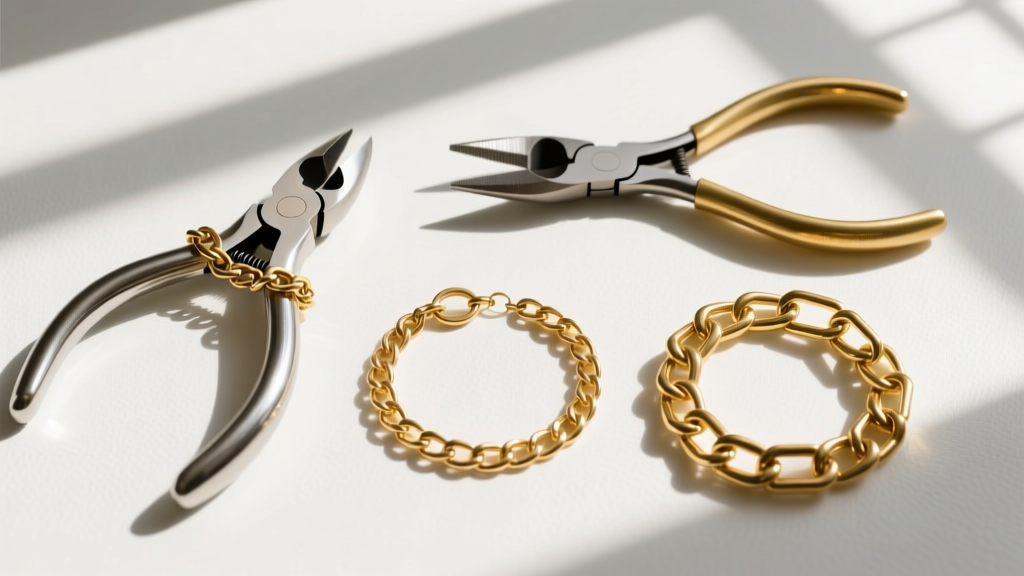
To shorten a standard link chain, you must avoid using standard household pliers, which feature serrated teeth that will gouge and scratch precious metals. Jewelry supply experts at Rio Grande recommend using carbon-steel, smooth-jawed chain-nose or flat-nose pliers.
- Measure and Mark: Drape the necklace on a velvet bust or measuring board. Use a piece of painter's tape to mark the exact link where the new clasp attachment will sit.
- Open, Don't Pull: To separate a link, grip it with two pairs of pliers and twist the ends laterally (side-to-side) like opening a door. Never pull the ends apart outward, as this will warp the link into an oval, weakening the metal's temper.
- Remove Excess and Reattach: Slide off the excess links and reattach the original spring ring or lobster clasp to the newly designated end link. Close the link by twisting it back flush, ensuring there is no gap that could catch on clothing.
When to Call a Professional Jeweler
If your gift features a platinum chain, a titanium pendant, or any of the continuous weave chains mentioned above, DIY is out of the question. Platinum requires extremely high temperatures to solder, often risking heat damage to nearby gemstones. Modern jewelers use laser welding for these scenarios. A laser welder uses concentrated light to fuse metal at a microscopic level without transferring heat to the rest of the chain or the pendant's setting. This is especially vital if you are gifting a piece with heat-sensitive stones like opals, emeralds, or tanzanite.
Occasion Matching: Choosing the Right Drop Length for the Event
Why are you shortening the necklace in the first place? As a gifter, your goal is to ensure the piece complements the specific occasion you are buying it for. A necklace that is perfect for a casual brunch will look entirely lost against formal evening wear.

The Bridal and Gala Guide
If you are gifting jewelry for a wedding or a black-tie gala, neckline matching is paramount.
- Choker (14-16 inches): Ideal for off-the-shoulder gowns, boat necks, or sweetheart necklines. It draws the eye upward and highlights the collarbone. Gift Tip: If the recipient has a longer neck, opt for 16 inches rather than 14 to avoid a restrictive fit.
- Princess (18 inches): The industry standard. It sits perfectly on the collarbone and pairs beautifully with V-necks and scoop necks. This is the safest bet for a versatile, everyday-wear anniversary gift.
- Matinee (20-24 inches): Best for high-necked dresses, turtlenecks, or business-casual blazers. If you are gifting a piece for a professional milestone (like a promotion or retirement), a matinee length offers a sophisticated, commanding presence.
- Opera (28-36 inches): Reserved for ultra-formal events or avant-garde fashion. Often worn doubled over as a faux-choker and pendant combo.
Stylist's Rule of Thumb: The pendant should never sit directly on the hemline of the wearer's neckline. It should either rest comfortably on the skin above the fabric's edge or plunge deep into the negative space of a V-neck.
The 'Adjustable' Gift Hack: Extender Chains and Sliding Clasps
If you are paralyzed by the fear of choosing the wrong length, consider modifying the gift to be adjustable rather than permanently shortening it. This is a brilliant strategy for gifters who are unsure of the recipient's exact preference or who want to provide maximum versatility.
- Add a 2-Inch Extender Chain: Instead of cutting off the excess length, ask a jeweler to move the clasp up and add a small 2-inch cable extender chain at the back. This allows the recipient to wear the piece as a 16-inch choker or an 18-inch princess drop depending on her outfit.
- Silicone Sliders and Bolo Clasps: For bead or pearl necklaces, a jeweler can install a silicone-lined sliding clasp. This allows the wearer to pull the chain tight or let it loose with a simple pinch, making it a one-size-fits-all dynamic gift.
Presentation Tips for Resized Jewelry Gifts
When you alter a piece of jewelry before gifting it, presentation is everything. Do not simply throw the cut-off excess links into the trash. If you shortened a solid 14k gold or sterling silver chain, those offcuts hold intrinsic melt value and sentimental worth.
Place the removed links into a small, velvet-lined keepsake box or a glass apothecary vial, and tuck it beneath the main jewelry box. Include a handwritten note explaining: 'I customized the length to perfectly match your emerald gown for tonight, but I kept the remaining gold links so we can use them to create a custom charm or matching earrings for our next anniversary.' This transforms a simple sizing adjustment into a profound demonstration of thoughtfulness, foresight, and care.


