Engineering the Ideal Tropical Necklace: Metals & Care
Discover the metallurgy and engineering behind a durable tropical necklace. Learn which marine-grade metals, UV resins, and clasps survive salt and sweat.

The Hostile Tropical Microclimate
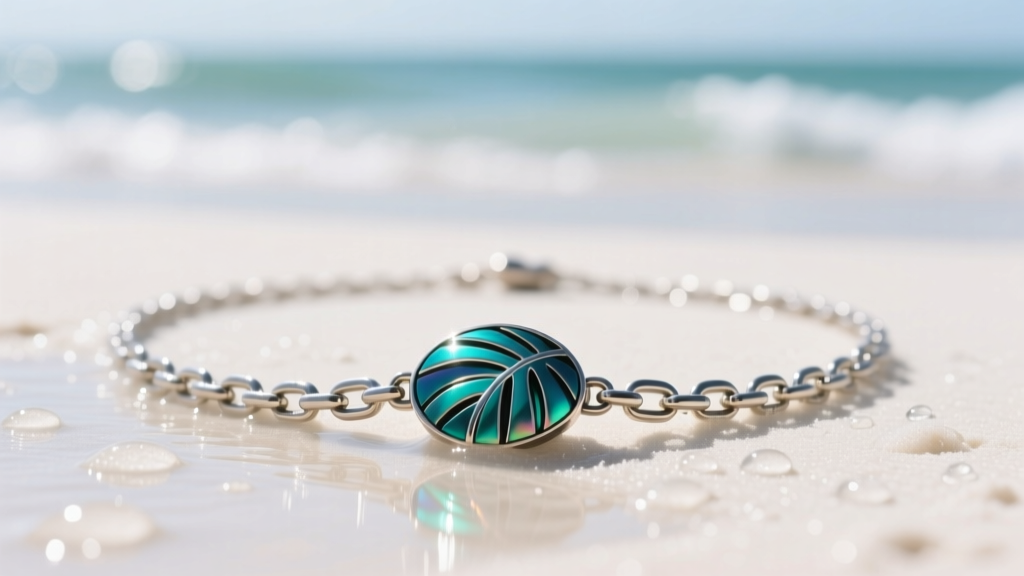
When designers and consumers discuss a "tropical necklace" in 2026, the conversation often revolves around aesthetic motifs—palm fronds, sea glass, and vibrant enamel. However, from a materials science perspective, a tropical environment represents one of the most hostile microclimates for personal adornment. The combination of high ambient humidity, intense ultraviolet (UV) radiation, and frequent exposure to saline and acidic compounds creates a perfect storm for material degradation.
Human sweat in tropical climates is produced in higher volumes and typically registers a pH between 4.5 and 7.0. This mild acidity acts as an electrolyte, accelerating galvanic corrosion when dissimilar metals are present. Furthermore, ocean spray introduces a 3.5% sodium chloride (NaCl) solution that aggressively attacks the passive oxide layers of standard jewelry alloys. To engineer a truly resilient tropical necklace, we must look beyond surface aesthetics and focus on metallurgical stability, polymer chemistry, and mechanical ingress protection.
Metallurgy: Selecting Corrosion-Resistant Alloys
The foundation of any high-performance tropical necklace lies in its metallic components. Standard sterling silver (92.5% Ag, 7.5% Cu) and brass are entirely unsuited for prolonged tropical exposure; the copper content rapidly oxidizes, resulting in unsightly verdigris and skin discoloration. Even standard 304 stainless steel is prone to pitting corrosion in chloride-rich environments.
For marine-grade durability, jewelers must utilize alloys with a high Pitting Resistance Equivalent Number (PREN). The PREN formula (PREN = %Cr + 3.3x%Mo + 16x%N) helps quantify an alloy's resistance to localized corrosion. According to the British Stainless Steel Association, upgrading from 304 to 316L stainless steel introduces 2-3% molybdenum, drastically increasing the PREN and providing robust defense against saltwater pitting.
| Alloy / Material | PREN Value | Saltwater Resistance | Weight Profile |
|---|---|---|---|
| 316L Stainless Steel | 24 - 28 | Excellent (Prolonged exposure requires rinsing) | Heavy |
| Grade 5 Titanium (Ti-6Al-4V) | N/A (Inert) | Superior (Impervious to chlorides) | Ultra-Light |
| Niobium (Anodized) | N/A (Inert) | Superior (Highly biocompatible) | Medium |
| Solid 14k/18k Gold (Nickel-Free) | N/A (Noble) | Excellent (Prone to mechanical scratching) | Heavy |
The Galvanic Series and Mixed-Metal Failures
A critical failure mode in tropical necklace design is galvanic corrosion. When a noble metal (like 14k gold) is physically coupled with a less noble metal (like sterling silver or copper) in the presence of an electrolyte (saltwater or sweat), a microscopic battery is formed. The less noble metal becomes the anode and corrodes at an exponentially accelerated rate. In 2026, expert engineering dictates that a tropical necklace must remain monometallic, or utilize inert dielectric barriers (such as PTFE washers) between mixed-metal components to break the electrical circuit.
Polymers, Resins, and Cord Engineering
The cordage and decorative resins used in tropical necklaces are equally susceptible to environmental degradation. Traditional silk and cotton cords undergo hydrolysis in high humidity, losing tensile strength while harboring bacterial growth that leads to odor and rot.
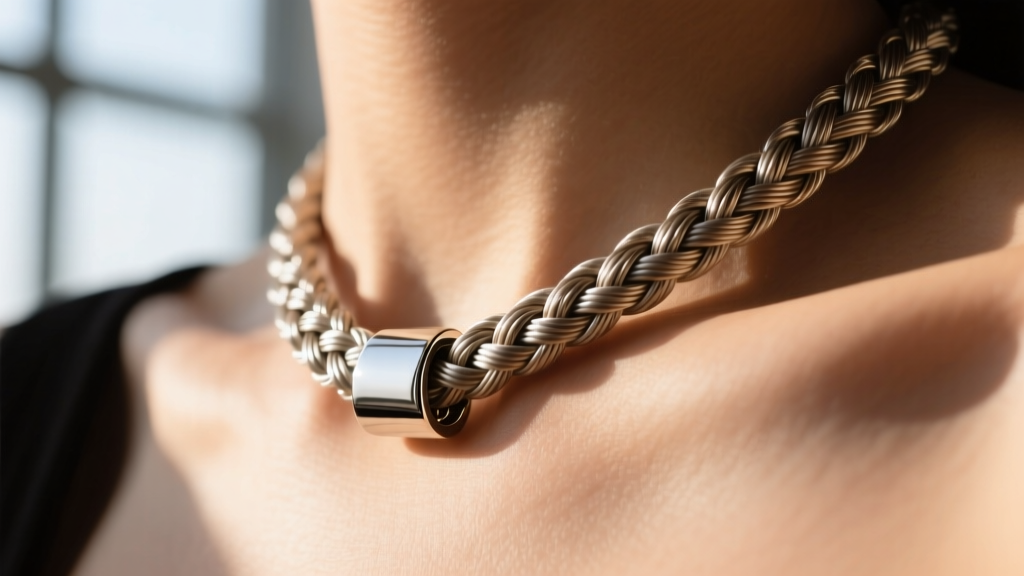
The modern standard for tropical cordage is Ultra-High-Molecular-Weight Polyethylene (UHMWPE), commonly known by the trade name Dyneema. UHMWPE is hydrophobic, UV-resistant, and possesses a tensile strength up to 15 times greater than steel by weight. For decorative elements, standard epoxy resins undergo photo-oxidation when exposed to tropical UV indexes, resulting in severe yellowing and brittleness. Formulators must instead use UV-stabilized polyurethane resins infused with Hindered Amine Light Stabilizers (HALS) to maintain optical clarity and structural integrity over years of direct sun exposure.
Clasp Mechanics: Defeating Sand Ingress
The clasp is the most common point of mechanical failure in beach and resort jewelry. The traditional lobster clasp relies on a microscopic steel spring and a hinged lever. When fine silicate sand enters the lever housing, it acts as an abrasive paste, jamming the hinge and eventually snapping the internal spring.
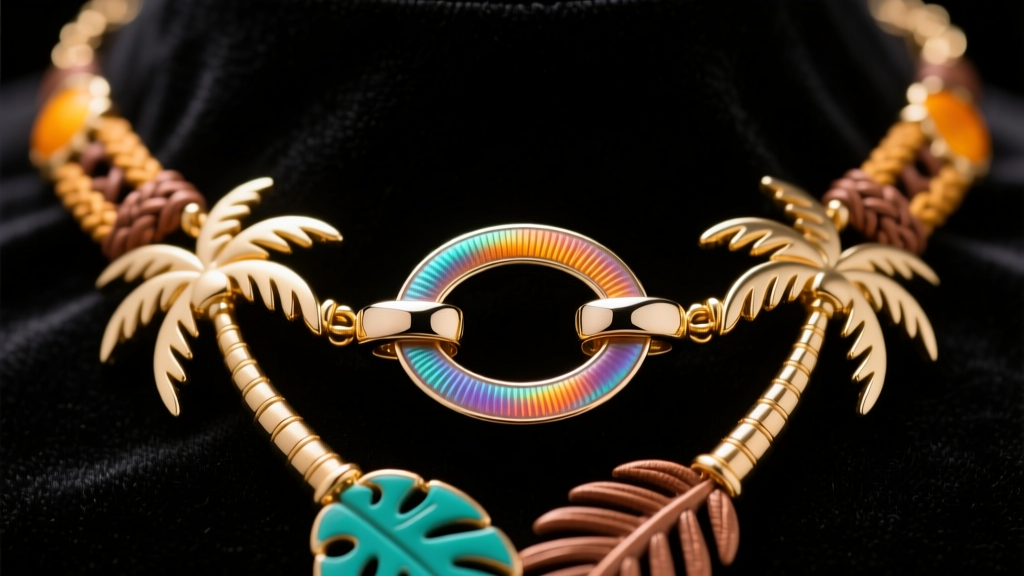
To defeat sand ingress, advanced tropical necklaces utilize shrouded magnetic clasps or mechanical bayonet fittings. Neodymium (NdFeB) magnets offer immense holding force but are highly susceptible to oxidation. Therefore, the magnets must be encased in a marine-grade titanium shell or coated with Parylene—a conformal polymer coating that provides a pinhole-free moisture barrier. Bayonet clasps, which operate on a push-and-twist cam mechanism similar to camera lenses, offer a purely mechanical, spring-free alternative that can be easily flushed with water if sand enters the tolerance gap.
Post-Exposure Maintenance Protocol
Even the most meticulously engineered tropical necklace requires a disciplined maintenance protocol to ensure longevity. The Gemological Institute of America (GIA) emphasizes that organic and porous gemstones frequently incorporated into tropical designs—such as turquoise, coral, and pearls—are highly sensitive to both salt and ultrasonic cleaning methods.
- Immediate Freshwater Flush: After ocean exposure, submerge the necklace in distilled or clean tap water for 5 minutes to dissolve chloride deposits before they can crystallize and cause micro-abrasions.
- Chemical Avoidance: Never apply sunscreen, DEET-based insect repellents, or sulfur-heavy tanning oils directly to the jewelry. DEET is a potent solvent that will melt certain polymer resins and degrade rubber O-rings in clasps.
- Drying Protocol: Air-dry the piece in a shaded, well-ventilated area. Trapped moisture in cordage weaves or clasp mechanisms can lead to localized crevice corrosion, even in highly resistant alloys like 316L.
"The true measure of a tropical necklace is not how it looks in a climate-controlled boutique, but how its metallurgical and mechanical systems perform after 100 hours of UV exposure, saltwater immersion, and mechanical abrasion."
By prioritizing high-PREN alloys, UHMWPE cordage, UV-stabilized polymers, and ingress-proof clasp mechanics, jewelers can create tropical necklaces that transcend seasonal resort wear, offering enduring performance and aesthetic stability in the world's most demanding climates.


