How to Wear Necklaces: The Ultimate Layering & Neckline Guide
Master how to wear necklaces for every neckline. Learn exact chain lengths, gauge pairings, and anti-tangle layering frameworks for flawless styling.


Knowing how to wear necklaces is less about intuition and more about understanding geometry, weight distribution, and visual proportion. Whether you are styling a delicate 14k gold stack or a singular, heavy sterling silver statement piece, the wrong length or chain weave can disrupt your outfit's silhouette or lead to a tangled mess. In this comprehensive guide, we break down the exact metrics, chain styles, and neckline frameworks you need to master necklace styling.
The Anatomy of Necklace Lengths & Gauges
Before building a stack, you must understand the standard measurements that dictate where a chain falls on the human body. According to Blue Nile's necklace length guide, standard lengths are categorized by their resting point on the torso. However, length is only half the equation; gauge (thickness) determines the visual weight and durability of the piece.
| Style | Length | Ideal Gauge | Best Chain Weave |
|---|---|---|---|
| Collar/Choker | 14' - 16' | 0.8mm - 1.5mm | Herringbone, Box, Cable |
| Princess | 17' - 19' | 1.0mm - 2.0mm | Rope, Bead, Curb |
| Matinee | 20' - 24' | 1.5mm - 3.0mm | Figaro, Wheat, Snake |
| Opera | 28' - 36' | 2.0mm - 4.0mm | Chunky Curb, Rope |
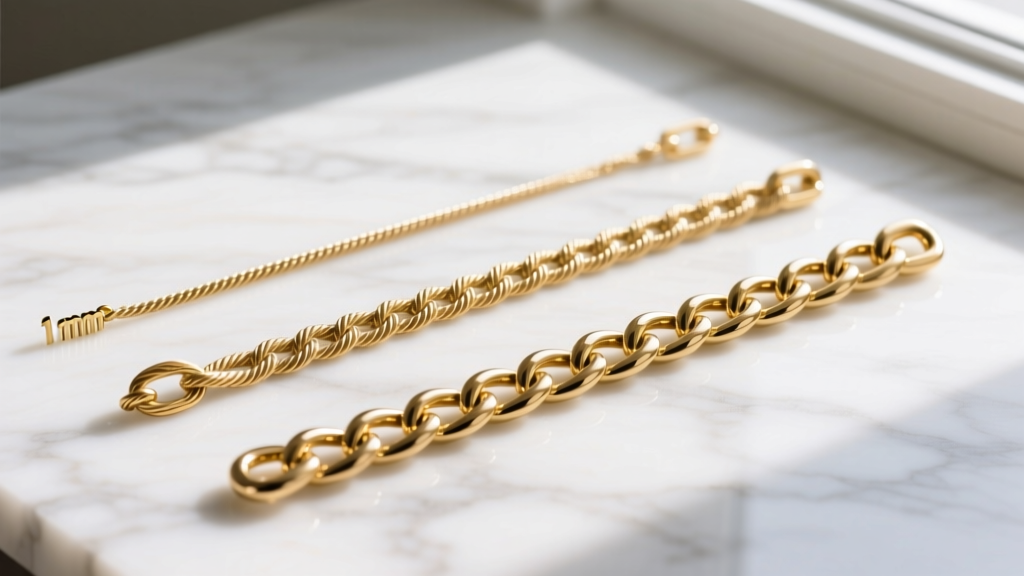
When learning how to wear necklaces in a layered stack, always ensure a minimum gauge variance of 0.5mm to 1.0mm between adjacent chains. This variance prevents the chains from visually blending into a single, thick line and allows each piece to catch the light independently.
How to Wear Necklaces: A Neckline-by-Neckline Framework
The neckline of your garment acts as the architectural frame for your jewelry. Ignoring this frame is the most common styling error. Here is how to pair specific necklace lengths and pendant drops with standard necklines.
The V-Neck: Cascading Proportions
The human eye naturally follows the V-shape down to the sternum. A single 16-inch princess chain stops abruptly at the collarbone, breaking the visual line and creating a boxed-in effect. To complement a V-neck, you must mimic its geometry.
- The Anchor: Use a 20-inch to 22-inch matinee chain with a V-shaped pendant or a pear-cut gemstone drop.
- The Spacer: Add an 18-inch delicate rope chain (1.2mm gauge) to bridge the gap between the collarbone and the pendant.
- The Frame: A 14-inch herringbone choker sits flush against the skin, framing the upper chest without competing with the lower layers.
The Crew Neck: The Statement Choker & Matinee Combo
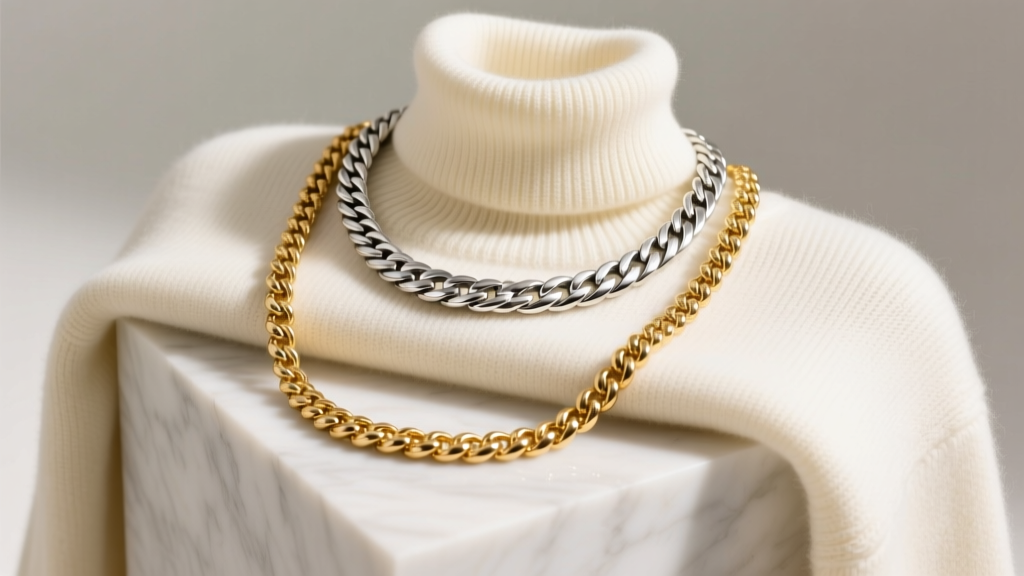
Crew necks and high round collars leave very little exposed skin, making traditional 18-inch pendants look awkward as they rest directly on the fabric seam. Instead, you must create extreme contrast. Pair a wide, 15-inch sterling silver or gold collar (3mm to 5mm gauge) that sits entirely above the fabric line with a long, 24-inch opera-length chain that drops entirely below the collar. This 'above-and-below' technique frames the garment rather than fighting it.
The Boatneck & Off-Shoulder: Collarbone Anchoring
Boatnecks and off-shoulder tops emphasize the horizontal line of the collarbones. Vertical pendants clash with this horizontal geometry. Opt for horizontal-focused jewelry: a 16-inch paperclip chain or a station necklace featuring small, evenly spaced bezel-set diamonds or gemstones. Avoid drop pendants entirely; instead, rely on the shimmer of horizontal links.
The 'Rule of Three' Layering Technique
If you are building a stack from scratch, the Rule of Three is the gold standard for balanced proportion. This framework relies on three distinct focal points to guide the eye without causing visual clutter.
- Layer 1 (The Base): A 14-inch or 15-inch chain. This should be the thickest or most reflective piece, such as a 2.5mm herringbone or snake chain. It acts as the foundation.
- Layer 2 (The Narrative): A 16-inch or 18-inch chain featuring a meaningful pendant. Ensure the bail (the loop connecting the pendant to the chain) is proportionate. A 4mm pendant requires a delicate 1.0mm cable chain; a heavy 15mm coin pendant requires a sturdy 2.0mm box chain to prevent the pendant from flipping upside down.
- Layer 3 (The Elongator): A 20-inch or 22-inch chain. This should be the lightest and most delicate, perhaps a simple beaded chain or a thin lariat, drawing the eye downward to elongate the torso.
Troubleshooting: The Physics of Chain Tangling
Nothing ruins a carefully curated stack faster than a tangled knot. Chains tangle when their weaves interlock. For example, three layers of 1.5mm cable chain will inevitably tangle because the uniform, open oval links easily slip into one another. According to metallurgical and jewelry design principles documented by the Gemological Institute of America (GIA), varying the physical structure of the metal links is crucial for both aesthetics and maintenance.
The Anti-Tangle Matrix:
- Combine Weaves: Pair a closed-weave chain (like a herringbone, snake, or wheat) with an open-weave chain (like a cable or curb). The closed weaves act as a physical barrier, preventing the open links from slipping through.
- Vary the Gauges: Never layer two chains of the exact same millimeter thickness. A 1.0mm chain and a 2.5mm chain will naturally repel each other's links due to the size disparity.
- Use a Necklace Spacer Clasp: For a permanent stack, invest in a 14k gold or sterling silver multi-strand spacer clasp. This single hardware piece holds 2 to 4 chains at fixed intervals (e.g., 14', 16', 18') at the back of the neck, making tangling physically impossible.
Clasp Hardware & Weight Distribution
The clasp is the most critical failure point on any necklace. When learning how to wear necklaces daily, you must match the clasp to the chain's weight.
- Spring Ring Clasps: Standard on delicate chains (under 1.2mm). They are lightweight but prone to breaking if subjected to the pull of a heavy pendant.
- Lobster Claw Clasps: The industry standard for medium to heavy chains (1.5mm to 3.0mm). They feature a stronger internal spring and a thicker metal housing.
- Magnetic or Box Clasps: Ideal for heavy, multi-strand, or opera-length chains. They provide security without requiring the dexterity needed to operate a tiny lobster claw behind your neck.
Expert Pro-Tip: If your necklace constantly flips, showing the clasp at the front of your neck, your chain is too light for the pendant. The pendant's center of gravity is pulling the chain forward. Upgrade to a chain that is at least 30% heavier, or add a small, discreet gold counterweight bead near the clasp at the nape of the neck.
Metal Mixing in 2026
The old rule of sticking to a single metal tone is obsolete. Mixed-metal styling is highly encouraged, provided it is done with intentionality. The key to successful metal mixing is to use a 'bridge piece'—a single necklace or pendant that incorporates both yellow gold and white gold (or sterling silver). Alternatively, use the 70/30 rule: let 70% of your stack be your dominant metal (e.g., 14k yellow gold) and use the remaining 30% for an accent metal (e.g., oxidized silver) to create depth and contrast. By mastering these structural and proportional rules, you elevate your jewelry from mere accessories to intentional, engineered style statements.


