Hutton Mdivani Jadeite Necklace: Material Properties & Legacy
Explore the material properties of the Hutton Mdivani jadeite necklace, analyzing Type A jadeite grades, Cartier clasp metallurgy, and market value.

The Legend of the Hutton-Mdivani Jadeite Necklace
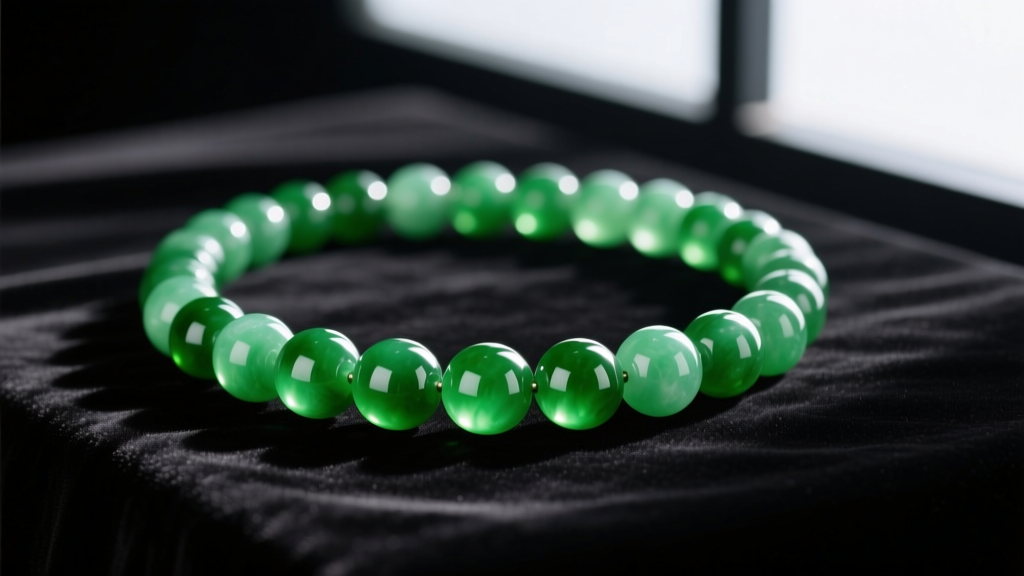
In the pantheon of high jewelry, few pieces command the reverence and material fascination of the Hutton-Mdivani jadeite necklace. Originally commissioned by Barbara Hutton's father, Frank Winfield Woolworth, as a wedding gift in 1933, and later owned by Princess Nina Mdivani, this masterpiece is a masterclass in gemological perfection. Comprising 27 perfectly matched, graduated jadeite beads ranging from 15.40mm to 19.20mm in diameter, the necklace represents the absolute pinnacle of material selection. As we navigate the 2026 high-jewelry market, where synthetic alternatives and treated stones are increasingly sophisticated, the benchmark set by the Hutton-Mdivani piece remains the ultimate standard for evaluating natural jadeite properties, provenance, and Cartier's unparalleled metallurgical craftsmanship.
Decoding Type A Jadeite: The Core Material
To understand the staggering $27.4 million valuation achieved at the 2014 Sotheby's auction, one must examine the mineralogy of the beads. Jadeite is a sodium- and aluminum-rich pyroxene with the chemical formula NaAlSi2O6. Unlike nephrite, which has a felt-like fibrous structure, jadeite features a tightly interlocking granular crystal structure that allows for superior polish and translucency.
Mineralogy and Optical Properties
The beads in the Hutton-Mdivani necklace are classified as 'Type A' jadeite, meaning they are entirely natural and untreated, save for the traditional plum juice polishing. According to the Gemological Institute of America (GIA), Type A jadeite exhibits a refractive index of approximately 1.66 and a specific gravity of 3.30 to 3.36. The Mohs hardness sits between 6.5 and 7, making it highly durable for everyday wear, though its interlocking crystalline matrix gives it an exceptional toughness that far exceeds its hardness rating.
The 'Imperial' Color Grade Explained
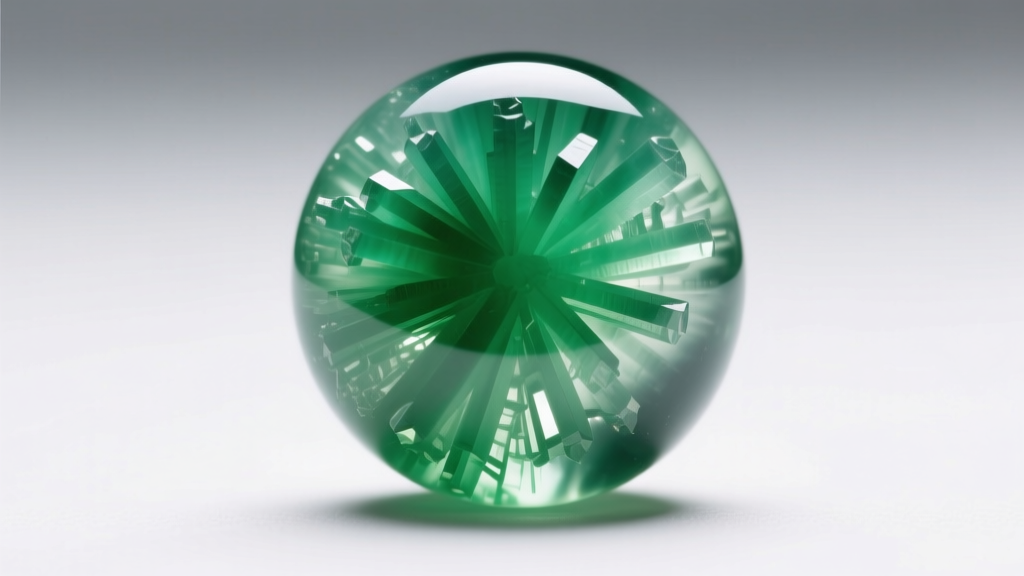
The vivid, emerald-like green of the Hutton-Mdivani beads is caused by trace amounts of chromium substituting for aluminum in the crystal lattice. This specific chromophore creates a highly saturated, slightly bluish-green hue that avoids the grayish or yellowish modifiers found in lesser stones. Furthermore, the 'water head' (shui tou) or translucency of these beads is exceptionally high. Light penetrates deeply into the crystalline structure before scattering, giving the beads an internal glow that gemologists refer to as a 'glassy' to 'vitreous' luster.
Material Comparison: Jadeite vs. Alternative Green Gemstones
While emeralds and tsavorites are frequently used in high-end necklaces, jadeite offers a unique set of physical properties that make it distinctly suited for large, spherical bead cutting. The table below contrasts the material properties of fine jadeite with other premium green gemstones.
| Property | Imperial Jadeite | Colombian Emerald | Tsavorite Garnet | Chrysoprase |
|---|---|---|---|---|
| Chemical Composition | NaAlSi2O6 | Be3Al2(SiO3)6 | Ca3Al2(SiO4)3 | SiO2 (Chalcedony) |
| Mohs Hardness | 6.5 - 7.0 | 7.5 - 8.0 | 7.0 - 7.5 | 6.5 - 7.0 |
| Specific Gravity | 3.30 - 3.36 | 2.67 - 2.78 | 3.57 - 3.73 | 2.58 - 2.64 |
| Cleavage / Fracture | None (Splintery) | Distinct (Basal) | None (Conchoidal) | None (Conchoidal) |
| Toughness | Exceptional | Poor to Fair | Good | Good |
| Primary Color Agent | Chromium | Chromium/Vanadium | Vanadium/Chromium | Nickel |
As the data illustrates, jadeite's lack of cleavage planes and exceptional toughness make it the only green gemstone capable of surviving the immense mechanical stress of being drilled and worn as large, heavy spherical beads without fracturing. An emerald of equivalent size and color would be far too brittle and heavily included to survive the bead-cutting process.
The Cartier Clasp: Platinum and Corundum Metallurgy
The Hutton-Mdivani necklace is not merely a string of beads; it is anchored by a spectacular clasp designed by Cartier. This clasp is a triumph of early 20th-century metallurgy and gem-setting. Crafted in platinum (typically Pt950, an alloy of 95% platinum and 5% ruthenium or iridium for structural rigidity), the clasp provides the necessary tensile strength to support the heavy jadeite beads while maintaining a low profile.
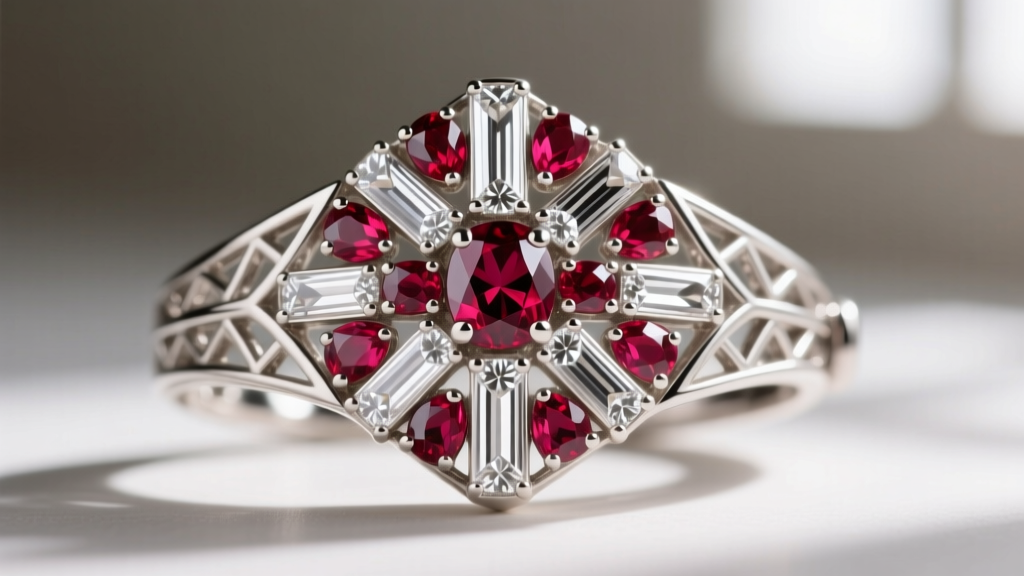
The clasp features a striking contrast of materials: calibre-cut rubies and baguette-cut diamonds. Rubies, the red variety of the mineral corundum (Al2O3), rank at a 9 on the Mohs scale. The use of ruby is not just aesthetic; its high hardness ensures that the structural pivot points and locking mechanisms of the clasp resist wear and deformation over decades of use. The diamonds (Mohs 10) are utilized in baguette cuts, which require exceptional clarity and precise geometric faceting, reflecting the Art Deco sensibilities of the 1930s. Cartier's archives, accessible via their heritage portal, detail how the tension and prong settings were engineered to maximize light return while securing the stones against the constant kinetic movement of a necklace.
Authentication and Market Valuation in the Modern Era
In today's market, authenticating a piece of this magnitude requires rigorous spectroscopic and microscopic analysis. Laboratories like the Swiss Gemmological Institute (SSEF) utilize infrared spectroscopy to detect the presence of polymer resins, which would immediately classify a stone as Type B (bleached and polymer-impregnated). The Hutton-Mdivani beads show a pristine infrared spectrum, confirming the absence of any foreign substances in the intergranular spaces.
Key Authentication Markers for High-Grade Jadeite:
- Spectroscopy: Presence of a sharp chromium absorption line at 691 nm, and broader bands at 655 nm and 630 nm, confirming natural chromophore saturation.
- Microscopy: Observation of natural internal stress fractures and 'cotton-like' inclusions, which are absent in the glassy, bubble-filled matrices of treated B-jade.
- Fluorescence: Type A jadeite is generally inert under long-wave UV light, whereas polymer-treated jadeite often exhibits a chalky blue-white fluorescence.
Conclusion
The Hutton-Mdivani jadeite necklace remains an unrivaled artifact of material perfection. It is a testament to the geological rarity of chromium-bearing, highly translucent Type A jadeite, paired with the enduring structural integrity of platinum and corundum. For collectors, gemologists, and jewelry historians, it serves as the ultimate reference point for evaluating the intersection of natural material properties and human craftsmanship.


