Crafting an Opal and Emerald Necklace: A Gemological Deep Dive
Discover the gemological science behind crafting an opal and emerald necklace. Learn about Mohs hardness, setting techniques, and care protocols.

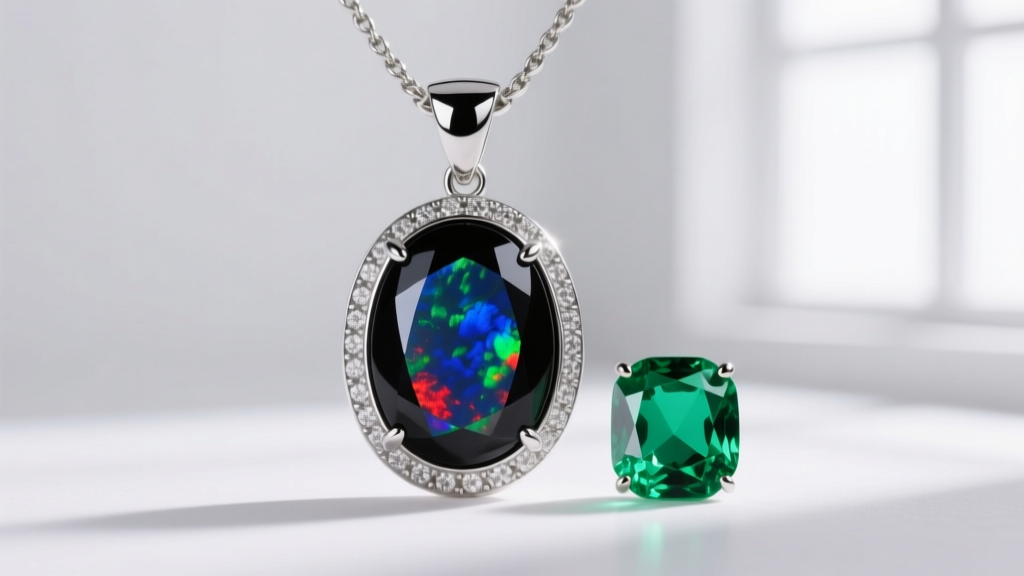
The Gemological Paradox: Combining Opal and Emerald
Designing an opal and emerald necklace is one of the most demanding challenges in bespoke jewelry engineering. While visually stunning—pairing the fiery play-of-color in opals with the deep, velvety green of emeralds—these two gemstones represent a gemological paradox. Both are notoriously fragile, yet they fail in completely different ways. Understanding the structural and chemical vulnerabilities of both stones is mandatory before a jeweler even touches a wax model or CAD file.
According to the Gemological Institute of America (GIA), opal is an amorphous form of silica containing anywhere from 3% to 21% water. This water content makes it susceptible to 'crazing' (a network of fine cracks) if exposed to rapid humidity shifts or heat. Emerald, a variety of the mineral beryl, presents a different problem. While it ranks higher on the Mohs scale, its toughness is severely compromised by 'jardin'—the natural fractures and inclusions that give emeralds their character but make them highly brittle.
Comparative Gemological Data
| Property | Precious Opal (Cabochon) | Natural Emerald (Faceted) |
|---|---|---|
| Mohs Hardness | 5.5 - 6.5 | 7.5 - 8.0 |
| Toughness (Impact Resistance) | Poor (Brittle) | Poor (Due to inclusions) |
| Specific Gravity | 1.98 - 2.25 | 2.67 - 2.78 |
| Cleavage / Fracture | None (Conchoidal) | Indistinct (Parting) |
| Common Treatments | None / Smoke / Impregnation | Oiling / Resin Filling |
Engineering the Setting: Protecting Fragile Stones
When setting an opal and emerald necklace, the primary goal is shock isolation and edge protection. Standard prong settings are almost universally inappropriate for the opal cabochon and highly risky for the emerald. The sharp corners of an emerald-cut stone are its weakest points; a single tap against a marble countertop can chip a corner right off.
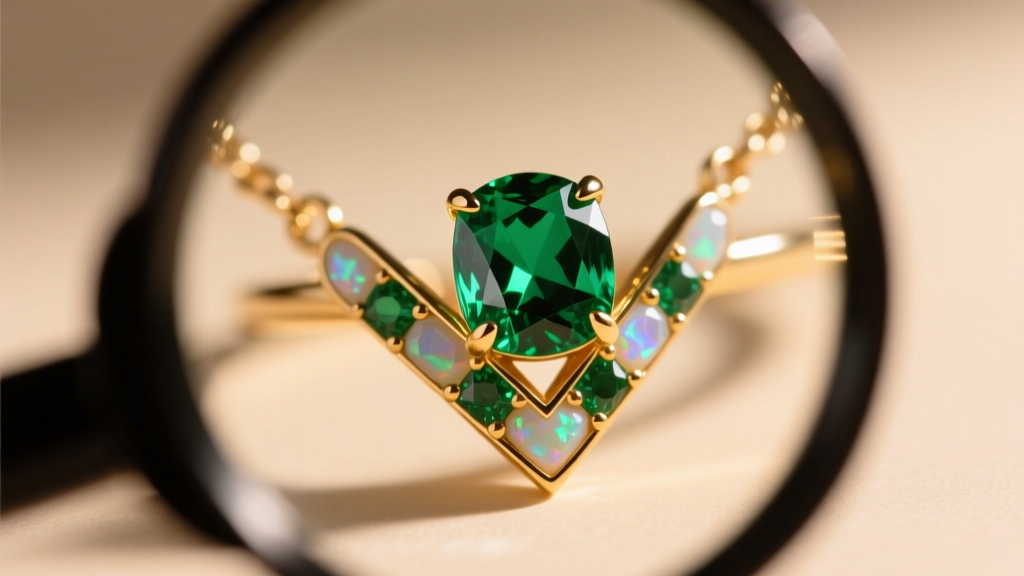
Bezel vs. V-Prong: The Structural Debate
For the opal, a low-profile bezel setting is non-negotiable. The bezel must be burnished tightly over the opal's girdle to prevent lateral movement, but the jeweler must avoid applying downward pressure on the dome, which can cause internal fracturing. For the emerald, V-prongs are the industry standard for protecting the corners. A V-prong encapsulates the sharp 90-degree angle of the cut, distributing any impact force across a wider area of the stone's pavilion.
Furthermore, if both stones are set in a single continuous pendant mount, the metal wall separating them must be engineered to absorb kinetic energy. Using 18-karat yellow gold is preferred over platinum or 14-karat gold for the setting walls. 18k gold has a higher specific gravity and a slightly softer yield strength, acting as a microscopic shock absorber that prevents mechanical shock from transferring directly from the emerald to the opal during a drop or impact.
Chain Selection and Weight Distribution
The pendant is only half the equation. An opal and emerald necklace of significant carat weight (typically 4 to 8 carats combined for a balanced look) requires a chain that manages both tension and swing dynamics. If the pendant flips backward—a common issue with top-heavy designs—the opal dome can strike the wearer's collarbone or a hard surface, leading to catastrophic conchoidal fracturing.
Gauge and Bail Engineering
- Chain Gauge: A minimum wire thickness of 1.2mm is required. Box chains or wheat chains are preferred over rope chains, as their interlocking geometry resists kinking and distributes the pendant's weight evenly across the neck.
- The Bail: A hidden bail or a European-style slide bail is superior to a standard soldered loop. A slide bail lowers the center of gravity, keeping the pendant flush against the sternum and drastically reducing the pendulum effect that leads to stone damage.
- Clasp Mechanics: A lobster clasp with a secondary safety figure-8 catch is mandatory. Spring ring clasps lack the internal spring tension to support the dynamic load of a heavy dual-gemstone pendant.
'The failure point in multi-gemstone necklaces is rarely the stone itself, but the bail connection. Always engineer the bail to accommodate the exact thickness of the chain to prevent micro-abrasions on the gold mount.' — Master Bench Jeweler Guidelines
Sourcing and Pricing: What to Expect in the Market
Sourcing matched pairs or complementary stones for an opal and emerald necklace requires navigating a complex market of treatments and origins. The Mindat Mineralogy Database notes that emerald origins drastically affect both price and stability, while opal stability is largely dictated by its formation environment.
Origin and Treatment Impacts on Pricing
Emeralds: Colombian emeralds command the highest premiums ($3,000 to $15,000+ per carat) but are often heavily fractured and require cedar oil treatment. Zambian emeralds are generally cleaner and more stable, making them a safer choice for everyday necklace wear, priced between $800 and $4,000 per carat. Avoid emeralds filled with epoxy resins (like Opticon) for necklace pendants, as prolonged exposure to skin oils and perfumes can degrade the resin over time, causing the stone to cloud.
Opals: Australian sedimentary opals (particularly from Lightning Ridge) are non-porous and highly stable, making them ideal for necklaces. They range from $500 to $5,000 per carat depending on the brightness and color spectrum of the play-of-color. Ethiopian hydrophane opals, while incredibly vibrant and cheaper ($50 to $300 per carat), absorb water and chemicals rapidly. Setting an Ethiopian opal in a necklace exposes it to sweat, perfumes, and humidity, which can cause the stone to lose its fire or crack. For an heirloom-quality piece, Australian black or white opal is the only responsible choice.
Maintenance Protocols: Avoiding Catastrophic Failure
Cleaning an opal and emerald necklace requires a strict departure from standard jewelry maintenance routines. The conveniences of modern jewelry cleaning are active threats to this specific gemstone pairing.
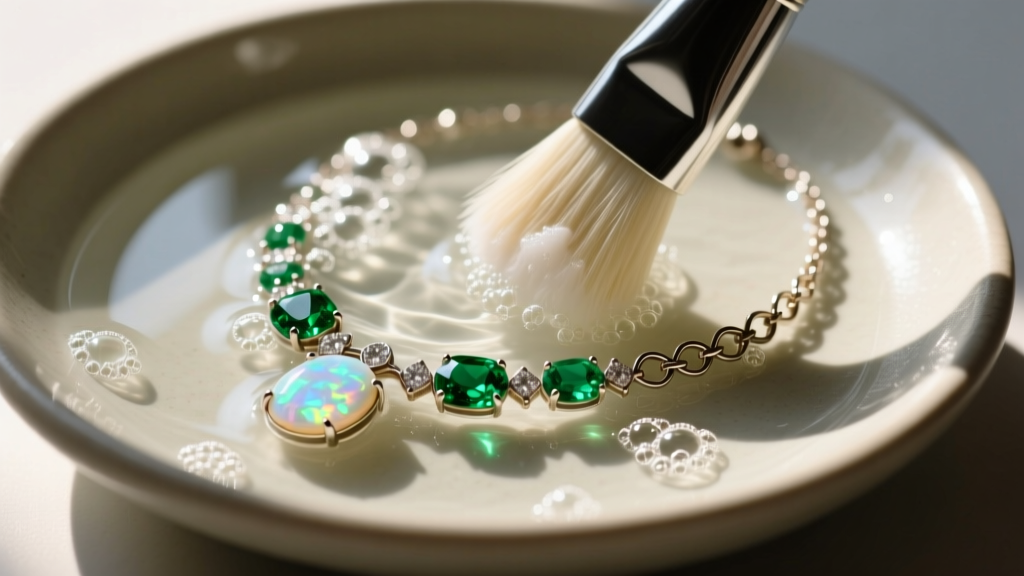
The Dangers of Ultrasonic and Steam Cleaning
Never place an opal and emerald necklace in an ultrasonic cleaner. The high-frequency acoustic cavitation will aggressively vibrate the fluid inside the emerald's fractures, potentially widening them or shattering the stone entirely. Similarly, the heat from the ultrasonic bath can cause the water trapped within the opal's silica spheres to expand, resulting in immediate and irreversible crazing.
Steam cleaners are equally destructive. The sudden thermal shock will fracture the opal, and the pressurized steam will strip the natural cedar oil from the emerald's fissures, leaving it looking opaque, white, and heavily included.
The Correct Cleaning Methodology
To safely maintain the brilliance of your necklace, follow this protocol:
- Prepare a solution of lukewarm distilled water and a single drop of pH-neutral dish soap.
- Submerge the pendant for no more than 60 seconds to loosen surface sebum and cosmetics.
- Use an ultra-soft, goat-hair makeup brush (not a standard toothbrush, which is too abrasive) to gently sweep around the V-prongs and the bezel edge.
- Rinse briefly under a gentle stream of room-temperature distilled water.
- Pat dry with a lint-free microfiber cloth, ensuring no moisture is trapped beneath the opal's bezel wall.
Final Verdict for Collectors and Jewelers
An opal and emerald necklace is not a piece of jewelry for the faint of heart, nor is it suitable for daily, active wear. It is an heirloom-grade investment that demands respect for the gemological realities of its components. By prioritizing 18k gold shock-absorbing mounts, utilizing V-prongs and low-profile bezels, and adhering to strict, non-invasive cleaning protocols, collectors can safely enjoy the breathtaking contrast of fire and forest green for generations. For those willing to respect the engineering requirements, the result is a masterclass in bespoke lapidary art.
For further reading on gemstone stability and treatment identification, consult the GIA Emerald Encyclopedia and always request a comprehensive origin and treatment report from a reputable gemological laboratory before commissioning your piece.


