Decoding the Image of Necklace Lengths: A Technical Sizing Guide
Master proportions with our technical guide. We analyze the standard image of necklace lengths against neck morphology, chain gauges, and drape physics.

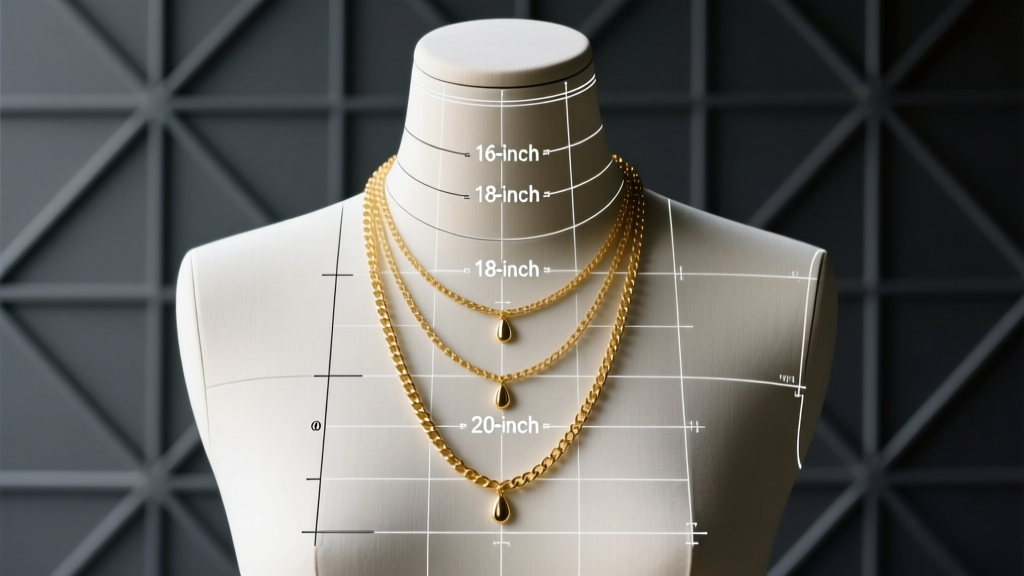
The Fallacy of the Standard Image of Necklace Lengths
When consumers and junior jewelers attempt to visualize how a piece will sit on the collarbone or sternum, they typically rely on a generic image of necklace lengths found in wholesale catalogs. This standard visual assumes a uniform mannequin neck—usually measuring exactly 13.5 inches in circumference—and a standardized, slender torso. In reality, human morphology varies wildly, rendering these generic charts fundamentally flawed for bespoke and high-end jewelry styling.
As of 2026, while advanced 3D photogrammetry and AI-driven virtual try-ons have improved online shopping accuracy, the physical physics of chain drape remain unchanged. To truly master necklace proportions, we must discard the idealized marketing imagery and apply rigorous morphological metrics, tensile physics, and material science to understand how a chain actually behaves on a living body.
Morphological Metrics: Calculating True Frontal Drop
The average female neck circumference in the United States is approximately 14.5 inches, while the male average hovers around 15.5 inches. When a standard 16-inch "choker" is placed on a 15.5-inch neck, the remaining 0.5 inches of chain must wrap around the entire circumference, leaving virtually zero frontal drop. The chain will sit tight against the larynx rather than resting elegantly on the clavicle.
To predict the actual fit, master jewelers use the Frontal Drop Formula: Visual Drop = (Chain Length - Neck Circumference) / 2. This calculation reveals the distance the chain will hang below the base of the front neck.
Morphological Variance Data Table
The table below demonstrates how the standard image of necklace lengths fails to account for anatomical variance, mapping actual frontal drop based on neck circumference:
| Neck Circumference | 16" Chain Frontal Drop | 18" Chain Frontal Drop | 20" Chain Frontal Drop | 24" Chain Frontal Drop |
|---|---|---|---|---|
| 13.0" (Industry Mannequin) | 1.50" (High Collar) | 2.50" (Clavicle) | 3.50" (Upper Chest) | 5.50" (Sternum) |
| 14.5" (Avg. Female) | 0.75" (Tight Choker) | 1.75" (Base of Neck) | 2.75" (Collarbone) | 4.75" (Mid-Chest) |
| 15.5" (Avg. Male) | 0.25" (Strangling Fit) | 1.25" (High Choker) | 2.25" (Upper Collar) | 4.25" (Clavicle Drop) |
| 17.0" (Plus Size/Athletic) | 0.00" (Unwearable) | 0.50" (Choker Fit) | 1.50" (Base of Neck) | 3.50" (Upper Chest) |
Source: Sizing standards adapted from manufacturing guidelines provided by Rio Grande and anthropometric jewelry fitting data.

Chain Gauge, Mass, and Catenary Drape Physics
The visual representation of a necklace is not solely dictated by length; it is heavily influenced by the chain's gauge (thickness) and overall mass. In physics, a hanging flexible chain forms a catenary curve. The equation of this curve dictates that heavier chains will pull the clasp forward and drop lower in the center compared to lightweight chains of the exact same measurement.
The Center of Gravity Shift
Consider two 18-inch chains: a 0.8mm sterling silver cable chain and a 4.5mm 14k gold Cuban link. The 0.8mm chain weighs approximately 3 grams, allowing it to rest softly against the skin, conforming to the hollow of the collarbone. The 4.5mm Cuban link weighs upwards of 35 grams. This concentrated mass pulls the chain downward, creating a sharper, deeper parabolic arc. Consequently, the heavy Cuban link will visually appear longer and sit lower on the sternum than the lightweight cable chain, completely distorting the standard image of necklace lengths.
Furthermore, metallurgical properties affect long-term drape. Sterling silver is highly susceptible to work-hardening and tensile stretching. A 20-inch silver rope chain may permanently elongate to 20.5 inches after six months of daily wear due to the mechanical stress of the neck's movement, whereas a 14k gold or platinum chain will maintain its structural integrity. According to the GIA Gem Encyclopedia, understanding these material tolerances is critical when setting heavy gemstone pendants, as the added weight exacerbates the catenary drop and accelerates metal fatigue.
Precision Layering: The 1.5-Inch Delta Rule
Layering necklaces is a dominant trend, but improper spacing leads to severe tangling and link abrasion. Tangling is not a random occurrence; it is a mechanical failure caused by the interlocking of links when the distance between two chains is less than the width of the largest link's outer diameter.
The 1.5-Inch Delta Rule: To prevent mechanical interlocking and friction-induced micro-scratches, the length difference between any two layered chains must be a minimum of 1.5 inches. If the primary chain is 16 inches, the secondary must be at least 17.5 inches.
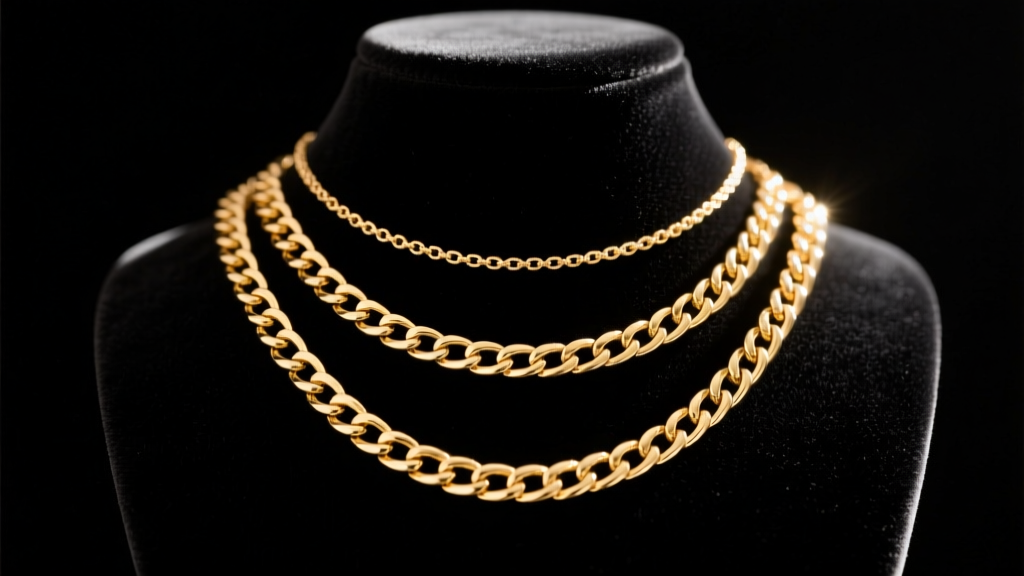
When layering three chains, the gauge must also descend or ascend progressively to manage the visual weight. A technically sound layering stack utilizes a 1.0mm cable (16"), a 2.0mm box chain (18"), and a 3.5mm paperclip chain (20"). This progressive increase in mass ensures that the heavier outer chains do not collapse inward and crush the lighter inner chains against the sternum.
Clasp Mechanics and Adjustability Hardware
The hardware used to secure the chain is the most common point of structural failure. When analyzing the functional image of necklace lengths, the inclusion of extender chains is a vital technical consideration for achieving custom morphological fits.
Shear Stress at the Clasp
Standard spring ring clasps are sufficient for chains under 5 grams. However, for heavier matinee or opera lengths (24 to 30 inches) that carry significant pendant weight, the lateral shear stress on a spring ring's internal spring mechanism will eventually cause failure. Master jewelers mandate the use of solid-cast lobster clasps or magnetic neodymium locking clasps for chains exceeding 15 grams.
When adding an extender chain to provide a customizable fit, the gauge of the extender must match or exceed the main chain. Attaching a 2.5mm extender chain to a 4.0mm main chain creates a weak point where the smaller links will deform under the tensile load of the heavier primary chain. For high-end bespoke pieces, a 5-link adjustable sliding silicone-lined bead (often called a macramé slider) offers infinite adjustability without compromising the structural integrity of the metal links, allowing the wearer to perfectly calibrate the frontal drop to their exact daily neckline.
Conclusion: Moving Beyond the Chart
Mastering necklace styling requires abandoning the simplistic, one-size-fits-all image of necklace lengths. By calculating true frontal drop based on individual neck circumference, accounting for the catenary physics of chain mass, and enforcing strict mechanical tolerances in layering and clasp hardware, jewelers and stylists can achieve flawless, mathematically sound proportions. True elegance in jewelry is not just about the karat weight or the gemstone cut; it is about the precise, engineered harmony between the metal and the human form.


